The Elite Playbook

Strategy is a disciplined series of choices rooted in clear trade-offs and built on understanding both internal competencies and external competition. Strategic thinking for elite leaders requires categorically distinguishing between operational effectiveness doing things right and true strategy doing the right things.

  • Competitive positions are not found in best practices. They are created by either doing what others do, but more efficiently, or by doing what others cannot. Sustained advantage comes from this separation.
  • Core concepts anchor the discipline. “Adjacency expansion” is disciplined growth by moving into closely related markets only when supported by clear customer and economic insight. “Core competencies” are the roots—collective learning that deliver end-product differentiation and resist imitation.
  • Balanced Scorecard frames strategy execution via four key lenses—Customer, Internal, Innovation, Financial. This provides multidimensional accountability and is a strategic bridge between intention and result.
  • Disruptive innovation occurs when new entrants meet overlooked customer needs at lower cost before gradually moving upmarket. Defending requires recognizing early signals and deploying containment or absorption strategies, not just improving existing operations.
  • Blue Ocean Strategy creates new market space, making competition irrelevant by shifting boundaries and redefining consumer expectations. The alternative, “Big-Bang disruption,” quickly upends an industry by simultaneously being better and more affordable.
  • Five Forces Framework analyzes the profit structure of industries, emphasizing the competitive context—rivalry, new entrants, substitute threats, buyer power, supplier power.
  • Strategic execution is the result of countless decisions, driven by information flow, clear rights, meaningful incentives, and effective structure. The strategy-to-performance gap is closed by making strategy actionable, setting priorities, and embedding tracking and learning.
  • Portfolio approaches see strategy as a set of options, not a fixed plan—leaders make staged decisions under uncertainty, using real options reasoning and continuously deploying and withdrawing resources as volatility plays out.
  • Modern imperatives: Lean startup models favor disciplined experimentation and customer feedback over premature scaling. Platform strategies embrace external ecosystems rather than mere resource accumulation.
  • Purpose and stakeholder-centered strategies move beyond shareholders—linking competitive advantage to broader societal value and integrating purpose directly into strategy for endurance and trust.
  • Transient advantage thinking replaces the fantasy of sustained dominance with agility—amassing portfolios of short-lived advantages and scaling down as soon as the context shifts.

Leadership Body Language: 10 Powerful Techniques to Command Respect

Have you ever noticed how certain leaders command attention the moment they enter a room? It’s rarely just about what they say—it’s how they carry themselves. The most influential leaders understand that body language speaks volumes before they utter a single word.

Research shows that up to 55% of communication is nonverbal. By mastering these 10 powerful body language techniques used by world-class leaders, you can dramatically enhance your presence and influence.

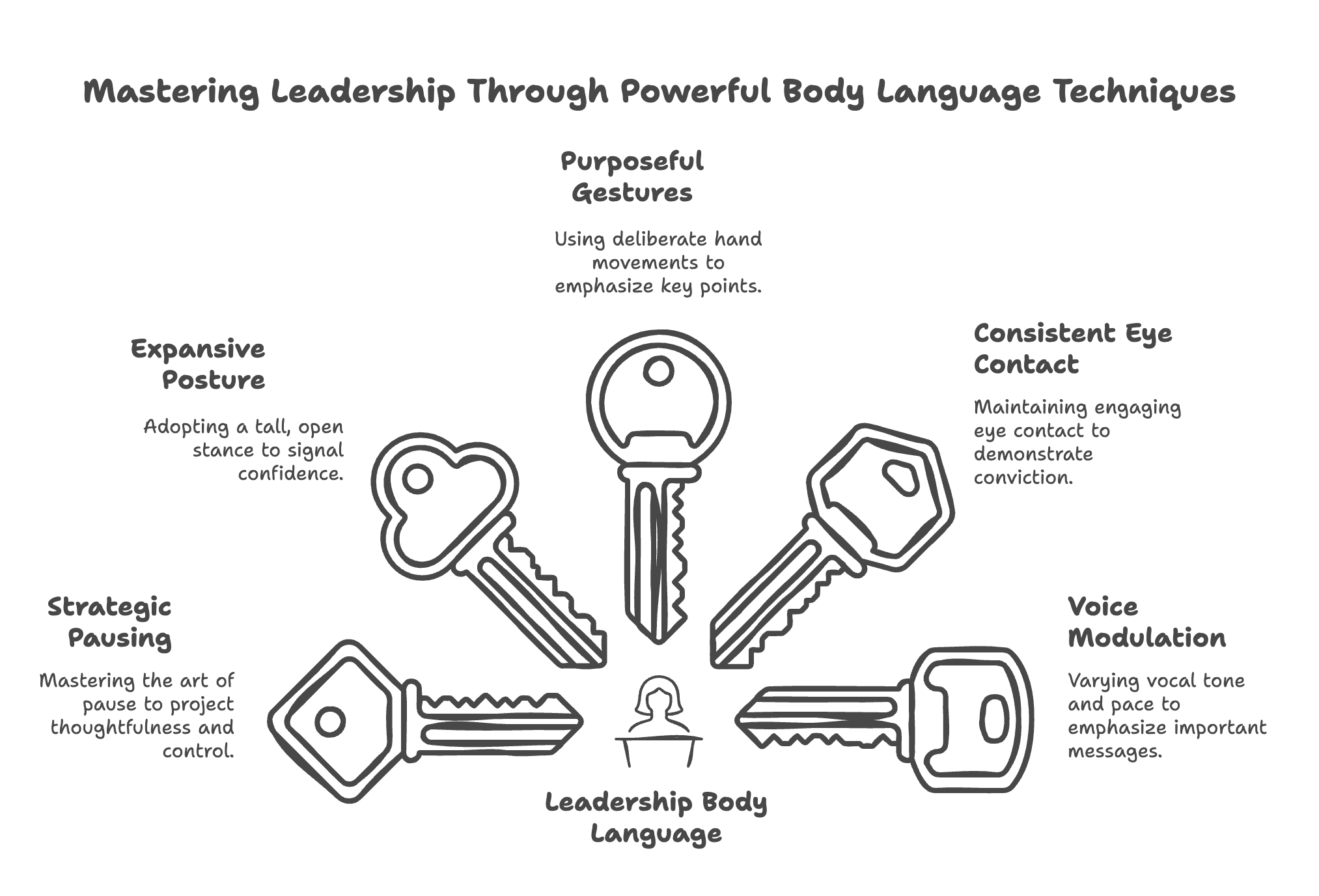
Leadership Body Language

1. Strategic Pausing

Watch footage of Barack Obama speaking, and you’ll notice his masterful use of the pause. Rather than rushing to respond to questions or challenges, effective leaders take a moment to gather their thoughts. This deliberate pause projects thoughtfulness and control rather than reactivity.

Try this: Count to three in your mind before responding to important questions. This brief moment allows you to formulate a more thoughtful response while signaling confidence and composure.

2. Expansive Posture

Leaders naturally take up appropriate space. This doesn’t mean appearing aggressive or domineering—rather, it’s about standing tall with shoulders back and chest open. This expansive posture signals confidence and commands respect.

Try this: Before important meetings, stand in a “power pose” for two minutes (feet shoulder-width apart, hands on hips or stretched overhead). Research suggests this can actually increase testosterone levels and decrease stress hormones.

3. Purposeful Gestures

Notice how influential leaders use clear, deliberate hand movements to emphasize key points. These purposeful gestures draw attention and reinforce their message, unlike the small, fidgety movements that signal nervousness.

Try this: Practice using broader, more deliberate hand gestures when making important points. Keep movements above the waist and visible to your audience.

4. Consistent Eye Contact

Steady, confident eye contact demonstrates engagement and conviction. Leaders maintain appropriate eye contact without the unnerving, unblinking “threat tracking” stare that creates discomfort.

Try this: Practice the “triangle technique”—moving your gaze between both eyes and the forehead of the person you’re speaking with. This creates connection without appearing intimidating.

5. Voice Modulation

The most compelling leaders vary their vocal tone, pace, and volume strategically. This prevents monotony and helps emphasize key points. Think of Martin Luther King Jr.’s powerful speeches with their rhythmic crescendos and thoughtful pauses.

Try this: Record yourself speaking and identify places where you can add emphasis through volume, slow down for important points, or speed up to create energy.

6. Selective Mirroring

Skilled leaders subtly adopt elements of others’ body language to build rapport, while still maintaining their own authoritative presence. This creates connection without sacrificing leadership stature.

Try this: Subtly match the energy level and speaking pace of those you’re communicating with, while maintaining your leadership posture.

7. Controlled Facial Expressions

Exceptional leaders maintain facial composure, particularly during challenging situations. They don’t telegraph every emotion, maintaining a calm, steady demeanor that inspires confidence.

Try this: Practice your “neutral but engaged” face in the mirror. This expression should appear attentive and interested without revealing anxiety or distress.

8. Grounded Stance

Watch footage of world leaders and notice how they stand—feet shoulder-width apart, weight evenly distributed. This grounded stance projects stability and confidence.

Try this: Practice standing with feet planted firmly, about shoulder-width apart. Feel the connection with the ground and avoid shifting weight from foot to foot.

9. Limited Self-Touching

Effective leaders avoid nervous habits like touching their face, adjusting clothing, or fidgeting with objects. These self-soothing behaviors signal insecurity and undermine authority.

Try this: Become aware of your self-touching habits and practice keeping your hands still or purposefully engaged in gestures rather than nervous adjustments.

10. Intentional Movement

The most commanding leaders move with intention rather than rushing. As mentioned in body language research, this “Royal Bengal Tiger” quality of deliberate movement draws attention and signals confidence.

Try this: Practice moving slightly more slowly than your natural pace. Take your time entering rooms, approaching podiums, or crossing stages.

Bringing It All Together

These techniques are most powerful when they become natural extensions of your authentic leadership style rather than forced affectations. Start by focusing on one or two areas where you see the most opportunity for growth.

Remember—effective leadership body language isn’t about manipulation. It’s about ensuring your nonverbal communication aligns with and reinforces your message, allowing your true leadership qualities to shine through unhindered by distracting habits.

What body language technique will you focus on developing first?

Top 5% Strategy

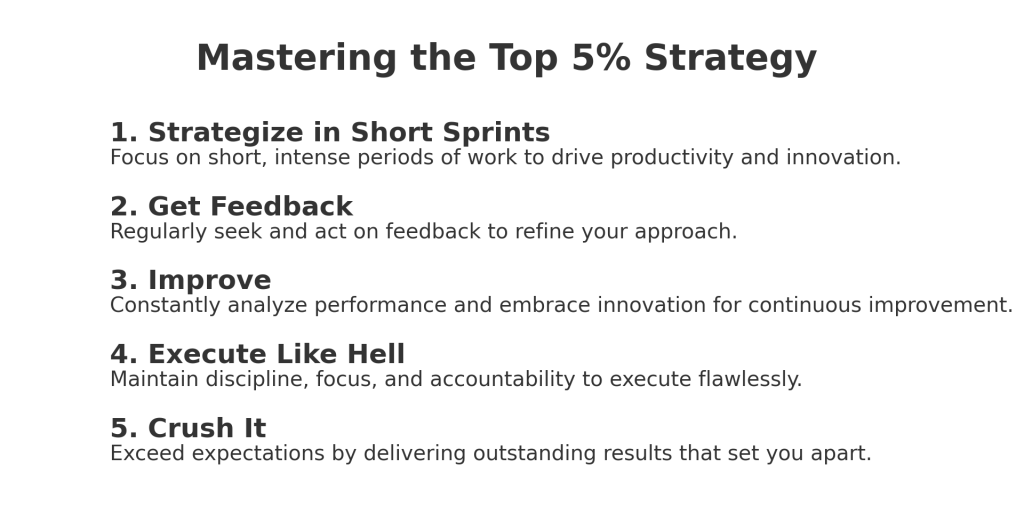
In the competitive world of business, achieving excellence often means adopting strategies that push you into the top 5% of performers. The key lies in an iterative process that focuses on rapid development, continuous feedback, relentless improvement, and flawless execution. Here’s how you can master this top-tier strategy:

Top 5% Strategy

1. Strategize in Short Sprints

Why It Matters:
Short sprints allow for focused, intense periods of work that drive productivity and innovation. By breaking down projects into manageable segments, you can maintain momentum and quickly adapt to new information or changing conditions.


Consider the early days of Tesla. Elon Musk adopted a sprint-based approach to quickly iterate on designs and technology. This approach allowed Tesla to innovate rapidly, delivering the groundbreaking Model S in record time, which set new standards for electric vehicles.

Implementation:

  • Set Clear Goals: Define what you aim to achieve in each sprint. Ensure these goals are specific, measurable, attainable, relevant, and time-bound (SMART).
  • Prioritize Tasks: Identify high-impact tasks that can be accomplished within the sprint period.
  • Time Boxing: Allocate fixed time slots for each task, ensuring that no single activity monopolizes your time and resources.

2. Get Feedback

Why It Matters:
Feedback is crucial for understanding how your strategies and actions are perceived and where improvements can be made. It provides the insights needed to refine your approach and align it more closely with desired outcomes.


When Sarah Blakely founded Spanx, she relied heavily on feedback from friends, family, and even store clerks. By listening to the needs and preferences of real customers, she was able to refine her product and create a billion-dollar business that revolutionized the shapewear industry.

Implementation:

  • Create Feedback Loops: Regularly seek input from stakeholders, team members, and customers.
  • Encourage Open Communication: Foster an environment where constructive criticism is welcomed and valued.
  • Act on Feedback: Use the insights gained to make informed adjustments to your strategy.

3. Improve

Why It Matters:
Continuous improvement is the backbone of sustained success. By constantly refining your processes and strategies, you can stay ahead of the competition and better meet the needs of your market.

Career Insight:
Jeff Bezos’s philosophy at Amazon has always been to “fail fast” and continuously improve. This mindset has driven Amazon to innovate relentlessly, from its humble beginnings as an online bookstore to becoming a global e-commerce giant and beyond, consistently setting the bar for customer satisfaction and operational efficiency.

Implementation:

  • Analyze Performance: Regularly review performance metrics to identify areas for improvement.
  • Embrace Innovation: Stay open to new ideas and technologies that can enhance efficiency and effectiveness.
  • Implement Incremental Changes: Make small, consistent adjustments to processes to drive continuous improvement without overwhelming your team.

4. Execute Like Hell

Why It Matters:
Execution is where strategies and plans are put into action. Excellence in execution requires discipline, focus, and a relentless drive to achieve the set goals.

Wealth Example:
Warren Buffett’s success is often attributed to his unwavering focus and disciplined execution. His investment strategy is built on thorough research and decisive action, enabling him to consistently outperform the market and build one of the most significant fortunes in history.

Implementation:

  • Maintain Focus: Avoid distractions and ensure that every team member is aligned with the sprint goals.
  • Drive Accountability: Hold yourself and your team accountable for delivering results.
  • Leverage Tools and Resources: Utilize project management tools and resources to streamline execution and track progress.

5. Crush It

Why It Matters:
To “crush it” means not just meeting but exceeding expectations. It’s about delivering outstanding results that set you apart from the competition and establish you as a leader in your field.

Inspirational Story:
Consider the journey of Oprah Winfrey. From humble beginnings, she crushed every challenge in her path through relentless work ethic, sharp strategic moves, and a commitment to excellence. Her ability to connect with audiences and consistently deliver high-quality content made her a media mogul and a billionaire, setting new standards in the industry.

Implementation:

  • Set High Standards: Aim for excellence in every task and project.
  • Celebrate Success: Recognize and reward achievements to motivate continued high performance.
  • Reflect and Learn: After achieving a milestone, review what worked well and what could be improved for future sprints.

By adopting a strategy of short sprints, continuous feedback, relentless improvement, disciplined execution, and aiming to “crush it,” you position yourself to achieve and sustain top 5% performance. This iterative, focused approach not only drives immediate results but also fosters a culture of excellence and innovation, ensuring long-term success in an ever-evolving business landscape.

Embrace this strategy, and watch as your team moves from strength to strength, consistently delivering outstanding results and setting new benchmarks for success. By learning from the successes of industry leaders and applying these principles to your own endeavors, you too can achieve remarkable career and financial success.