The A.D.F.A. Method

In a world brimming with complexities, both in our professional and personal lives, the quest for simplicity often seems like an elusive dream. Yet, simplicity is not just a desirable trait; it’s a necessary one for efficiency, clarity, and impactful decision-making, especially at the executive level. This is where the A.D.F.A. method comes into play – a transformative approach that offers a beacon of clarity in a sea of complexity.

1. Awareness: The Bedrock of Simplicity

Awareness is the cornerstone of this method. It demands a vigilant understanding of the circumstances and challenges at hand. In the realm of executive decision-making, this means being attuned to every nuance of your organization and market dynamics. It’s about identifying not just the obvious challenges, but also the subtle nuances that add unnecessary layers of complexity. Awareness is about seeing through the fog of information overload and pinpointing what truly matters.

“Awareness is like the sun. When it shines on things, they are transformed.”

Thich Nhat Hanh

2. De-complication: Simplifying the Complex

“Life is really simple, but we insist on making it complicated.”

Confucius

Once you’ve identified the complexities, the art of de-complication comes into play. This step is akin to a skilled sculptor chipping away at a block of marble to reveal the masterpiece within. It’s about breaking down seemingly insurmountable challenges into smaller, manageable parts. De-complication requires a keen analytical mind that can dissect a problem and find the simplest path to a solution. In the business world, this often means streamlining processes, eliminating redundancies, and focusing on what’s most effective.

3. Focus on Fundamentals: Back to Basics

“Success is neither magical nor mysterious. Success is the natural consequence of consistently applying the basic fundamentals.”

Jim Rohn

The third pillar, focusing on fundamentals, is about reconnecting with the core principles that drive success. In a business context, this could be your company’s core values, mission, or key performance indicators. It’s about ensuring that every action, every decision, aligns with these fundamental principles. This focus acts as a guiding star, ensuring that despite the complexities and distractions, your direction remains true and unfaltering.

4. Avoid Overthinking: Decisiveness in Action

The final step is avoiding the trap of overthinking. In the executive world, time is a precious commodity, and indecision can be costly. Overthinking leads to paralysis by analysis, where the fear of making the wrong decision leads to no decision at all. This step is about trusting the process, making informed decisions swiftly, and moving forward with confidence.

The A.D.F.A. method is more than a problem-solving tool; it’s a philosophy for life and business. It’s about approaching challenges with a structured method that makes them less daunting and more manageable. This approach is applicable across various spectrums, from personal development goals like weight loss and strength gain to enhancing productivity and efficiency in the workplace.

The A.D.F.A. method is a powerful tool in the arsenal of any leader. It provides a clear roadmap to cut through the clutter, focus on what’s essential, and make decisions with confidence and clarity. By embracing this method, we not only simplify our challenges but also amplify our potential to achieve greater success. Let’s A.D.F.A. our way to clarity and conquer the complexities that stand in our path.

5L Formula


Imagine leadership as a voyage across the vast ocean of organizational challenges. Just as a skilled sailor uses a compass to navigate the seas, a leader needs a reliable tool to steer through the complexities of management and team dynamics. The 5L Formula is that compass for leaders, guiding them towards effective communication and impactful decision-making. In this blog, we’ll explore each aspect of the 5L Formula, enriching our understanding with analogies and highlighting key takeaways, to enhance your leadership journey.

1. Listen: The Anchor of Understanding
“Listening is not merely hearing. It is tuning into the melody beneath the words.” In the realm of leadership, ‘Listen’ acts as the anchor, grounding leaders in the reality of their team’s thoughts and feelings. Like an anchor that steadies a ship amidst turbulent waters, effective listening stabilizes the leader’s understanding in the tumult of daily challenges.

5L Formula

2. Learn: The Compass of Adaptation
The second L, ‘Learn’, can be likened to a ship’s compass, always pointing towards improvement and adaptation. Continuous learning helps leaders stay on course, adjusting their sails to navigate the ever-changing winds of market trends, team dynamics, and technological advancements.

“A leader who learns is a leader who grows.”

3. Lead: The Lighthouse of Guidance
To ‘Lead’ is to be the lighthouse, providing guidance and direction amidst the fog of uncertainty. It’s about illuminating the path with a clear vision and strong values, guiding the team towards the shores of success and stability.

“Leading by example illuminates the path for others to follow.”

4. Leverage: The Wind in Your Sails
‘Leverage’ represents the wind that fills the sails of your organizational ship. It’s about harnessing the diverse talents and resources available, propelling the team forward with efficiency and innovation.

“Leverage is the art of turning individual strengths into collective performance.”

5. Lift: The Crew’s Growth
Finally, ‘Lift’ is akin to nurturing the growth of your crew. Empowering team members is like providing them with the right tools and training, ensuring they are prepared and confident to navigate their own voyages within the larger journey.


The 5L Formula is not just a set of directives; it’s a holistic approach to navigating the complex seas of leadership. By integrating listening, learning, leading, leveraging, and lifting into your leadership style, you embark on a journey that not only enhances your effectiveness but also propels your team towards uncharted territories of success and fulfillment.


Reflect on your leadership voyage: Which ‘L’ is your strongest wind, and which is your uncharted water? Share your insights and join the conversation as we navigate these waters together, each a captain on a continuous journey of growth and discovery.

Unlock Your Productivity and Take Control with Soft Determinism: The Attention Span Revolution!

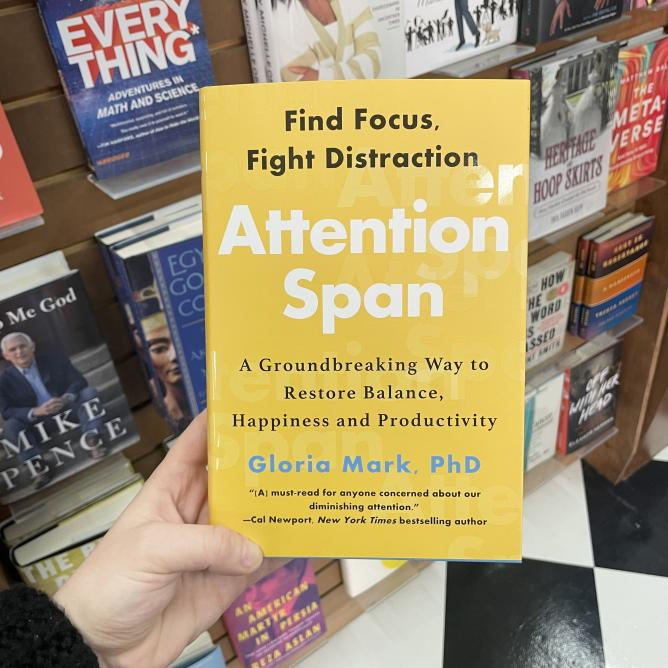
Gloria Mark’s latest book, “Attention Span: A Groundbreaking Way to Restore Balance, Happiness, and Productivity,” delves into the concept of soft determinism and how it relates to our attention spans. Soft determinism acknowledges that our actions are determined by a combination of factors, including our genetics, environment, and choices. This means that while we are not entirely free to do whatever we want, we still have some degree of control over our actions.

Mark’s research shows that our brains are constantly being bombarded with stimuli, and we have to make countless decisions every day. In this context, it can be helpful to view our actions as being determined, but not entirely out of our control. This perspective can help us to better understand our behavior and make positive changes in our lives.

One of the benefits of soft determinism is that it can help us to accept responsibility for our actions. By acknowledging the various factors that influence our behavior, we can be more compassionate towards ourselves and others. Soft determinism can also help us to take control of our lives by making intentional choices that align with our values and goals.

To improve our attention spans, Mark recommends making changes to our environment and habits. For example, we can reduce distractions by working in a quiet space or using noise-cancelling headphones. We can also improve our attention spans by taking regular breaks, practicing mindfulness, and avoiding multitasking.

Mark’s book provides helpful insights into the complex interplay between determinism and attention. She emphasizes the importance of focusing on the things that we can control and letting go of the things that we can’t. This can help us to cultivate a sense of inner peace and contentment, even in the midst of a busy and chaotic world.

In addition to discussing soft determinism, Mark also explores the benefits of attention in our lives. She argues that attention is essential for productivity, happiness, and well-being. When we are able to focus our attention on the task at hand, we are more likely to experience a sense of flow, or being fully immersed in what we are doing.

However, our attention spans are under constant threat from the many distractions in our environment. Mark cites research that shows that the average person checks their phone over 100 times a day. This constant stimulation can make it difficult to maintain focus and can lead to feelings of overwhelm and burnout.

To combat these challenges, Mark recommends developing a mindfulness practice. This can help us to become more aware of our thoughts and emotions, and to develop a greater sense of mental clarity and focus. Mark also encourages us to take breaks throughout the day to recharge our batteries and to make time for activities that bring us joy and fulfillment.

Mark’s book is a well-written and informative resource for anyone looking to improve their attention and overall well-being. Her research is sound, and her advice is practical and actionable. Whether you are struggling to focus at work, feeling overwhelmed by the demands of daily life, or simply looking to cultivate a greater sense of balance and peace, “Attention Span” is a must-read.

Soft determinism is not without its challenges, however. One of the main challenges is that it can be difficult to understand how our actions are determined. The process of determinism is complex and multifaceted, and it can be challenging to tease apart the various factors that influence our behavior.

Another challenge of soft determinism is that it can sometimes lead to feelings of fatalism. If we believe that our actions are predetermined and that we have no control over our lives, we may become resigned to our circumstances and give up on making positive changes.