Nvidia CEO Jensen Huang on capturing opportunities:
“You want to position yourself near opportunities. You don’t have to be that perfect you know. You want to position yourself near the tree and even if you don’t catch the Apple before it hits the ground so long as you’re the first one to pick it up you want to position yourself close to the opportunities now. So that’s kind of a lot of my work is positioning the company near opportunities and having the company having the skills to monetize each one of the steps along the way so that we can be sustainable.”
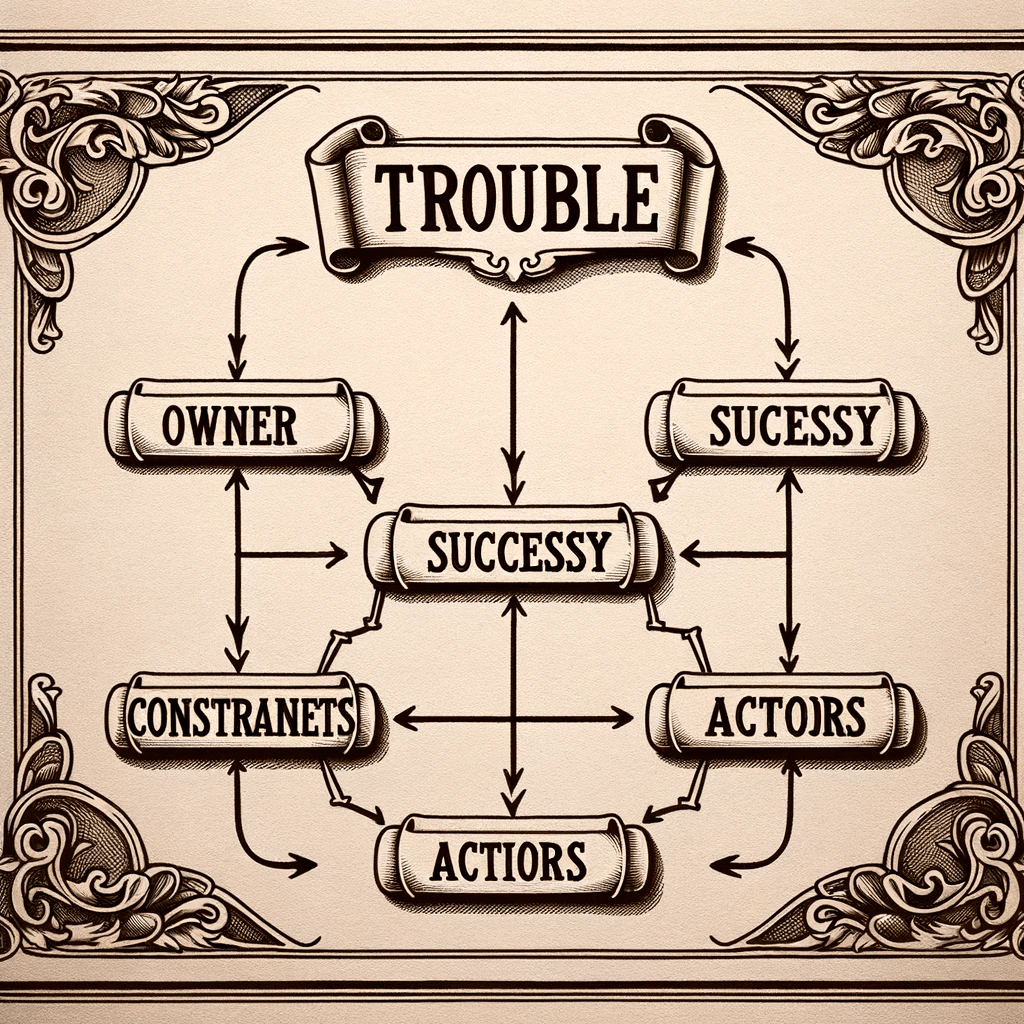
In the realm of consulting, the ability to define problems effectively is paramount. It’s the critical first step toward developing innovative solutions that drive organizations forward. One valuable tool at the disposal of strategy consultants is the TOSCA framework, an acronym that stands for Trouble, Owner, Success, Constraints, and Actors. In this blog, we’ll explore how the TOSCA framework serves as a guiding star in the complex world of strategy consulting.
TOSCA Framework
Trouble: Identifying the Heart of the Issue
The first pillar of the TOSCA framework is “Trouble.” This involves delving deep into the challenge at hand, peeling away superficial layers to uncover the core issue. Strategy consultants ask probing questions and analyze data to gain a comprehensive understanding of the trouble. They look for patterns, anomalies, and potential root causes. By defining the trouble accurately, they set the stage for targeted and effective problem-solving.
Owner: Pinpointing Responsibility
“Owner” is the second element of the TOSCA framework. It involves identifying who within the organization or team is responsible for addressing the trouble. Clear ownership ensures accountability and streamlines the decision-making process. Strategy consultants collaborate closely with stakeholders to define roles and responsibilities, ensuring that the right people are engaged in finding solutions.
Success: Defining the End Game
The third pillar, “Success,” involves articulating what victory looks like. Strategy consultants work with clients to establish clear and measurable goals. These success criteria serve as benchmarks to gauge progress and determine when the problem has been effectively resolved. Success metrics align everyone’s efforts toward a common objective, fostering motivation and focus.
Constraints: Recognizing Boundaries
Every problem-solving endeavor faces limitations, and the “Constraints” component of the TOSCA framework addresses these boundaries head-on. Strategy consultants identify and acknowledge the constraints, whether they are budgetary, logistical, or regulatory. Recognizing these limitations from the outset allows consultants to craft solutions that work within these constraints, increasing the likelihood of successful implementation.
Actors: Mapping the Landscape
The final element of the TOSCA framework is “Actors.” In any complex challenge, various individuals and groups play crucial roles. Strategy consultants create a comprehensive map of these actors, understanding their motivations, influence, and relationships. This knowledge helps consultants navigate the human dynamics involved in problem-solving, fostering collaboration and buy-in from key stakeholders.
Applying TOSCA to a Real-World Challenge
To illustrate the power of the TOSCA framework, let’s consider a real-world scenario: a struggling retail company aiming to revitalize its brand.
Trouble: Through market research, the consultants identify that declining sales are the core trouble. Further analysis reveals that changing consumer preferences and increased competition are contributing factors.
Owner: The CEO of the company takes ownership of addressing this issue, committing to lead the transformation effort.
Success: Success is defined as achieving a 15% increase in sales within the next fiscal year.
Constraints: The company faces budget constraints and a tight timeline, which must be factored into the strategy.
Actors: The actors include the CEO, marketing team, store managers, and external consultants. Each group has a role in executing the revitalization plan.
The TOSCA framework is a valuable tool that empowers strategy consultants to define problems systematically and comprehensively. By addressing Trouble, Owner, Success, Constraints, and Actors, consultants lay a strong foundation for effective problem-solving. This approach not only streamlines the consulting process but also increases the likelihood of achieving meaningful and sustainable solutions. In a world where complex challenges abound, the TOSCA framework is a beacon guiding strategy consultants and their clients toward brighter horizons.
In the world of culinary arts, the croissant is a symbol of delicate craftsmanship, a harmony of flavors, and a race against time. Its flaky layers and rich texture are not just a gastronomic delight but also a metaphor for something more profound – our career growth. Just as a croissant must be prepared, baked, and sold within a specific time frame to retain its value, our career paths demand timing, precision, strategy, and adaptability. This intriguing connection has given birth to what we call the “Croissant Theory,” and in this piece, we’ll unravel how this culinary concept can be deliciously applied to various aspects of personal and professional development.
1. Understanding Supply and Demand: Identifying Your Niche
Croissant Analogy: Bakeries must gauge customer demand to produce the right number of croissants, neither too few nor too many.
Career Growth Example: In your career, identifying a niche or area of expertise where there’s demand can set you apart. For instance, specializing in a particular technology or skill can make you more valuable in the job market.
2. Quality vs. Quantity: Focus on Continuous Improvement
Croissant Analogy: A well-made croissant demands time, effort, and attention to detail. Quality always wins over quantity.
Career Growth Example: Rather than rushing to add multiple skills to your résumé, focusing on mastering one skill can lead to greater success. A graphic designer, for example, might excel by becoming an expert in a specific design software.
3. Pricing Strategies: Knowing Your Worth
Croissant Analogy: Bakeries may reduce the price of croissants as the day wears on to minimize losses.
Career Growth Example: Knowing your worth and negotiating your salary or freelance rates can maximize your earnings. An experienced project manager, for example, might negotiate a higher salary based on a proven track record.
4. Innovation and Adaptation: Embracing Change
Croissant Analogy: Bakeries innovate with new flavors, delivery methods, or services to keep customers engaged.
Career Growth Example: Adapting to changes in your industry and learning new skills can keep your career fresh. A marketing professional who learns the latest digital marketing trends can stay ahead of the curve.
The Recipe for Success
Just as a perfect croissant requires the right ingredients, timing, and technique, a successful career demands a mix of specialization, focus on quality, understanding your value, and adaptability.
The Croissant Theory serves as a delightful analogy, offering insights into career growth that are as layered and intricate as the pastry itself. Whether you’re a fresh graduate or a seasoned professional, you can apply these principles to bake your success story, one flaky layer at a time.


 Maverick