Top Goal Framework

In the pursuit of career advancement and financial success, prioritization and consistency are paramount. The “Top Goal Framework” is a simple yet effective method that helps individuals focus on their most crucial tasks, dedicating two hours daily to their top priority. By following this framework, you can make significant strides toward your goals. Let’s explore how this approach has transformed the lives of professionals through real-life anecdotes.

Top Goal Framework

The Power of Prioritization

Maria was a marketing executive with a passion for data analytics. Despite her interest, her busy work schedule left little room for pursuing this new field. Inspired by the Top Goal Framework, Maria decided to dedicate two hours each morning to learning data analytics. Over the course of a year, she completed several online courses and worked on personal projects to build her portfolio.

Maria’s consistent effort paid off. She landed a new job as a data analyst at a tech company, a role that not only aligned with her passion but also came with a substantial salary increase. Maria’s story illustrates the power of prioritization and how dedicating time to your top goal can open doors to new career opportunities.

Consistency Over Intensity

David, a software engineer, always aspired to achieve financial independence. He decided to use the Top Goal Framework to focus on understanding investment strategies. For two hours each evening, David immersed himself in books, podcasts, and online courses about investing.

Within two years, David had built a diversified investment portfolio. His disciplined approach allowed him to maximize returns, and he eventually reached a point where his passive income streams covered a significant portion of his living expenses. David’s journey demonstrates how consistency, rather than sporadic bursts of effort, can lead to substantial wealth growth over time.

Real-World Applications:

Sarah had always dreamed of starting her own fashion line but struggled to find time amidst her demanding job as a graphic designer. By setting aside two hours every morning for her fashion project, Sarah gradually developed her brand identity, designed a collection, and built an online presence.

Her consistent dedication resulted in the successful launch of her fashion line. Sarah’s brand gained traction, and she soon transitioned to working full-time on her business. The Top Goal Framework helped Sarah turn her entrepreneurial dream into reality, showing that steady progress can lead to significant accomplishments.

Implementing the Framework

To implement the Top Goal Framework, start by identifying your top priority—be it career advancement, a new skill, or financial growth. Set aside two hours each workday to focus solely on this goal. Protect this time from distractions, treating it as a crucial commitment to yourself. Over time, the cumulative effect of these dedicated hours will become evident in your achievements.

The Top Goal Framework is a powerful tool for unlocking career and wealth potential. The stories of Maria, David, and Sarah highlight the transformative impact of dedicating just two hours a day to one’s top priority. This consistent effort can lead to remarkable success, whether it’s a career shift, financial independence, or starting a new venture. Start applying the Top Goal Framework today, and witness how it can help you achieve amazing things in your professional and personal life. Remember, it’s not about how hard you work for a short period, but how consistently you work toward your goals over time.
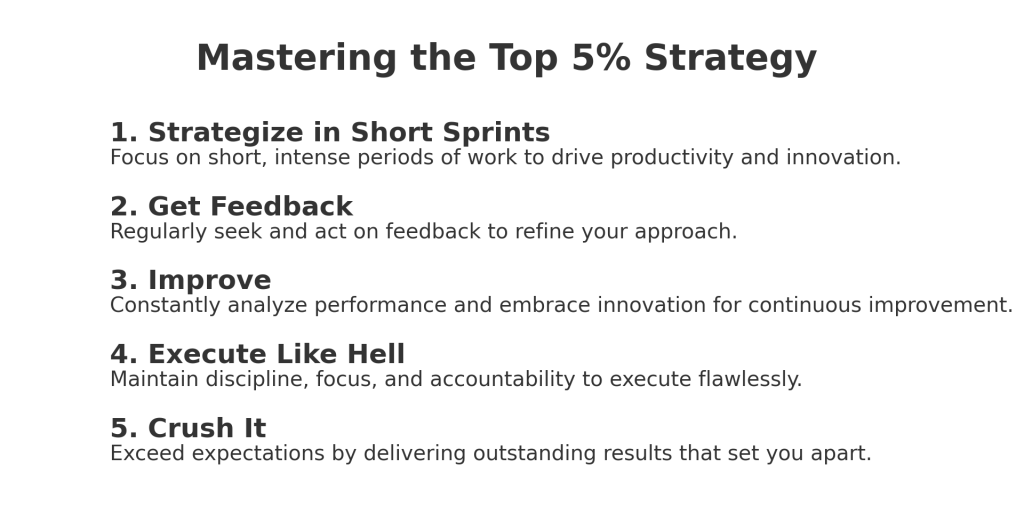

Top 5% Strategy

In the competitive world of business, achieving excellence often means adopting strategies that push you into the top 5% of performers. The key lies in an iterative process that focuses on rapid development, continuous feedback, relentless improvement, and flawless execution. Here’s how you can master this top-tier strategy:

Top 5% Strategy

1. Strategize in Short Sprints

Why It Matters:
Short sprints allow for focused, intense periods of work that drive productivity and innovation. By breaking down projects into manageable segments, you can maintain momentum and quickly adapt to new information or changing conditions.


Consider the early days of Tesla. Elon Musk adopted a sprint-based approach to quickly iterate on designs and technology. This approach allowed Tesla to innovate rapidly, delivering the groundbreaking Model S in record time, which set new standards for electric vehicles.

Implementation:

  • Set Clear Goals: Define what you aim to achieve in each sprint. Ensure these goals are specific, measurable, attainable, relevant, and time-bound (SMART).
  • Prioritize Tasks: Identify high-impact tasks that can be accomplished within the sprint period.
  • Time Boxing: Allocate fixed time slots for each task, ensuring that no single activity monopolizes your time and resources.

2. Get Feedback

Why It Matters:
Feedback is crucial for understanding how your strategies and actions are perceived and where improvements can be made. It provides the insights needed to refine your approach and align it more closely with desired outcomes.


When Sarah Blakely founded Spanx, she relied heavily on feedback from friends, family, and even store clerks. By listening to the needs and preferences of real customers, she was able to refine her product and create a billion-dollar business that revolutionized the shapewear industry.

Implementation:

  • Create Feedback Loops: Regularly seek input from stakeholders, team members, and customers.
  • Encourage Open Communication: Foster an environment where constructive criticism is welcomed and valued.
  • Act on Feedback: Use the insights gained to make informed adjustments to your strategy.

3. Improve

Why It Matters:
Continuous improvement is the backbone of sustained success. By constantly refining your processes and strategies, you can stay ahead of the competition and better meet the needs of your market.

Career Insight:
Jeff Bezos’s philosophy at Amazon has always been to “fail fast” and continuously improve. This mindset has driven Amazon to innovate relentlessly, from its humble beginnings as an online bookstore to becoming a global e-commerce giant and beyond, consistently setting the bar for customer satisfaction and operational efficiency.

Implementation:

  • Analyze Performance: Regularly review performance metrics to identify areas for improvement.
  • Embrace Innovation: Stay open to new ideas and technologies that can enhance efficiency and effectiveness.
  • Implement Incremental Changes: Make small, consistent adjustments to processes to drive continuous improvement without overwhelming your team.

4. Execute Like Hell

Why It Matters:
Execution is where strategies and plans are put into action. Excellence in execution requires discipline, focus, and a relentless drive to achieve the set goals.

Wealth Example:
Warren Buffett’s success is often attributed to his unwavering focus and disciplined execution. His investment strategy is built on thorough research and decisive action, enabling him to consistently outperform the market and build one of the most significant fortunes in history.

Implementation:

  • Maintain Focus: Avoid distractions and ensure that every team member is aligned with the sprint goals.
  • Drive Accountability: Hold yourself and your team accountable for delivering results.
  • Leverage Tools and Resources: Utilize project management tools and resources to streamline execution and track progress.

5. Crush It

Why It Matters:
To “crush it” means not just meeting but exceeding expectations. It’s about delivering outstanding results that set you apart from the competition and establish you as a leader in your field.

Inspirational Story:
Consider the journey of Oprah Winfrey. From humble beginnings, she crushed every challenge in her path through relentless work ethic, sharp strategic moves, and a commitment to excellence. Her ability to connect with audiences and consistently deliver high-quality content made her a media mogul and a billionaire, setting new standards in the industry.

Implementation:

  • Set High Standards: Aim for excellence in every task and project.
  • Celebrate Success: Recognize and reward achievements to motivate continued high performance.
  • Reflect and Learn: After achieving a milestone, review what worked well and what could be improved for future sprints.

By adopting a strategy of short sprints, continuous feedback, relentless improvement, disciplined execution, and aiming to “crush it,” you position yourself to achieve and sustain top 5% performance. This iterative, focused approach not only drives immediate results but also fosters a culture of excellence and innovation, ensuring long-term success in an ever-evolving business landscape.

Embrace this strategy, and watch as your team moves from strength to strength, consistently delivering outstanding results and setting new benchmarks for success. By learning from the successes of industry leaders and applying these principles to your own endeavors, you too can achieve remarkable career and financial success.

The West Coast Offense

The West Coast Offense is a sophisticated football strategy, emphasizing short, horizontal passing plays to control the ball, extend drives, and open up the defense for longer plays. The West Coast Offense (WCO) stands as a testament to innovation, precision, and strategic depth. Originally developed by Bill Walsh and popularized by the San Francisco 49ers during the 1980s, this offense strategy has been influential in shaping modern football.

The Comeback Kid: Bill Walsh and the 1981 San Francisco 49ers

The West coast Offense

The year was 1981. The San Francisco 49ers, once a dominant force, were floundering.Their aging players, rigid playbook, and predictable style left them vulnerable. Enter Bill Walsh, a young coach with a revolutionary vision: the West Coast Offense.

Instead of relying on brute force like their rivals, Walsh’s offense emphasized precision, timing, and quick-hitting plays.expand_more Quarterback Joe Montana, initially resistant to the change, became a believer as Walsh patiently explained the intricacies of the playbook, fostering open communication and trust.

However, challenges arose. Receivers struggled with the complex routes, and the offensive line wasn’t used to protecting for shorter passes.Walsh remained calm, adapting the system to his players’ strengths. He communicated adjustments clearly, building their confidence and understanding.

The results were electrifying. Montana, empowered by Walsh’s trust, dissected defenses with laser-sharp throws. Receivers like Dwight Clark and Freddie Solomon transformed into reliable targets, running crisp routes in tight spaces. The 49ers, once predictable, became unpredictable, adapting their attack based on the opponent’s weaknesses.

Their journey wasn’t smooth. Early losses tested their resolve, but Walsh’s unwavering belief in his system and open communication with his team kept them united. He fostered a culture of continuous learning and adaptation, encouraging players to suggest adjustments and celebrate small victories.

By season’s end, the doubters were silenced. The 49ers, a team on the brink, had become champions, fueled by Walsh’s innovative leadership, clear communication, and dedication to adaptation. Their story stands as an inspiration to business leaders, demonstrating the power of collaboration, embracing new ideas, and adjusting to changing circumstances.

The West coast Offense

At its core, the West Coast Offense is predicated on the use of short, horizontal passing plays as an extension of the running game. This approach aims to control the ball, manage the clock effectively, and systematically dismantle the defense. By maintaining possession and methodically advancing down the field, teams employing the WCO can dominate time of possession, keeping their defense rested and the opposing offense sidelined.

  • Ball Control: Utilizing short, high-percentage passes to maintain possession.
  • Time Management: Controlling the clock and setting the game’s pace.

Mastering the Playbook

The playbook of the West Coast Offense is intricate, with a heavy emphasis on passing routes that require precision and timing. Understanding these routes and the quarterback’s decision-making process in selecting the optimal receiver based on defensive formations is crucial.

  • Passing Routes: Focus on slants, outs, and screens.
  • Reading Defenses: The ability to identify defensive setups and adjust accordingly.

Quarterback Skills

In the WCO, the quarterback’s role is paramount. Accuracy, timing, and footwork are the pillars upon which success is built. A quarterback must deliver the ball with precision, ensuring receivers can catch in stride and maximize yards after catch (YAC).

  • Accuracy and Timing: Essential for the success of short passing plays.
  • Footwork: Critical for navigating the pocket and executing plays effectively.

Wide Receiver and Running Back Involvement

Receivers and running backs play versatile roles in the WCO, not just in traditional capacities but also as pivotal components of the passing game. Their ability to run precise routes and make catches in space is vital.

  • Route Running: Precision and adaptability in route execution.
  • Pass Catching: Running backs and receivers must excel in catching and YAC.


The West Coast Offense, with its emphasis on precision, strategy, and adaptability, offers valuable lessons for leadership beyond the football field. By applying these principles, leaders can enhance communication, foster teamwork, drive strategic execution, and lead their organizations to sustained success. Just as the WCO revolutionized football, leaders can transform their organizations with thoughtful application of these time-tested strategies.