The RIDE methodology

Ever feel like your dreams are trapped behind a wall of obstacles, both seen and unseen? You’re not alone. But what if those obstacles could be transformed into stepping stones? The RIDE methodology unlocks the secret: Reflecting on your deepest desires, Investigating your blockers, Doing practical tasks for progress, and Elevating your future self. This infographic is your roadmap to self-improvement, showing you how RIDE can pave the way to a fulfilling future.
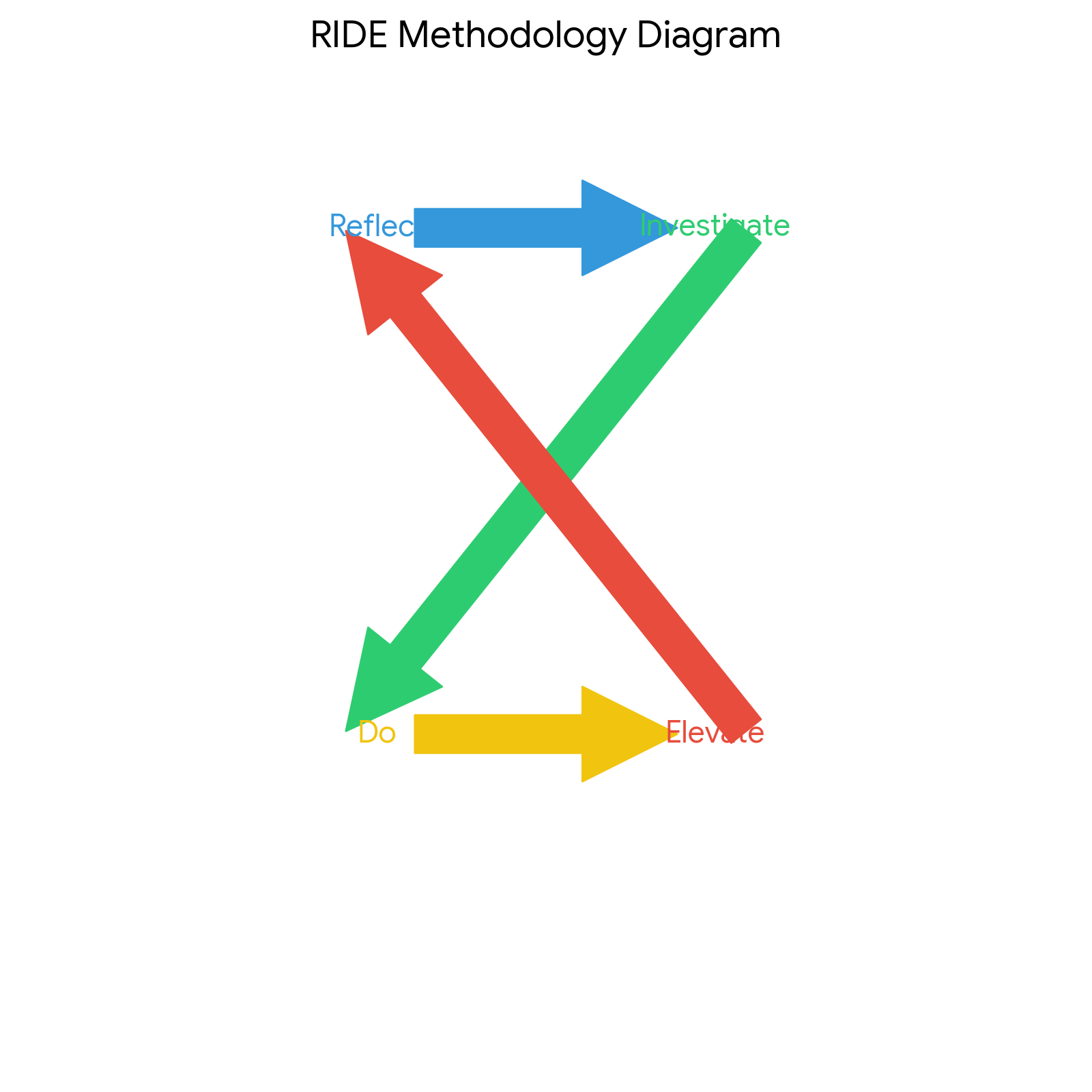
R: Reflect on Your Inner Compass Before embarking, pause and ask, “What truly matters to me?” Like Anna, who dreamt of becoming a renowned author, identify your burning desire. This, like Anna’s moment of clarity, is your guiding star. Remember, Lao Tzu reminds us, “The journey of a thousand miles begins with one step.” Yours starts with identifying your destination.

I: Investigate Your Inner Dragons No hero slays the dragon without understanding it. Here, face your “dragons” – those self-doubts, fears, or limiting beliefs that hinder your progress. Michael, a talented musician, discovered his dragon was stage fright, rooted in past failures. Only by acknowledging and confronting this fear could he conquer his stage and shine. Remember, as the Zen proverb says, “Obstacles do not block the path, they are the path.” Use them to grow stronger.

D: Do the Daily Dance of Progress Dreams are beautiful, but action is the bridge to reality. Divide your journey into small, actionable steps, like laying stones across a river. Sarah, who yearned to run a marathon, broke her goal into daily runs, gradually increasing the distance. Each step, like Sarah’s, is a victory, building strength and turning dreams into achievable goals. Channel Pablo Picasso’s wisdom: “Action is the foundational key to all success.” Take action, one step at a time.

E: Elevate Your Future Self Imagine your future self, successful and thriving. This vision, like John’s dream of leading his own startup, becomes your wind in the sails. It propels you forward, even through storms. Abraham Lincoln said, “The best way to predict your future is to create it.” So create your future, one step at a time.

The RIDE is More Than a Map, It’s a Philosophy RIDE isn’t just a strategy, it’s a way of life. Reflecting gives direction, investigating empowers you to overcome, doing builds momentum, and envisioning propels you forward. Remember, the journey itself holds the beauty, the growth, and the discoveries. As Ralph Waldo Emerson said, “Life is a journey, not a destination.” Embrace the RIDE, dear adventurer, and transform your path into a journey of endless possibility.


Do you feel lucky? Yes, you are

“The Luck Factor” by Richard John Wiseman demystifies the concept of luck by presenting it as a skill that can be developed. Through engaging narratives, scientific insights, and practical exercises, the book offers readers a roadmap to enhance their luck and overall well-being. It challenges the conventional understanding of luck as a random occurrence, arguing that individuals hold the key to creating their luck.

Principles:

The author identifies four main principles that underpin luck, explaining that luck is not a mystical force but rather a set of habits and behaviors that can be learned and cultivated.

  1. Maximize Your Chance Opportunities: Being open to new experiences, building and maintaining a strong network, and recognizing opportunities when they arise.
  2. Listen to Your Lucky Hunches: Developing intuition through relaxation and meditation, listening to gut feelings, and acting on them.
  3. Expect Good Fortune: Maintaining a positive outlook, setting achievable goals, and expecting success can create a self-fulfilling prophecy of good luck.
  4. Turn Your Bad Luck Into Good: Adopting a resilient attitude, learning from mistakes, and finding the silver lining in adverse situations.

Tactics: How to Implement the Principles

The author provides actionable tactics to implement these principles:

  1. Create and Maintain a Luck Journal: Record daily events and reflect on lucky and unlucky experiences.
  2. Network and Stay Connected: Encourage social interactions and engage with diverse groups to create chance opportunities.
  3. Develop Intuition through Mindfulness: Practice mindfulness techniques to enhance intuition and recognize hunches.
  4. Set Positive Expectations: Visualize success and maintain a hopeful attitude.
  5. Cultivate Resilience: Embrace failure as a learning opportunity and remain optimistic.

Example: Concrete Examples to Show the Principles and Tactics in Action

Wiseman illustrates the principles and tactics through real-life stories and scientific experiments:

  • Luck School: Participants learned to implement the principles and showed significant improvements in luck, happiness, and satisfaction.
  • The Case of Lucky and Unlucky People: Through interviews and observations, the author identifies patterns that differentiate “lucky” and “unlucky” individuals.
  • Exercises and Techniques: The book offers practical exercises, such as visualization, networking tips, and reflective questions, to apply the principles in daily life.

The author describes a “Luck School” where participants engage in exercises related to all four principles. It includes practice, reflection, goal-setting, and behavioral changes to increase luck.

These exercises and techniques are designed to be practical and accessible, allowing readers to apply the principles of luck in their daily lives. By engaging with these exercises, the author argues that anyone can increase their levels of luck, confidence, and success.

Here’s a detailed summary of the exercises and techniques presented in the book:

Principle One: Maximize Your Chance Opportunities

Exercise: Social Engagement

  • Goal: To increase opportunities by expanding social networks.
  • Steps:
    1. Attend social gatherings and events.
    2. Engage in conversation with strangers.
    3. Set goals to meet a specific number of new people each week.

Exercise: Openness to Opportunities

  • Goal: To recognize and seize opportunities.
  • Steps:
    1. Reflect on missed opportunities.
    2. Visualize acting on an opportunity.
    3. Practice being more open and receptive.

Principle Two: Listen to Your Lucky Hunches

Exercise: Develop Intuition

  • Goal: To enhance intuitive abilities.
  • Steps:
    1. Practice relaxation and meditation techniques.
    2. Focus on gut feelings and inner voice.
    3. Record intuitive experiences in the Luck Journal.

Principle Three: Expect Good Fortune

Exercise: Positive Visualization

  • Goal: To foster a positive expectation of success.
  • Steps:
    1. Visualize achieving goals.
    2. Create a mental image of success.
    3. Practice daily visualization exercises.

Principle Four: Turn Your Bad Luck Into Good

Exercise: Resilience Building

  • Goal: To cultivate resilience and turn bad luck into good.
  • Steps:
    1. Reflect on past failures and what was learned.
    2. Focus on the silver lining in negative experiences.
    3. Develop a constructive attitude toward setbacks.

Get So Good At Your Own Thing They Can’t Ignore You

In today’s hyper-connected world, the challenge to stand out in the crowd and create your own unique identity is as real as it gets. To be seen, heard, and appreciated, one needs to possess an edge that separates them from the masses. Golden principle: Get so good at your own thing that they can’t ignore you.

Photo by Daniel Burka on Unsplash

1. Discover Your Unique Strengths

Everyone has their unique set of strengths and talents. Some people are fantastic at visualizing and creating art, while others excel in understanding complex systems or algorithms. Your strengths may be unique and different from the majority, but that is where your potential lies. The key is to identify these strengths and refine them.

The process of discovering your strengths involves self-exploration and introspection. You may find clues in activities you enjoy or tasks at which you naturally excel. Feedback from others can also provide valuable insights into areas where you shine. Tools such as StrengthsFinder and personality tests like Myers-Briggs can also help identify your strengths and areas of interest.

2. Pursue Mastery

Once you’ve identified your strengths, it’s time to commit to mastering them. Mastery is not about knowing everything there is to know about a subject. Instead, it involves continuously striving for improvement and learning with an open mind. It’s about going beyond proficiency, honing your skills to the point that you become an expert.

In the pursuit of mastery, patience and consistency are key. It requires commitment, hours of practice, and sometimes, facing failure and setbacks. Malcolm Gladwell’s “10,000-hour rule” suggests that it takes approximately 10,000 hours of deliberate practice to become world-class in any field.

3. Embrace Your Uniqueness

While developing your skills and abilities, remember to embrace the uniqueness that comes with them. In a world where imitation is often easier than innovation, it’s crucial to hold onto the traits that set you apart. As Oscar Wilde aptly said, “Be yourself; everyone else is already taken.”

Your unique approach to your skills and interests is what makes you stand out. Embrace your quirks, your different style, your unique way of thinking, and infuse them into your craft. That’s what will make you unforgettable.

4. Showcase Your Skills

No matter how good you become at your craft, if no one knows about it, your efforts will remain unappreciated. Hence, the need to showcase your skills, your improvements, your unique take on your craft is important.

Creating a portfolio, maintaining an active online presence, networking in the relevant communities, speaking at events, and publishing your work are all effective ways to showcase your skills. Be proud of your progress and your unique approach, and share it with the world.

5. Keep Evolving

Lastly, remember that growth is a lifelong journey. What makes you unique and valuable today may become commonplace tomorrow. To stay relevant and unignorable, you must continue to learn, evolve, and grow. Stay updated with the latest trends, continue learning new skills, and adapt to changes to keep refining your craft.

Success is a journey, not a destination. As you continue to improve, evolve and excel at your own thing, the world will take notice. In the words of Steve Martin, “Be so good they can’t ignore you.” So, go forth and make your mark by getting exceptionally good at your own unique thing. Your path to becoming unignorable has already begun.