The Value of Persistence


In the realm of creative pursuits, the feeling of being stuck can be disheartening. It’s that moment when inspiration seems to dwindle, and doubt starts to creep in. However, recent research sheds light on the power of persistence, suggesting that pushing through these moments of uncertainty can lead to unexpected breakthroughs. This article explores the value of persistence, emphasizing the importance of disregarding the instinct to give up and instead forging ahead in pursuit of better solutions.

Persistence

1. Defying the Feeling of Stagnation:When faced with a creative challenge, it’s common to reach a point where ideas appear to have dried up. According to studies, this feeling is often deceptive and shouldn’t be taken as a sign of actual creative depletion. Researchers suggest that disregarding this instinctual urge to quit can be pivotal in discovering new possibilities.
2. Challenging Assumptions:
The research emphasizes the need to challenge assumptions about creative limits. By persisting beyond the point where one might assume all ideas have been exhausted, individuals can tap into reservoirs of creativity they never knew existed. This mindset shift opens doors to innovative thinking and alternative solutions.
3. Short-Term Persistence Yields Results:
Although the study participants worked on their tasks for relatively short periods, the findings offer valuable insights. It remains unclear whether the results apply to longer timeframes, but the implications of persistence are evident. The act of persisting, even in short bursts, can lead to enhanced outcomes and greater satisfaction with the final results.
4. Applying the Lessons in Everyday Life:
The researchers themselves find practical applications for their findings in their own work. For instance, when faced with a meeting that generates mediocre ideas, they refuse to surrender. Instead, they evaluate the quality of the existing solutions and recognize the potential for improvement. By persisting, they believe better solutions can be found and implemented.
5. A Journey Without a Formula:
While persistence is vital, there is no one-size-fits-all formula to determine when the best solution has been reached. Each creative endeavor is unique, and progress is often subjective. The key lies in evaluating the current solutions and acknowledging their shortcomings. This process propels individuals forward, instilling confidence that better alternatives lie ahead.


The value of persistence in creative endeavors cannot be understated. Pushing through moments of stagnation and resisting the urge to give up can lead to unexpected breakthroughs. It’s crucial to remember that feeling stuck does not equate to running out of ideas but rather signals an opportunity for growth and exploration. By persisting, we open ourselves up to new solutions, unleashing our full creative potential and achieving greater heights of success. So, the next time you feel stuck, embrace persistence as your ally and discover the limitless possibilities that await.
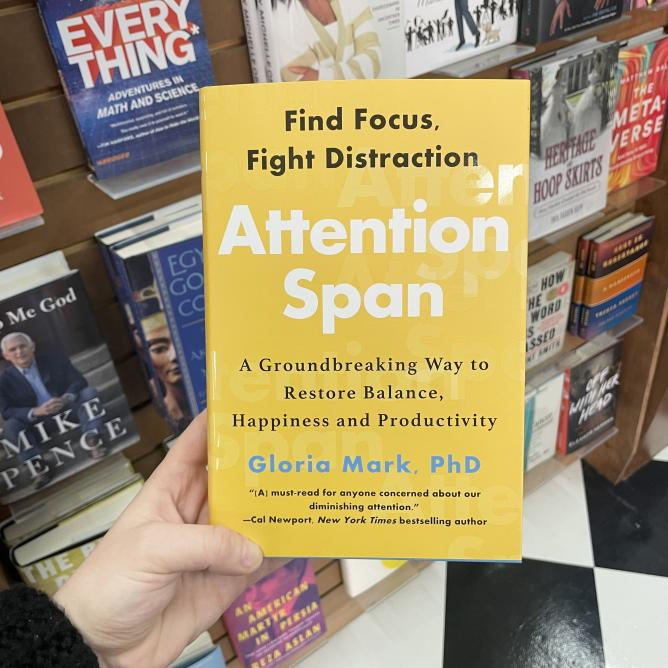
Unlock Your Productivity and Take Control with Soft Determinism: The Attention Span Revolution!

Gloria Mark’s latest book, “Attention Span: A Groundbreaking Way to Restore Balance, Happiness, and Productivity,” delves into the concept of soft determinism and how it relates to our attention spans. Soft determinism acknowledges that our actions are determined by a combination of factors, including our genetics, environment, and choices. This means that while we are not entirely free to do whatever we want, we still have some degree of control over our actions.

Mark’s research shows that our brains are constantly being bombarded with stimuli, and we have to make countless decisions every day. In this context, it can be helpful to view our actions as being determined, but not entirely out of our control. This perspective can help us to better understand our behavior and make positive changes in our lives.

One of the benefits of soft determinism is that it can help us to accept responsibility for our actions. By acknowledging the various factors that influence our behavior, we can be more compassionate towards ourselves and others. Soft determinism can also help us to take control of our lives by making intentional choices that align with our values and goals.

To improve our attention spans, Mark recommends making changes to our environment and habits. For example, we can reduce distractions by working in a quiet space or using noise-cancelling headphones. We can also improve our attention spans by taking regular breaks, practicing mindfulness, and avoiding multitasking.

Mark’s book provides helpful insights into the complex interplay between determinism and attention. She emphasizes the importance of focusing on the things that we can control and letting go of the things that we can’t. This can help us to cultivate a sense of inner peace and contentment, even in the midst of a busy and chaotic world.

In addition to discussing soft determinism, Mark also explores the benefits of attention in our lives. She argues that attention is essential for productivity, happiness, and well-being. When we are able to focus our attention on the task at hand, we are more likely to experience a sense of flow, or being fully immersed in what we are doing.

However, our attention spans are under constant threat from the many distractions in our environment. Mark cites research that shows that the average person checks their phone over 100 times a day. This constant stimulation can make it difficult to maintain focus and can lead to feelings of overwhelm and burnout.

To combat these challenges, Mark recommends developing a mindfulness practice. This can help us to become more aware of our thoughts and emotions, and to develop a greater sense of mental clarity and focus. Mark also encourages us to take breaks throughout the day to recharge our batteries and to make time for activities that bring us joy and fulfillment.

Mark’s book is a well-written and informative resource for anyone looking to improve their attention and overall well-being. Her research is sound, and her advice is practical and actionable. Whether you are struggling to focus at work, feeling overwhelmed by the demands of daily life, or simply looking to cultivate a greater sense of balance and peace, “Attention Span” is a must-read.

Soft determinism is not without its challenges, however. One of the main challenges is that it can be difficult to understand how our actions are determined. The process of determinism is complex and multifaceted, and it can be challenging to tease apart the various factors that influence our behavior.

Another challenge of soft determinism is that it can sometimes lead to feelings of fatalism. If we believe that our actions are predetermined and that we have no control over our lives, we may become resigned to our circumstances and give up on making positive changes.