The Ben Franklin Effect

“He that has once done you a kindness will be more ready to do you another, than he whom you yourself have obliged.” – Benjamin Franklin

The Ben Franklin Effect, a psychological phenomenon named after the famous American founding father, offers a surprising and counterintuitive approach to winning people over and advancing your career. As Franklin’s quote suggests, asking someone for a favor can be more effective in gaining their support than doing them a favor first.

The Ben Franklin Effect

Imagine your career as a rocket ship, ready to launch into the stratosphere of success. Just as a rocket needs a launch pad and boosters to propel it skyward, your career needs the support and mentorship of influential people to reach new heights. But how do you gain their favor and turn critics into allies?

The person who receives the most favors is the one who knows how to return them.

Thiruman Archunan

The key lies in the Ben Franklin Effect. By strategically asking for favors from the right people, you create cognitive dissonance in their minds. They subconsciously justify their actions by believing they must like you, otherwise they wouldn’t have done you the favor. This subtle shift in their perception can transform indifferent or even adversarial colleagues into supportive allies.

To apply this effect to your career advancement, start by building genuine relationships and seeking small favors, such as asking for advice or recommendations. As you progress, look for opportunities to collaborate on high-visibility projects or gain introductions to key stakeholders. Remember, the goal is not to manipulate others, but to create mutually beneficial relationships that help you grow and succeed.

The successful networkers I know, the ones receiving tons of referrals and feeling truly happy about themselves, continually put the other person’s needs ahead of their own.

Bob Burg

As you navigate the corporate landscape, remember that the Ben Franklin Effect is just one tool in your career advancement toolkit. It requires tact, timing, and a focus on building authentic connections. By combining this strategy with a genuine desire to help others and provide value, you’ll create a powerful network of supporters who will champion your success.

Consider the story of Michael, a talented VP of Operations who aspired to become the company’s next Chief Operating Officer (COO). He knew that to reach this goal, he needed the support of the current COO, Lisa, a renowned industry leader known for her strategic insights and influential network. However, Lisa had little reason to notice Michael, let alone champion his career growth.

Instead of trying to impress Lisa with his achievements or doing her unsolicited favors, Michael decided to apply the Ben Franklin Effect. He approached Lisa after a board meeting and asked if she could recommend any leadership development programs or executive coaching resources that had been instrumental in her own career journey. Lisa, flattered by the request, shared her experiences and offered to connect Michael with her own executive coach.

That simple favor request sparked a mentoring relationship that accelerated Michael’s path to the C-suite. Lisa began to see Michael as a high-potential leader and took him under her wing. She provided guidance, shared invaluable insights, and even advocated for his promotion to COO when she decided to step down. By asking for that initial favor, Michael had turned a distant executive into a committed sponsor who played a pivotal role in his ascent to the C-suite.

“The successful networkers I know, the ones receiving tons of referrals and feeling truly happy about themselves, continually put the other person’s needs ahead of their own.” – Bob Burg

As you navigate the path to executive leadership, remember that the Ben Franklin Effect is just one tool in your career advancement toolkit. It requires tact, timing, and a focus on building authentic connections. By combining this strategy with a genuine desire to help others and provide value, you’ll create a powerful network of supporters who will champion your success.

So, take a lesson from one of history’s most influential figures and start turning critics into allies, one favor at a time. As you do, you’ll unlock new opportunities, gain valuable mentorship, and propel your career to new heights. The sky’s the limit when you harness the surprising power of the Ben Franklin Effect.
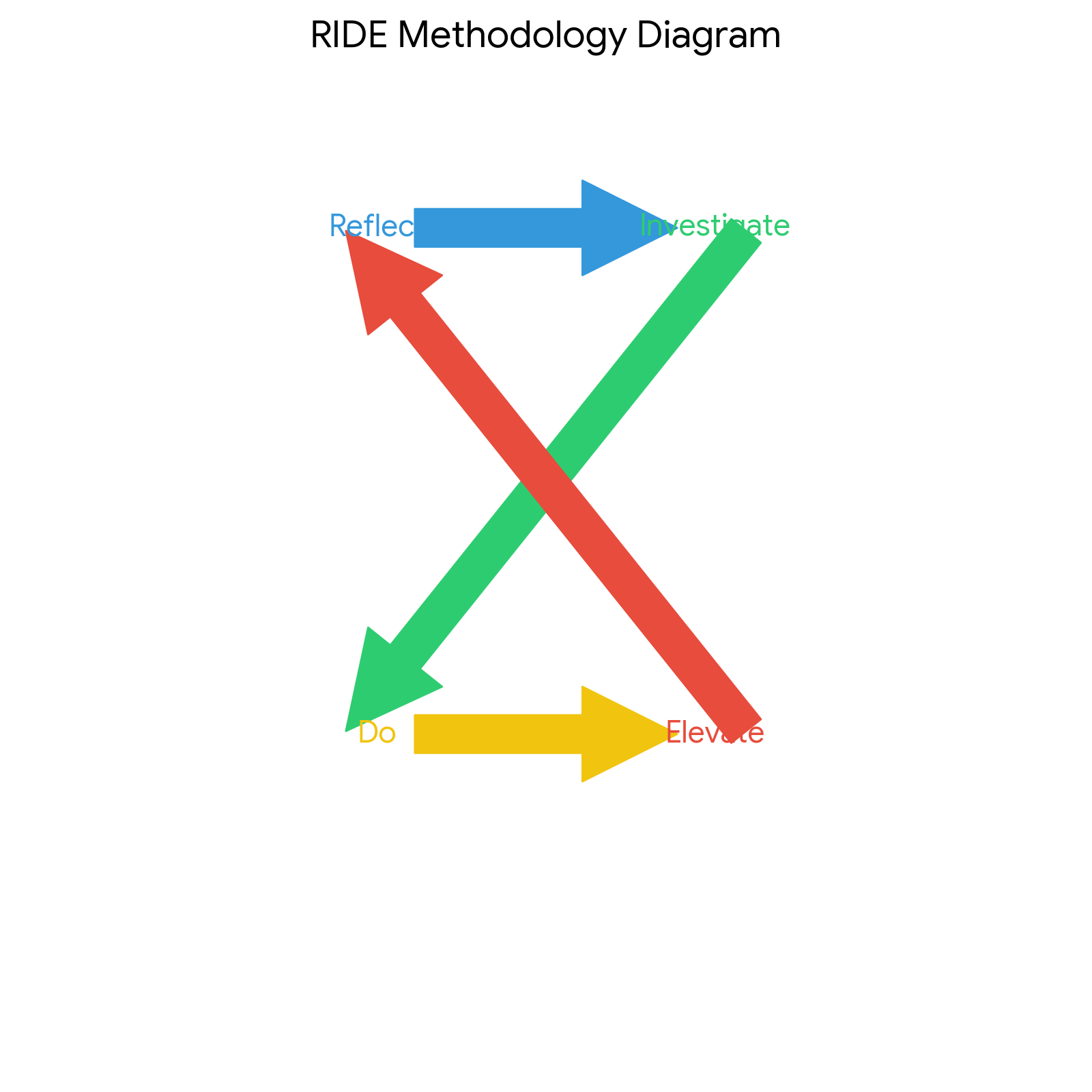
The RIDE methodology

Ever feel like your dreams are trapped behind a wall of obstacles, both seen and unseen? You’re not alone. But what if those obstacles could be transformed into stepping stones? The RIDE methodology unlocks the secret: Reflecting on your deepest desires, Investigating your blockers, Doing practical tasks for progress, and Elevating your future self. This infographic is your roadmap to self-improvement, showing you how RIDE can pave the way to a fulfilling future.

R: Reflect on Your Inner Compass Before embarking, pause and ask, “What truly matters to me?” Like Anna, who dreamt of becoming a renowned author, identify your burning desire. This, like Anna’s moment of clarity, is your guiding star. Remember, Lao Tzu reminds us, “The journey of a thousand miles begins with one step.” Yours starts with identifying your destination.

I: Investigate Your Inner Dragons No hero slays the dragon without understanding it. Here, face your “dragons” – those self-doubts, fears, or limiting beliefs that hinder your progress. Michael, a talented musician, discovered his dragon was stage fright, rooted in past failures. Only by acknowledging and confronting this fear could he conquer his stage and shine. Remember, as the Zen proverb says, “Obstacles do not block the path, they are the path.” Use them to grow stronger.

D: Do the Daily Dance of Progress Dreams are beautiful, but action is the bridge to reality. Divide your journey into small, actionable steps, like laying stones across a river. Sarah, who yearned to run a marathon, broke her goal into daily runs, gradually increasing the distance. Each step, like Sarah’s, is a victory, building strength and turning dreams into achievable goals. Channel Pablo Picasso’s wisdom: “Action is the foundational key to all success.” Take action, one step at a time.

E: Elevate Your Future Self Imagine your future self, successful and thriving. This vision, like John’s dream of leading his own startup, becomes your wind in the sails. It propels you forward, even through storms. Abraham Lincoln said, “The best way to predict your future is to create it.” So create your future, one step at a time.

The RIDE is More Than a Map, It’s a Philosophy RIDE isn’t just a strategy, it’s a way of life. Reflecting gives direction, investigating empowers you to overcome, doing builds momentum, and envisioning propels you forward. Remember, the journey itself holds the beauty, the growth, and the discoveries. As Ralph Waldo Emerson said, “Life is a journey, not a destination.” Embrace the RIDE, dear adventurer, and transform your path into a journey of endless possibility.

The Two-Arrows Concept

“Between stimulus and response, there is a space. In that space is our power to choose our response. In our response lies our growth and our freedom.” – Viktor E. Frankl

Life often presents us with scenarios that feel like a double-edged sword. This brings us to the ‘Two-Arrow Concept,’ a philosophy that suggests we have two types of challenges to face: the initial problem itself (the first arrow) and our emotional reaction to it (the second arrow). In this blog, we’ll explore how understanding and applying this concept can offer profound insights into navigating life’s challenges.

Two-arrows Concept

Imagine you’ve been working diligently on a project at work, only to have it criticized publicly by your boss. The first arrow is the criticism. It’s external and beyond your control. The second arrow is your emotional reaction, which could range from humiliation to anger. This arrow is something you can control.

The Tale of Two Friends:

Two friends, Sarah and Emily, faced the same scenario. Sarah’s second arrow was aimed inward, resulting in feelings of inadequacy and self-doubt. Emily, on the other hand, chose to see the criticism as an opportunity for improvement. The difference in their outcomes was staggering. Sarah’s productivity dipped, while Emily went on to receive commendations for her work.

“Don’t Shoot the Second Arrow”

Buddhist philosophy advises us not to shoot the second arrow, meaning, don’t add suffering to an already challenging situation. As Henry David Thoreau said, “It’s not what you look at that matters; it’s what you see.” When we stop fueling the emotional fire, we empower ourselves to find rational, constructive responses to the first arrow.

The CEO’s Choice:

Consider a CEO faced with plummeting sales figures. The first arrow is the decline itself—hard, factual, and external. The second arrow could be panic or despair, but the seasoned CEO knows better. Instead, they initiate a detailed analysis, identify gaps, and reformulate strategies.

Mastering the Second Arrow

“Maturity is achieved when a person accepts life as full of tension,” said Joshua L. Liebman. Accepting that the first arrow will hit is half the battle. The mastery lies in how you deal with the second one.

Understanding the Two-Arrow Concept is akin to acquiring a life skill. It teaches us to separate the controllable from the uncontrollable, to act rather than react, and to turn challenges into stepping stones for growth. It’s not the absence of problems but your ability to deal with them that defines your journey.

“In the middle of difficulty lies opportunity,” Albert Einstein once said. So the next time life shoots an arrow at you, remember, you have the power to decide whether or not to shoot the second one.

The Two-Arrow Concept is not just a philosophy; it’s a framework for emotional intelligence and rational decision-making. By mastering this concept, you open doors to resilience, wisdom, and an enriched life experience.