Leadership Body Language: 10 Powerful Techniques to Command Respect

Have you ever noticed how certain leaders command attention the moment they enter a room? It’s rarely just about what they say—it’s how they carry themselves. The most influential leaders understand that body language speaks volumes before they utter a single word.

Research shows that up to 55% of communication is nonverbal. By mastering these 10 powerful body language techniques used by world-class leaders, you can dramatically enhance your presence and influence.
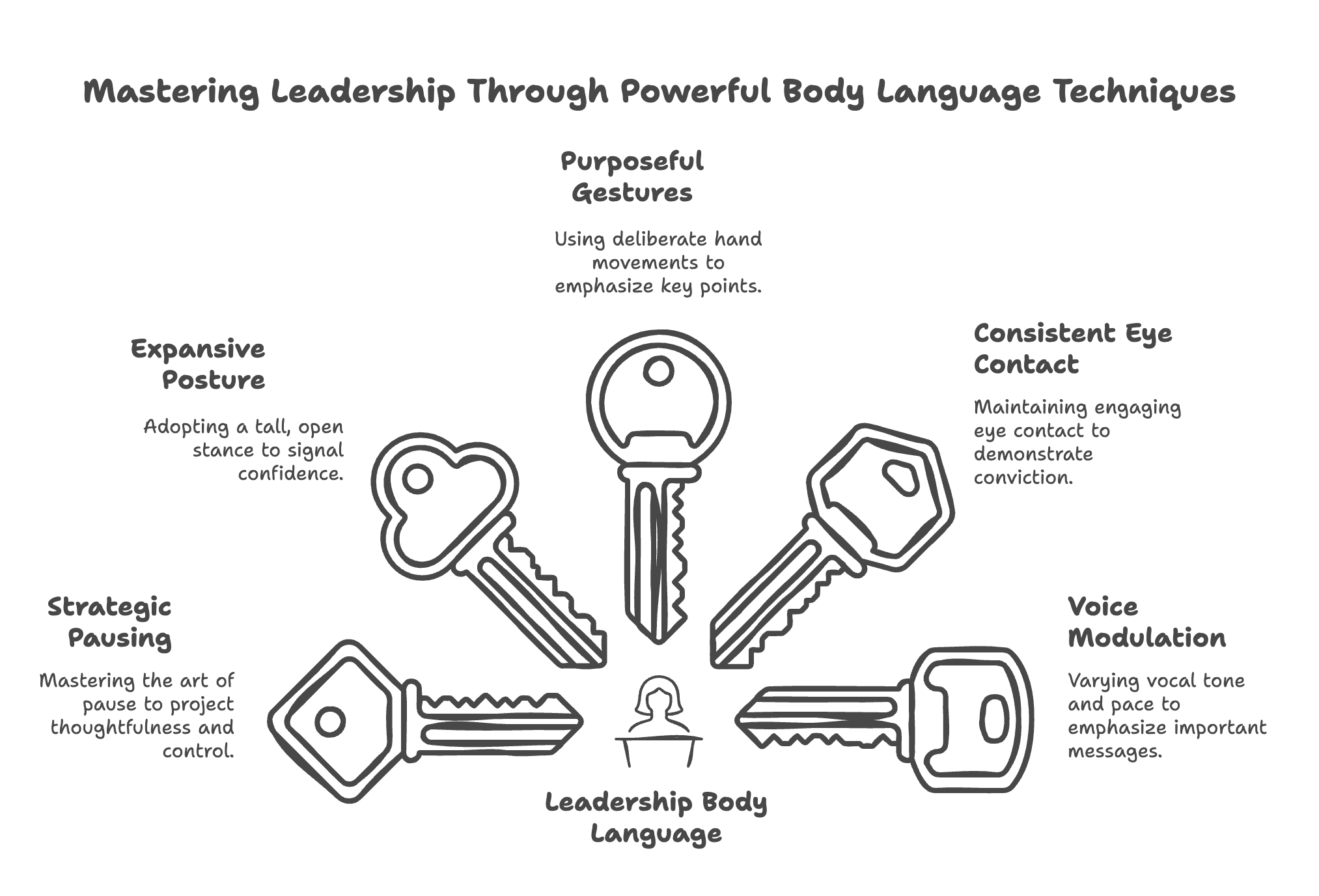
Leadership Body Language

1. Strategic Pausing

Watch footage of Barack Obama speaking, and you’ll notice his masterful use of the pause. Rather than rushing to respond to questions or challenges, effective leaders take a moment to gather their thoughts. This deliberate pause projects thoughtfulness and control rather than reactivity.

Try this: Count to three in your mind before responding to important questions. This brief moment allows you to formulate a more thoughtful response while signaling confidence and composure.

2. Expansive Posture

Leaders naturally take up appropriate space. This doesn’t mean appearing aggressive or domineering—rather, it’s about standing tall with shoulders back and chest open. This expansive posture signals confidence and commands respect.

Try this: Before important meetings, stand in a “power pose” for two minutes (feet shoulder-width apart, hands on hips or stretched overhead). Research suggests this can actually increase testosterone levels and decrease stress hormones.

3. Purposeful Gestures

Notice how influential leaders use clear, deliberate hand movements to emphasize key points. These purposeful gestures draw attention and reinforce their message, unlike the small, fidgety movements that signal nervousness.

Try this: Practice using broader, more deliberate hand gestures when making important points. Keep movements above the waist and visible to your audience.

4. Consistent Eye Contact

Steady, confident eye contact demonstrates engagement and conviction. Leaders maintain appropriate eye contact without the unnerving, unblinking “threat tracking” stare that creates discomfort.

Try this: Practice the “triangle technique”—moving your gaze between both eyes and the forehead of the person you’re speaking with. This creates connection without appearing intimidating.

5. Voice Modulation

The most compelling leaders vary their vocal tone, pace, and volume strategically. This prevents monotony and helps emphasize key points. Think of Martin Luther King Jr.’s powerful speeches with their rhythmic crescendos and thoughtful pauses.

Try this: Record yourself speaking and identify places where you can add emphasis through volume, slow down for important points, or speed up to create energy.

6. Selective Mirroring

Skilled leaders subtly adopt elements of others’ body language to build rapport, while still maintaining their own authoritative presence. This creates connection without sacrificing leadership stature.

Try this: Subtly match the energy level and speaking pace of those you’re communicating with, while maintaining your leadership posture.

7. Controlled Facial Expressions

Exceptional leaders maintain facial composure, particularly during challenging situations. They don’t telegraph every emotion, maintaining a calm, steady demeanor that inspires confidence.

Try this: Practice your “neutral but engaged” face in the mirror. This expression should appear attentive and interested without revealing anxiety or distress.

8. Grounded Stance

Watch footage of world leaders and notice how they stand—feet shoulder-width apart, weight evenly distributed. This grounded stance projects stability and confidence.

Try this: Practice standing with feet planted firmly, about shoulder-width apart. Feel the connection with the ground and avoid shifting weight from foot to foot.

9. Limited Self-Touching

Effective leaders avoid nervous habits like touching their face, adjusting clothing, or fidgeting with objects. These self-soothing behaviors signal insecurity and undermine authority.

Try this: Become aware of your self-touching habits and practice keeping your hands still or purposefully engaged in gestures rather than nervous adjustments.

10. Intentional Movement

The most commanding leaders move with intention rather than rushing. As mentioned in body language research, this “Royal Bengal Tiger” quality of deliberate movement draws attention and signals confidence.

Try this: Practice moving slightly more slowly than your natural pace. Take your time entering rooms, approaching podiums, or crossing stages.

Bringing It All Together

These techniques are most powerful when they become natural extensions of your authentic leadership style rather than forced affectations. Start by focusing on one or two areas where you see the most opportunity for growth.

Remember—effective leadership body language isn’t about manipulation. It’s about ensuring your nonverbal communication aligns with and reinforces your message, allowing your true leadership qualities to shine through unhindered by distracting habits.

What body language technique will you focus on developing first?

Babble Effect

In the cacophony of a bustling marketplace, where hundreds of voices clash and blend into a relentless hum, there exists an unseen struggle for clarity and dominance. Each vendor shouts louder than the last, attempting to capture the fleeting attention of passersby. This scenario, mirroring the ‘babble effect’ found in crowded or noisy environments, presents an interesting parallel to the dynamics of communication and leadership within the corporate world, particularly during meetings.

The Babble of the Boardroom

Just as the marketplace is saturated with competing voices, the modern meeting room often becomes a stage for a similar phenomenon. Among the multitude of ideas and opinions voiced, it is easy for messages to get lost in the babble. However, within this chaotic symphony, certain individuals manage to emerge as leaders, their voices cutting through the noise, much like a skilled vendor who knows exactly when and how to pitch his goods to stand out from the crowd.

Crafting the Call: The Secret to Standing Out

The key to emerging as a leader in a meeting, much like succeeding in the bustling marketplace, lies not in the volume of one’s voice but in its clarity and relevance. The babble effect teaches us that simply talking more or louder is not enough. Instead, it is the ability to articulate ideas succinctly and compellingly that captures attention and fosters leadership. This is akin to a vendor whose unique call or presentation makes him audible over the din of the market.

Babble Effect

The Dual Blade: Speaking and Listening

Effective leadership, however, demands more than just cutting through the noise. It requires an acute awareness of the ‘babble’—the background noise made up of competing ideas and voices—and the skill to navigate it thoughtfully. This involves not just speaking but listening, discerning, and then responding in a way that acknowledges the contributions of others while steering the conversation towards productive outcomes. It is about transforming the babble into a dialogue, where every voice is valued, but direction and clarity prevail.

Echoing Through the Babble: Strategies for Aspiring Leaders

To echo through the babble of the corporate world and be recognized as a leader, one must master a few critical strategies:

– Speak with Purpose:Your contributions should add value, offering insights or solutions rather than merely adding to the noise.

– Be Concise and Clear:In a sea of voices, simplicity and clarity are your allies. Aim to articulate your thoughts in a manner that is easily understood and remembered.

– Listen Actively:Leadership is as much about listening as it is about speaking. By actively listening, you can better understand the room’s dynamics and tailor your contributions to be more impactful.

– Foster Inclusivity:Encourage others to speak and listen to their ideas. Leadership often involves amplifying voices that might otherwise be drowned out by the babble.

Concluding the Symphony

In corporate world, much like a bustling marketplace, is filled with the babble of competing voices. The challenge and opportunity for aspiring leaders lie in their ability to stand out—not by merely being the loudest but by being the most resonant. By speaking with purpose, clarity, and empathy, and by mastering the art of listening, one can navigate the babble, emerging as a beacon of leadership that guides the team towards harmony and success. Remember, in the symphony of the corporate world, it is not just about having your voice heard but about making your voice matter.

 The Heliotropic Effect

 The heliotropic effect: the phenomenon whereby plants naturally turn toward and grow in the presence of light. 

Nature

The Heliotropic Effect in Leadership

The heliotropic effect, a term borrowed from biology, describes the tendency in all living systems towards energy that sustains life and away from energy that depletes life. In leadership, this translates to the natural inclination of people to gravitate towards leaders who exude positivity and life-enhancing energy.

Understanding Positive Affective Presence

Positive affective presence is more than just a feel-good factor; it’s a strategic advantage. Leaders who exhibit this trait create an environment where team members feel genuinely valued, inspired, and motivated.

Consider the story of Sarah, a project manager known for her vibrant energy. Her team often remarked how her presence alone could turn a stressful day into a productive one, exemplifying the heliotropic effect in action.

Photo by Riccardo Annandale on Unsplash

Cultivating Positive Affective Presence

  1. Emotional Intelligence: Develop a keen awareness of your emotions and those of others. This sensitivity allows you to connect with team members authentically: “Emotional intelligence is the key to both personal and professional success” – Daniel Goleman.
  2. Authentic Communication: Engage in open, honest, and empathetic communication. It builds trust and demonstrates your genuine interest in your team’s well-being: Imagine a leader who always speaks from the heart, whose words are not just heard but felt. This leader doesn’t just communicate; they connect on a deeper level.
  3. Inspirational Motivation: Be the source of inspiration. Share your vision in a way that excites and motivates your team: “Leadership is not about a title or a designation. It’s about impact, influence, and inspiration.” – Robin S. Sharma.
  4. Positive Reinforcement: Acknowledge and celebrate successes. This not only boosts morale but also reinforces the behaviors you want to see. When Alex’s team achieved a major milestone, he didn’t just send an email; he organized a small celebration. This act of recognition made the team feel valued and motivated.
  5. Empathy and Support: Show understanding and support for your team’s challenges. Being empathetic strengthens relationships and fosters a supportive work culture.There was once a leader who always made time to listen. When a team member was facing a personal challenge, they knew they had a leader who would understand and support them.

The Impact of Positive Affective Presence

Leaders who embody positive affective presence can transform the atmosphere of their teams. They create a ripple effect of positivity, leading to increased productivity, creativity, and overall job satisfaction.

“People will forget what you said, people will forget what you did, but people will never forget how you made them feel.” – Maya Angelou.

Maya Angelou’s powerful words resonate deeply with the human experience. They capture the essence of how our interactions with others leave a lasting impact. This quote serves as a timeless reminder of the importance of empathy, compassion, and understanding in our interactions with one another. It highlights the enduring significance of emotional connections and the profound influence they have on our lives. As we navigate through our daily interactions, whether big or small, let us strive to leave a positive and lasting impression through the way we make others feel.

The power of positive affective presence in leadership, underscored by the heliotropic effect, cannot be overstated. It’s about being a beacon of positivity, guiding and inspiring your team towards success. As John Quincy Adams once said, “If your actions inspire others to dream more, learn more, do more and become more, you are a leader.”