The Power of Attention

In today’s fast-paced, information-saturated world, capturing and maintaining attention has become a valuable currency. Whether you’re an entrepreneur, artist, or influencer, your ability to stand out from the crowd can make or break your success. This is where Law 6 comes into play: Attract Attention by being outrageous or creating an aura of mystery.
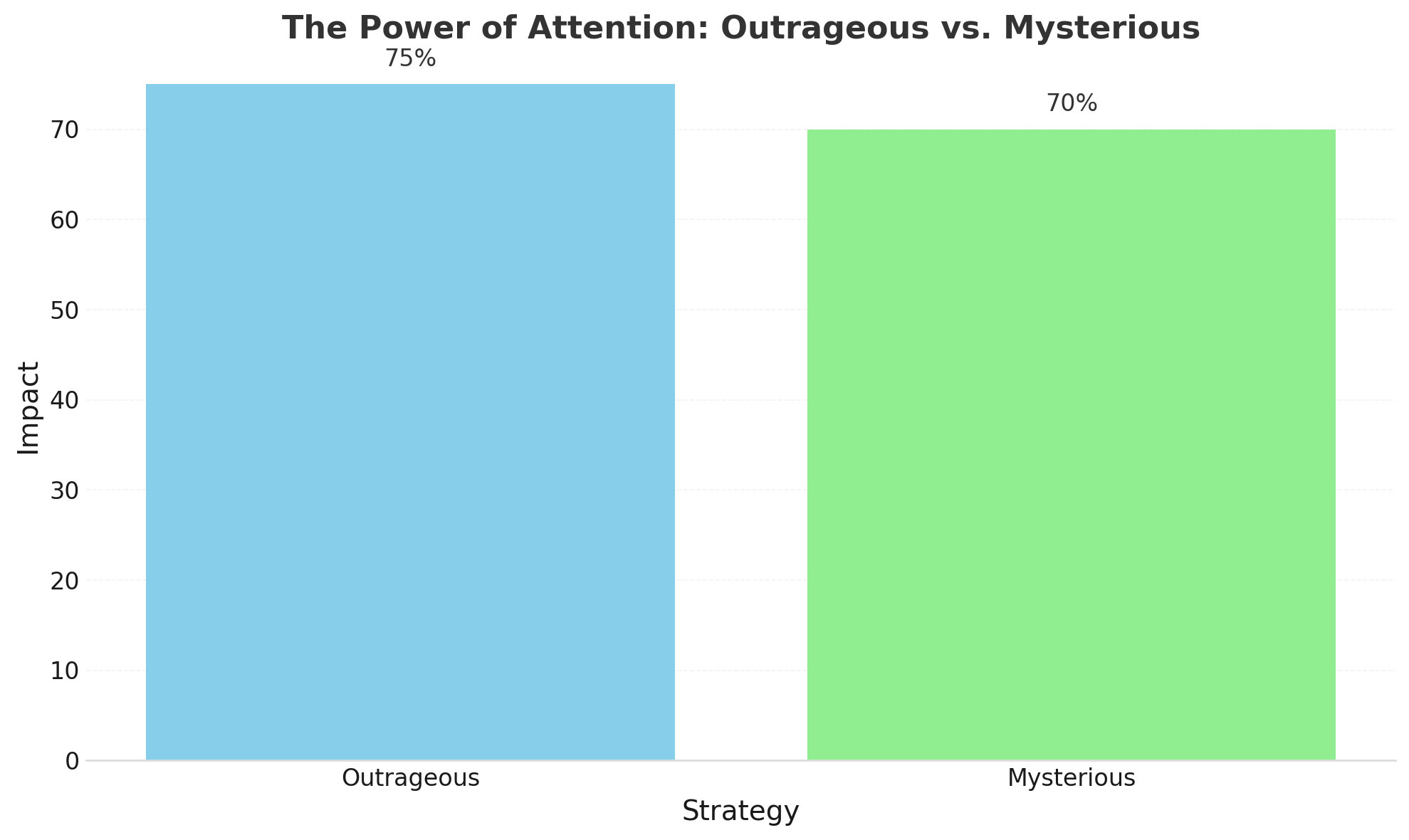
The Attention Economy

We live in an attention economy, where the most precious commodity is not money or resources, but the ability to capture and hold people’s focus. With countless stimuli vying for our attention every second, those who can cut through the noise and make a lasting impression are the ones who ultimately succeed.

The Power of Being Outrageous

One effective way to attract attention is by being outrageous. This doesn’t mean you should be offensive or harmful, but rather that you should push boundaries and challenge conventions in a way that makes people take notice. Think of figures like Lady Gaga, Elon Musk, or Richard Branson – their unconventional approaches and bold statements have kept them in the public eye and contributed to their success.

Being outrageous can involve:

  1. Making bold claims or predictions
  2. Adopting an unusual personal style
  3. Taking on seemingly impossible challenges
  4. Speaking out on controversial topics
  5. Creating products or experiences that defy expectations

The Allure of Mystery

On the other hand, cultivating an air of mystery can be equally effective in attracting attention. Human curiosity is a powerful force, and people are naturally drawn to what they don’t fully understand. By strategically withholding information or creating an enigmatic persona, you can pique interest and keep people engaged.

Ways to create mystery include:

  1. Teasing upcoming projects or announcements
  2. Maintaining a low profile on social media
  3. Crafting an intriguing personal narrative
  4. Using symbolism or hidden meanings in your work
  5. Leaving certain aspects of your life or business open to interpretation

The Value of Any Attention

It’s important to note that, according to this law, any attention – positive or negative – is better than being ignored. While it’s generally preferable to attract positive attention, even controversy or criticism can work in your favor by keeping you in the public eye and sparking discussions around your brand or persona.

However, it’s crucial to navigate this carefully. While negative attention can initially boost visibility, it’s essential to have a strategy for turning it into a positive narrative or leveraging it for growth.

Attention Leads to Wealth

The ultimate goal of attracting attention is to convert it into tangible benefits, often in the form of wealth. When you successfully capture people’s interest, you open doors to numerous opportunities:

  1. Increased brand recognition and loyalty
  2. Higher engagement rates on social media and other platforms
  3. More opportunities for collaborations and partnerships
  4. Greater media coverage and free publicity
  5. Improved sales and revenue streams

In a world where attention is increasingly scarce and valuable, mastering the art of attracting and maintaining it can be a game-changer for your personal and professional success. Whether you choose to be outrageous, mysterious, or a combination of both, remember that the key is to be authentic and strategic in your approach.

By implementing Law 6 and making yourself impossible to ignore, you can harness the power of attention to create wealth, influence, and lasting impact in your chosen field. Just remember to use this power responsibly and always strive to provide value to your audience, even as you captivate their attention.


The Law of Assumption

The Law of Assumption is a powerful concept that can transform your life by reshaping how you perceive and interact with the world. Popularized by Neville Goddard, this principle posits that whatever you assume to be true becomes your reality. By assuming the feeling of your desire already fulfilled, you align your thoughts and actions with that desired state, thus attracting it into your life.

Law of Assumption

Understanding the Law of Assumption

At its core, the Law of Assumption is about embodying the mindset and emotional state of already having achieved your goals. This concept hinges on the idea that our external reality is a reflection of our internal beliefs. By changing our assumptions, we can alter our reality.

Key Principles of the Law of Assumption:

  1. Assume the Desired State: Believe that your goal is already achieved. Feel the emotions associated with that achievement.
  2. Live from the End: Act and think as if your desired outcome is your current reality.
  3. Persist in the Assumption: Maintain this belief regardless of external circumstances or current reality.

To harness the Law of Assumption for career advancement, start by clearly defining your career goals. Whether you aim for a promotion, a new job, or success in your current role, visualize yourself in that position.

  1. Visualize Success: Close your eyes and imagine yourself in your desired role. See the office, feel the satisfaction, and experience the confidence.
  2. Embody the Role: Act as if you are already in that position. Dress the part, speak with authority, and take on responsibilities that align with your future role.
  3. Positive Affirmations: Use affirmations to reinforce your new belief. Phrases like “I am successful in my career” or “I am thriving in my dream job” can help solidify your new reality.

Applying the Law of Assumption to Wealth Creation

For wealth, the Law of Assumption requires you to shift your mindset from lack to abundance. Assume the feeling of financial freedom and prosperity.

Steps to Apply for Wealth:

  1. Visualize Abundance: Picture your bank account filled with money, imagine the freedom to buy what you want, and feel gratitude for your financial success.
  2. Financial Affirmations: Repeat affirmations like “I am wealthy,” “Money flows to me easily,” and “I am financially free.”
  3. Act Wealthy: Make financial decisions as if you are already wealthy. This doesn’t mean overspending but rather managing your finances wisely, investing in your growth, and making choices that reflect abundance.

Living from the End

Living from the end means embodying the state of your desired outcome. This requires a mental shift where you act, think, and feel as if you have already achieved your goals. By doing so, you align your actions with your beliefs, making it easier for your goals to manifest.

Tips for Living from the End:

  1. Daily Visualization: Spend a few minutes each day visualizing your desired outcome.
  2. Gratitude: Practice gratitude for what you have and what you are manifesting.
  3. Consistent Practice: Regularly reinforce your new beliefs and assumptions through meditation, journaling, and affirmations.

By incorporating the Law of Assumption into your daily routine, you can start living from the end and manifesting the career and wealth you desire. Remember, the power lies within your beliefs and assumptions. Start today and transform your reality.

Pie Fallacy

The notion that the world’s wealth is a fixed pie, to be divvied up among us, is an enduring myth that persists from the playgrounds of our youth to the boardrooms of our adult lives. This childhood misconception leads many to view the economy as a zero-sum game, where one person’s gain is another’s loss. However, this is the Pie Fallacy—a misleading belief that fails to recognize the dynamic nature of wealth creation.

“Wealth is not about having a lot of money; it’s about having a lot of options.” – Chris Rock

Pie Fallacy

Wealth is not a stagnant pond but a spring, continuously fed by the streams of innovation, labor, and entrepreneurship. The concept of money, often mistaken for wealth itself, is merely a facilitator, a means of exchanging the value that we create. The static view of wealth overlooks the fact that every day, individuals and businesses are engaged in activities that expand the pie for everyone.

Consider the example of technology startups that have revolutionized industries and created services that were previously unimaginable. These companies didn’t take a larger slice of the pie from others; they baked a whole new one. When you download a new app that simplifies your life or use a service that saves you time, you’re witnessing the expansion of wealth.

The same principle applies on a more personal scale. When someone restores an old car, they aren’t merely transferring wealth from one place to another; they are adding value through their skills and effort. The car, once a rusting hulk, is transformed into a valuable classic. Its increased value is a direct result of human ingenuity and hard work, not the deprivation of another.

This truth has profound implications for how we approach wealth as a society. Policies aimed at merely redistributing wealth, while sometimes necessary, don’t address the core engine of economic growth: wealth creation. Encouraging innovation, protecting intellectual property rights, and fostering a business environment where new ideas can flourish—these are the keys to expanding the pie for everyone.

In dispelling the Pie Fallacy, we must embrace the idea that wealth is not finite. Our economic system thrives on the creation of value, not the mere circulation of currency. As we innovate and build, as we refine and improve, the pie grows, and with it, the potential for prosperity for all. Understanding this is crucial for developing economic policies that foster growth and opportunity, rather than just redistributing a falsely perceived limited resource.

The Pie Fallacy should be left in the past, along with other childhood myths. It’s time to recognize the boundless nature of human potential to generate wealth, ensuring that the pie doesn’t just get sliced more thinly, but that it gets bigger and better for everyone partaking in it.