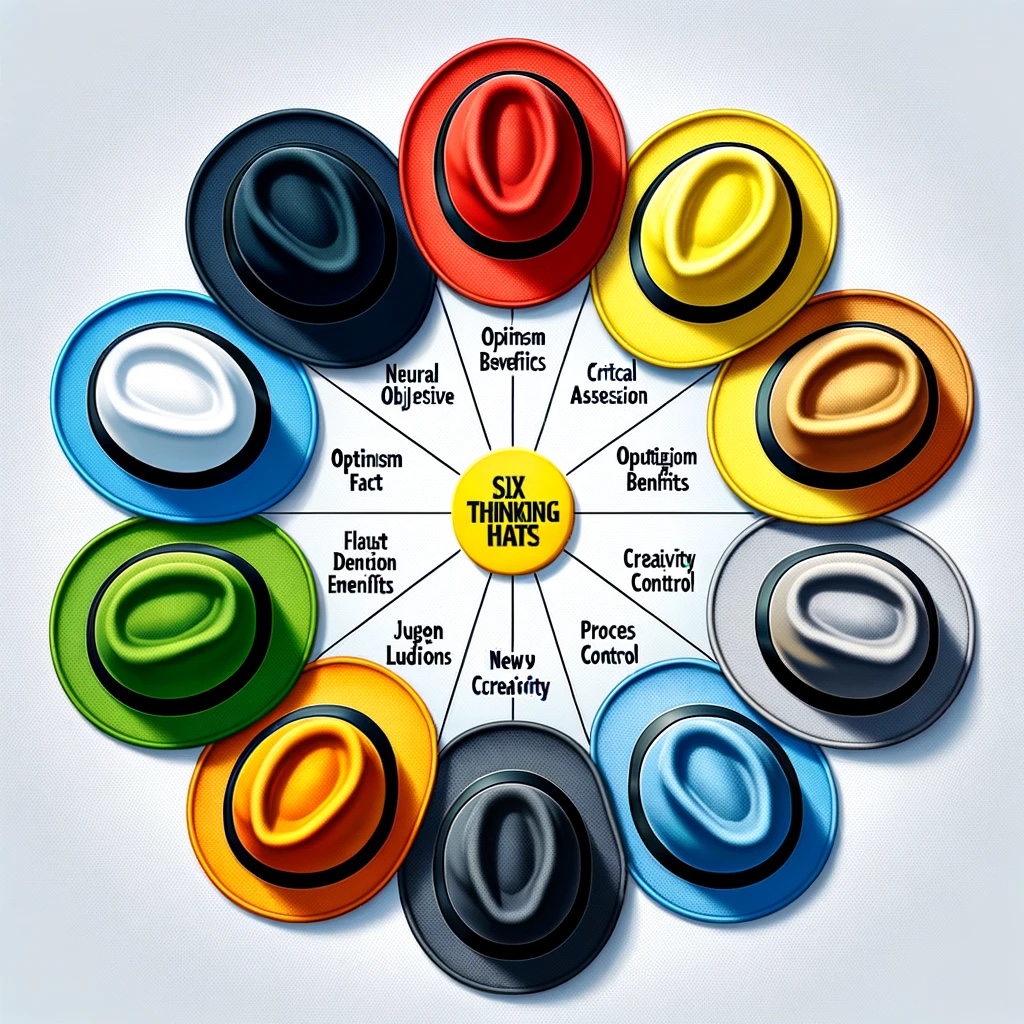
Always approach problem-solving using the Six Thinking Hats framework, which is a valuable tool for examining issues from various perspectives:
White Hat (Facts and Information): Start by gathering all the available data and facts related to the problem. What do we know?
Red Hat (Emotions and Feelings): Consider the emotional aspects of the problem. How do you and your team feel about it? What are your initial gut reactions?
Black Hat (Critical Thinking): Analyze the potential drawbacks, risks, and challenges associated with the problem. What are the potential pitfalls and obstacles?
Yellow Hat (Optimism and Positivity): Focus on the positive aspects and opportunities that may arise from solving the problem. What are the potential benefits and solutions?
Green Hat (Creativity and Innovation): Encourage creative thinking and brainstorming for new ideas and solutions. What innovative approaches can you explore?
Blue Hat (Process Control): Finally, take control of the thinking process. Summarize the insights gained from the other hats, prioritize actions, and outline a plan to address the problem. What’s the next step?
By systematically examining the problem from these different angles, you can arrive at a well-rounded and thoughtful solution.
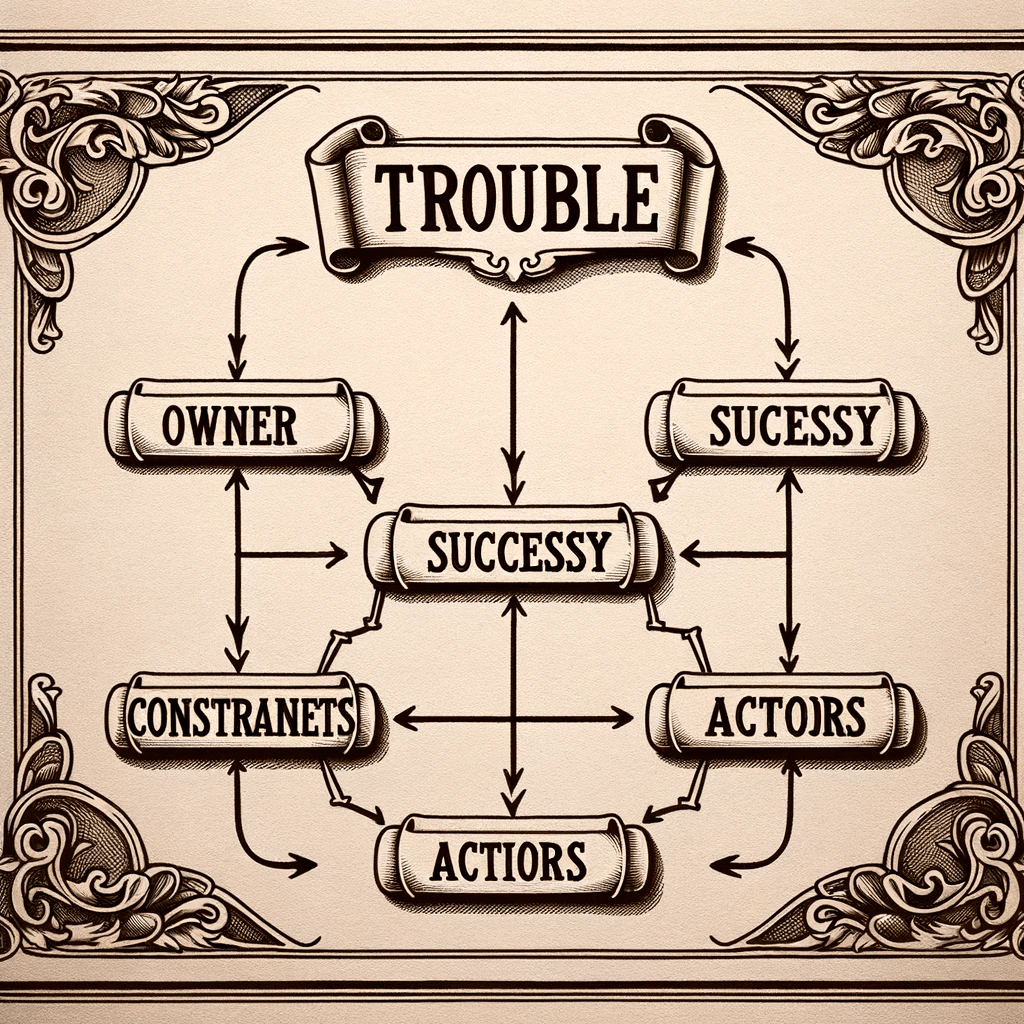
In the realm of consulting, the ability to define problems effectively is paramount. It’s the critical first step toward developing innovative solutions that drive organizations forward. One valuable tool at the disposal of strategy consultants is the TOSCA framework, an acronym that stands for Trouble, Owner, Success, Constraints, and Actors. In this blog, we’ll explore how the TOSCA framework serves as a guiding star in the complex world of strategy consulting.
TOSCA Framework
Trouble: Identifying the Heart of the Issue
The first pillar of the TOSCA framework is “Trouble.” This involves delving deep into the challenge at hand, peeling away superficial layers to uncover the core issue. Strategy consultants ask probing questions and analyze data to gain a comprehensive understanding of the trouble. They look for patterns, anomalies, and potential root causes. By defining the trouble accurately, they set the stage for targeted and effective problem-solving.
Owner: Pinpointing Responsibility
“Owner” is the second element of the TOSCA framework. It involves identifying who within the organization or team is responsible for addressing the trouble. Clear ownership ensures accountability and streamlines the decision-making process. Strategy consultants collaborate closely with stakeholders to define roles and responsibilities, ensuring that the right people are engaged in finding solutions.
Success: Defining the End Game
The third pillar, “Success,” involves articulating what victory looks like. Strategy consultants work with clients to establish clear and measurable goals. These success criteria serve as benchmarks to gauge progress and determine when the problem has been effectively resolved. Success metrics align everyone’s efforts toward a common objective, fostering motivation and focus.
Constraints: Recognizing Boundaries
Every problem-solving endeavor faces limitations, and the “Constraints” component of the TOSCA framework addresses these boundaries head-on. Strategy consultants identify and acknowledge the constraints, whether they are budgetary, logistical, or regulatory. Recognizing these limitations from the outset allows consultants to craft solutions that work within these constraints, increasing the likelihood of successful implementation.
Actors: Mapping the Landscape
The final element of the TOSCA framework is “Actors.” In any complex challenge, various individuals and groups play crucial roles. Strategy consultants create a comprehensive map of these actors, understanding their motivations, influence, and relationships. This knowledge helps consultants navigate the human dynamics involved in problem-solving, fostering collaboration and buy-in from key stakeholders.
Applying TOSCA to a Real-World Challenge
To illustrate the power of the TOSCA framework, let’s consider a real-world scenario: a struggling retail company aiming to revitalize its brand.
Trouble: Through market research, the consultants identify that declining sales are the core trouble. Further analysis reveals that changing consumer preferences and increased competition are contributing factors.
Owner: The CEO of the company takes ownership of addressing this issue, committing to lead the transformation effort.
Success: Success is defined as achieving a 15% increase in sales within the next fiscal year.
Constraints: The company faces budget constraints and a tight timeline, which must be factored into the strategy.
Actors: The actors include the CEO, marketing team, store managers, and external consultants. Each group has a role in executing the revitalization plan.
The TOSCA framework is a valuable tool that empowers strategy consultants to define problems systematically and comprehensively. By addressing Trouble, Owner, Success, Constraints, and Actors, consultants lay a strong foundation for effective problem-solving. This approach not only streamlines the consulting process but also increases the likelihood of achieving meaningful and sustainable solutions. In a world where complex challenges abound, the TOSCA framework is a beacon guiding strategy consultants and their clients toward brighter horizons.
In our fast-paced world, productivity is often hailed as the key to success. We are constantly told to work harder, longer, and faster to achieve our goals. However, there exists a paradox within this notion of productivity, one that draws inspiration from the majestic lion’s work ethic. Just like the king of the jungle, we can learn to balance our efforts by embracing the art of sprinting, resting, and repeating. Let’s delve into this paradox and explore how incorporating moments of rest can actually boost productivity and lead to more sustainable success.
Sprint: Unleashing the Lion’s Roar The lion is a symbol of power and strength, renowned for its explosive bursts of energy when hunting. Similarly, in our work lives, there are moments when we must unleash our inner lion and sprint towards our goals with unwavering focus. These sprints represent periods of intense effort and dedication, where we give our best to achieve significant milestones. During these phases, we prioritize tasks, eliminate distractions, and channel our energy like the mighty lion chasing its prey.
Rest: The Power of the Lion’s Slumber Yet, even the most powerful of beasts needs to rest after a hunt. Rest is not a sign of weakness; rather, it is a crucial aspect of maintaining a sustainable work ethic. Just as the lion conserves its energy during periods of inactivity, we too must recognize the importance of downtime. Rest allows us to recharge our minds and bodies, promoting creativity, better decision-making, and enhanced problem-solving abilities. Embracing rest doesn’t equate to laziness; instead, it is an investment in our long-term productivity and well-being.
Repeat: Embracing Cycles for Lasting Success The beauty of the lion’s work ethic lies in its cyclical nature. After each sprint and rest, the lion doesn’t shy away from repeating the process when hungry again. Similarly, we must adopt a mindset of perseverance and adaptability in our work lives. Embracing the idea of cycles enables us to continually improve, learn from our experiences, and refine our strategies. By acknowledging that success is not linear but consists of ups and downs, we become better equipped to handle challenges and stay on the path towards our goals.
Breaking the Paradox: A Harmonious Blend To break the paradox of productivity, we must realize that embracing both the sprint and the rest is not an either-or proposition. Instead, it is a harmonious blend of the two that leads to sustained success. By aligning our work habits with the lion’s example, we can achieve a state of balance and flow, optimizing our performance and overall well-being.
Practical Tips for Embracing the Lion’s Work Ethic:
Prioritize tasks and set specific sprint periods for focused work.
During sprints, eliminate distractions and create a conducive work environment.
Incorporate short breaks throughout the day to recharge and rejuvenate.
Practice mindfulness and relaxation techniques during rest periods.
Reflect on past experiences to learn from successes and challenges.
Embrace flexibility and adaptability, knowing that progress is not always linear.
Celebrate accomplishments, no matter how small, to boost motivation and morale.
In the paradox of productivity, the lion’s work ethic teaches us valuable lessons about the power of balance and cycles. By sprinting towards our goals with focus, resting to recharge, and repeating the process, we can achieve sustainable success while maintaining our well-being. Embrace the paradox, and let the spirit of the lion guide you on your journey to a more fulfilling and productive life. Remember, it’s not about working harder all the time; it’s about finding the harmony between exertion and rejuvenation, just like the king of the jungle.

 Maverick