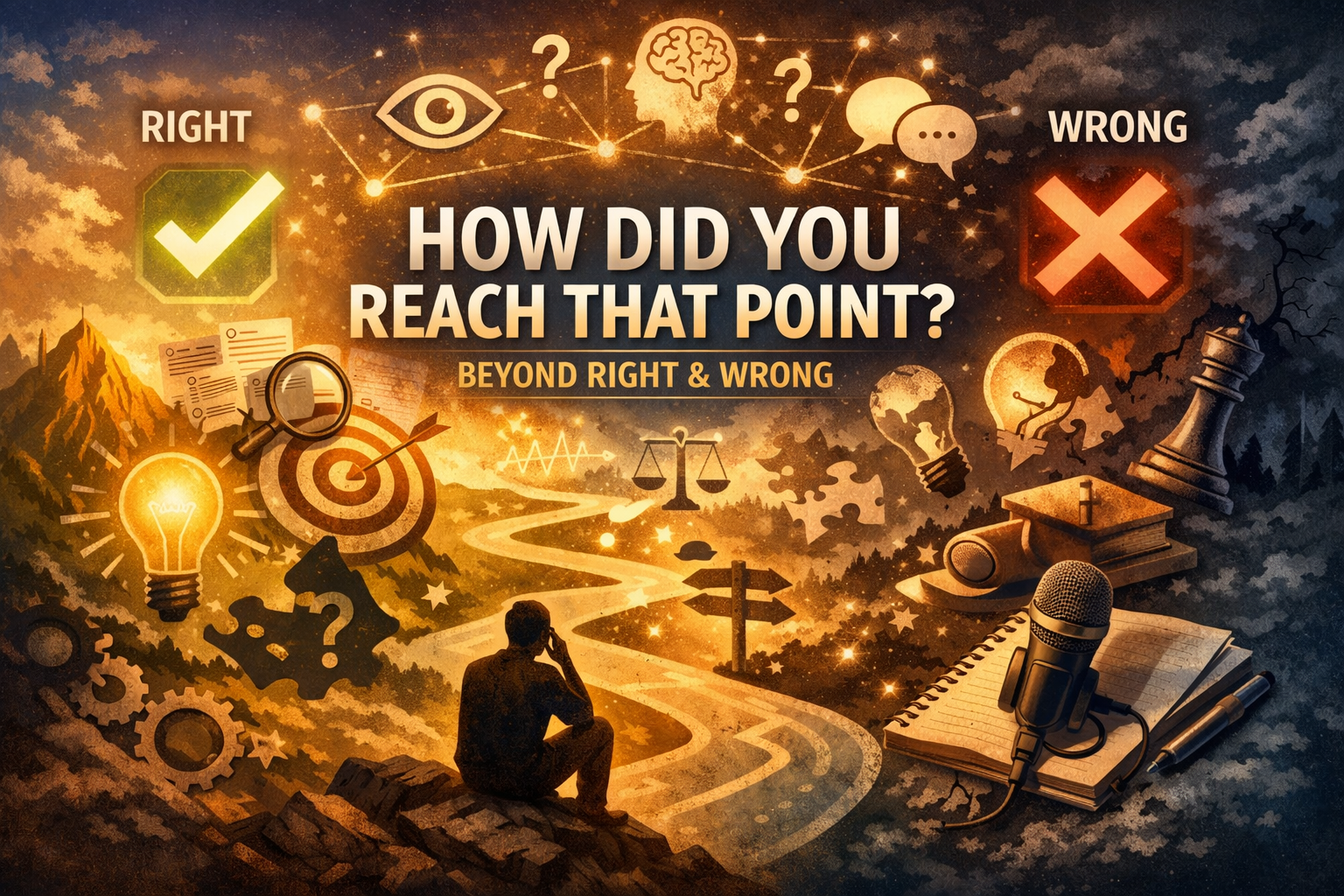
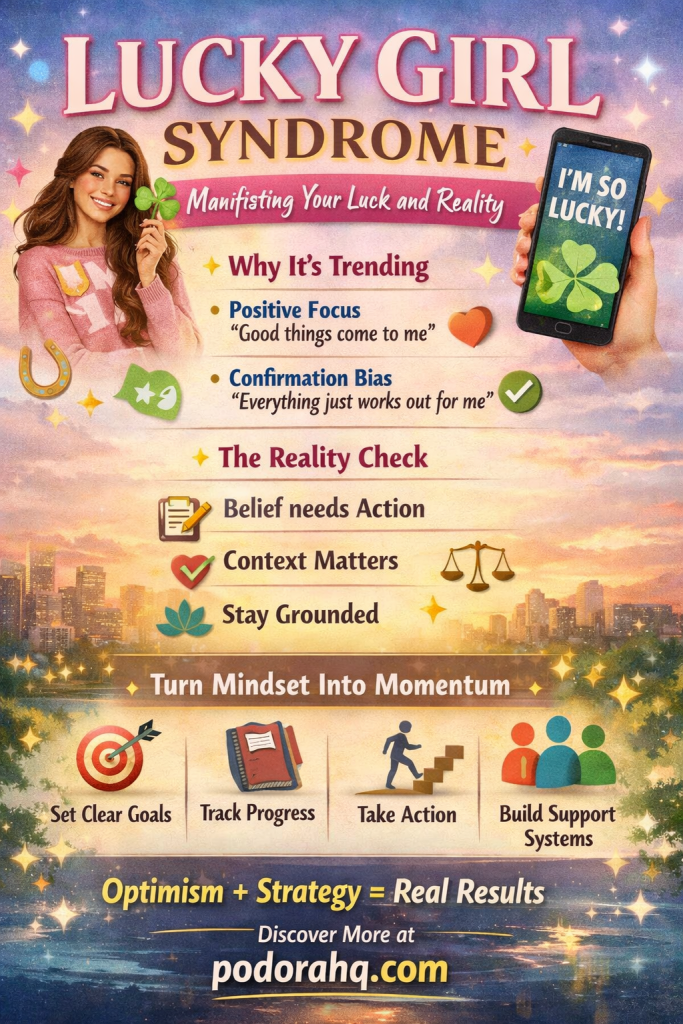
Lucky Girl Syndrome

In the age of TikTok trends and self-improvement mantras, Lucky Girl Syndrome has emerged as one of the most talked-about mindsets online. Millions of users are sharing videos and affirmations under the hashtag #LuckyGirlSyndrome, describing how adopting a “luck-first” mindset has changed their day-to-day experiences. But what is Lucky Girl Syndrome really, and how should you think about it in a practical way? 

The Trend That Took Off on Social Media

Lucky Girl Syndrome isn’t an official psychological diagnosis. It’s a phrase born out of social media culture especially TikTok that describes a form of manifestation and positive affirmation where people tell themselves things like “I am so lucky” or “everything just works out for me” with the belief that this mindset will attract better outcomes. 

Users describe everyday wins green lights, unexpected opportunities, smooth experiences as evidence that adopting these affirmations changed their luck. That perceived uplift in everyday moments is what keeps the phenomenon trending. 

What Makes It So Popular

At its core, Lucky Girl Syndrome taps into two psychological mechanisms:

1. Positive Focus: Repeating optimistic statements trains your brain to notice the good things around you. You start noticing opportunities you might have ignored before. 

2. Confirmation Bias: When you expect good things, you are more likely to remember the times things go well and overlook when they don’t. This strengthens the feeling that you’re “naturally lucky.” 

This combination makes the trend compelling. It feels empowering, it’s easy to practice, and it creates a sense of progress even before goals are achieved.

The Real Psychological Impact

Scientific research on positive thinking supports the idea that a hopeful mindset can influence stress, mood, motivation, and resilience. Optimism doesn’t make goals magically happen, but it can change how you approach challenges and setbacks. 

However, there are important caveats:

It’s not a substitute for action. Simply believing you’re lucky won’t replace planning, effort, and decision-making. Over-reliance on luck can create complacency or make setbacks harder to process. 

Context matters. Social media success stories often gloss over the work, privilege, support systems, or resources behind those outcomes. Not everyone starts from the same position, and that discrepancy matters. 

Positive thinking should be grounded. Mindfulness, realistic goal-setting, and self-compassion are ways to take the emotional benefits of positive thought without slipping into magical thinking or toxic positivity. 

Turning Mindset Into Momentum

Here’s how to make the trend work for you:

  • Start with realistic affirmations that reinforce effort as well as belief.
  • Journal both your progress and your learnings when things don’t go as planned.
  • Use positive thinking to bolster resilience, not to replace action.
  • Surround yourself with structures that support your goals: people, routines, systems.

If Lucky Girl Syndrome has something valuable to offer, it’s this: focusing on outcomes you want can help you frame your objectives and stay motivated. But the real results come when mindset meets strategy — clear goals, measurable progress, and consistent effort.

Lucky Girl Syndrome is more than a catchy hashtag. It reveals how powerful belief and attention are in shaping experience — but it also highlights the need for disciplined follow-through. Optimism can widen your lens. Strategy makes progress tangible.

For deeper insights on how to channel trends like this into meaningful personal growth and performance, explore podorahq.com.

Comfort Protects. Faith Carries. Purpose Decides

Image

Comfort says protect yourself at all costs.
Faith says carry what matters and I will carry you.
Purpose decides which voice you follow.

Most modern advice worships comfort. Avoid pain. Minimize friction. Optimize ease. It sounds reasonable and it is incomplete. Comfort can keep you safe, but it cannot make you whole. Safety is not the same as peace.

You were not built for a painless life.
You were built for a purposeful one.

Image

Why Comfort Fails at the Exact Moment You Need It

Comfort is defensive by design. It scans for risk, retreats from uncertainty, and treats discomfort as a signal to stop. That works for survival. It fails for meaning.

A life organized around comfort slowly narrows. Decisions become smaller. Convictions weaken. Energy leaks away through avoidance. You stay busy but feel strangely empty.

This is why comfort often feels anxious. It is always protecting something fragile.

Faith Is Not Blind. It Is Directional.

Faith is not denial of difficulty. It is clarity about what is worth carrying. When you choose meaning over ease, pain changes character. It stops feeling like punishment and starts feeling like cost.

When struggle has meaning, even exhaustion feels clean.
Not because it is easy.
Because it is honest.

Faith does not remove the weight. It aligns it.

Purpose Reframes Struggle

Purpose does not eliminate hardship. It gives hardship context.

Running from struggle creates noise.
Choosing struggle creates order.
Accepting struggle creates peace.

This is the paradox most people miss. Peace does not live where life is soft. Peace lives where effort is aligned. Where difficulty is chosen rather than feared. Where the work makes sense.

Image

Stop Running. Choose Deliberately.

The question is not how to avoid hardship. That is impossible.
The question is which hardship is worth your energy.

Choose the struggle that builds you.
Choose the tension that sharpens you.
Choose the path that demands something real from you.

That is not self punishment. That is self respect.

Where This Becomes Practical

Meaning does not emerge from vague motivation. It emerges from reflection, articulation, and continuity. You need a place where your thinking can live long enough to mature. Where insights are not lost to noise. Where struggle is examined rather than numbed.

That is why long form thinking matters. That is why structured reflection matters. Platforms like Podora exist for this exact reason. To give serious ideas a durable home. To turn raw experience into understanding. To let purpose compound over time.

If you want peace, do not ask how to be comfortable.
Ask what is worth carrying.
Then build your life around that answer.

Explore reflective thinking and purposeful work at https://podorahq.com.

Right or Wrong Is the Wrong Question

Right or Wrong Is the Wrong Question. The Real Question Is How You Got There

Most debates collapse into a tired binary. Right versus wrong. Agree versus disagree. Win versus lose.

That framing is lazy.

In real decision making, in leadership, in strategy, in personal growth, outcomes matter less than the thinking that produced them. Two people can land on the same answer for entirely different reasons. One path is sound. The other is fragile. The result may look identical today, but only one of those paths scales tomorrow.

The uncomfortable truth is this.

Most people cannot explain how they reached their conclusion. They only know what they believe.

That gap matters.

Outcomes Are Noisy. Thinking Is Not.

Outcomes are polluted by timing, luck, incomplete information, and external forces you do not control. A bad decision can look brilliant in the short term. A sound decision can fail due to factors no one could reasonably anticipate.

If you judge thinking by outcome alone, you train yourself to chase validation instead of clarity.

Serious thinkers reverse the order.

They ask three questions.

What information did I privilege

What assumptions did I accept

What reasoning steps did I follow

Only after that do they evaluate whether the conclusion holds.

This is how experienced operators separate signal from noise.

Most Opinions Are Post-Rationalized Instincts

Here is the uncomfortable part most people avoid.

The majority of opinions are not reasoned. They are felt first, then justified later.

The brain is remarkably good at constructing explanations that feel logical while quietly protecting identity, ego, or tribe. This is not a character flaw. It is a human default.

The danger appears when people confuse justification with reasoning.

Reasoning is directional. It moves from premises to conclusion.

Justification is defensive. It moves from conclusion backward.

Once you see the difference, you cannot unsee it.

The Hidden Skill: Making Your Thinking Inspectable

High leverage thinkers do one thing differently.

They make their thinking visible.

They externalize their reasoning. They capture how ideas formed, what evidence influenced them, what doubts existed along the way, what changed their mind, and what still feels unresolved.

This is not journaling for therapy.

This is building an audit trail for your mind.

When thinking stays internal, it feels coherent even when it is not. When thinking is externalized, weak links surface quickly.

This is why writing, speaking, and structured reflection sharpen judgment faster than passive consumption ever will.

It is also why platforms that capture thinking, not just outcomes, quietly compound intellectual advantage over time.

Why Smart People Disagree More Than You Think

When two capable people disagree, the difference is rarely intelligence. It is usually one of three things.

They started with different assumptions

They weighted evidence differently

They optimized for different constraints

Arguing about the conclusion skips the real work.

The real work is mapping the path.

Once you understand the path, disagreement becomes productive. You can examine premises. You can challenge weights. You can adjust constraints.

Without that, debate devolves into posture.

Thinking in Public Forces Better Thinking in Private

There is a reason founders, researchers, and serious builders talk through ideas out loud.

When thinking is shared, even imperfectly, it becomes accountable.

You notice gaps you ignored.

You hear contradictions you rationalized.

You detect overconfidence you did not feel internally.

This is not about performance. It is about pressure testing.

This is also why audio has become a powerful medium for thinking. Speaking forces sequence. You cannot hide behind reordering paragraphs after the fact. You move forward in time, thought by thought.

Platforms like https://podorahq.com exist precisely for this reason. They are not about polished conclusions. They are about preserving the intellectual journey. The false starts. The pivots. The moments where certainty softened into nuance.

That record becomes a personal knowledge asset over time.

The Long-Term Advantage of Process-Oriented Thinking

People who focus only on being right plateau.

People who focus on how they think keep improving.

Process oriented thinkers do three things consistently.

They revisit old beliefs without defensiveness

They track how their thinking evolves over time

They separate identity from opinion

This compounds.

Five years later, they are not just more informed. They are structurally better thinkers.

They make fewer unforced errors. They adapt faster. They hold complexity without collapsing into certainty too early.

If You Care About Truth, Start With Your Method

Truth is not a destination. It is an asymptote.

You do not arrive. You approach.

The only way to move closer is to improve the method, not obsess over the last answer you happened to land on.

Ask yourself this instead of asking if you are right.

What did I assume

What did I ignore

What would change my mind

If you cannot answer those, the conclusion does not matter yet.

And if you want a durable place to capture, revisit, and refine that thinking over time, https://podorahq.com is built for exactly that purpose.

Not to declare certainty.

But to document the path that led you there.