How to Be a Better Leader by Communicating More Assertively

Lead with Clarity. Lead with Conviction. Lead with Intent.

Leadership often fails not because of strategy or talent, but because the message never lands with the force it needs. People follow direction only when they understand it, trust it, and feel the confidence behind it. That is the real work of assertive communication. It sits between silence and force. It allows you to say what needs to be said with clarity, with steadiness, and with respect.

Assertiveness is not volume. It is not dominance. It is the ability to speak with a clear mind, a steady tone, and a firm sense of what matters. When you communicate this way, people understand your expectations, your standards, and your priorities. They know you are present. They know you are intentional. They know you are accountable.
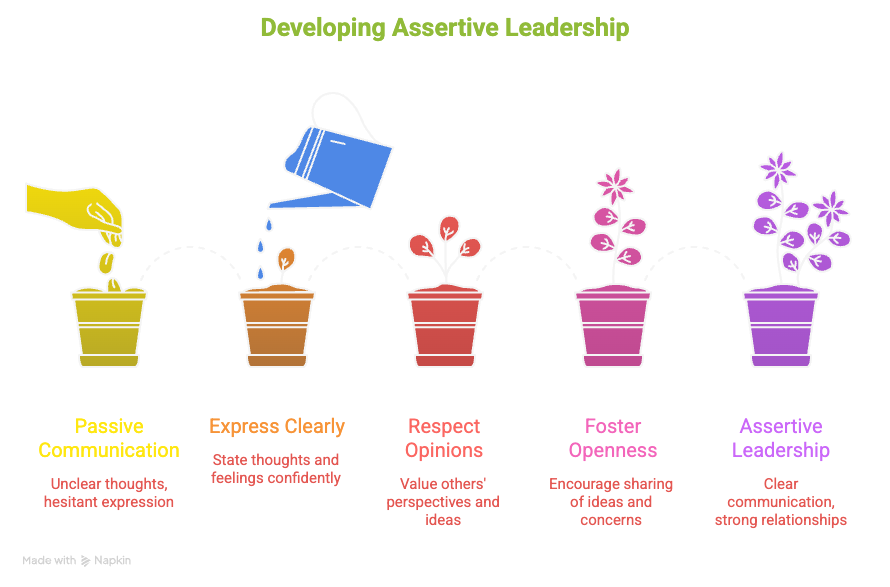
The Development of assertive leadership through stages such as passive communication, clear expression, and fostering openness.

Assertiveness is not pushing harder. It is removing ambiguity. It is raising the standard.

The most effective leaders do three things consistently.

They speak with clarity instead of uncertainty.
They give direct feedback instead of indirect hints.
They set boundaries that protect focus instead of allowing everything to expand by default.

Clarity gives people direction.
Direct feedback gives them improvement.
Boundaries give them confidence in what matters.

You do not need aggressive language to lead with authority. You need structure in your thinking, simplicity in your message, and conviction in your delivery.

Assertiveness is learned. It is practiced. It is earned.

Great communicators prepare before the moment. They decide the outcome they want. They sharpen the point they need to make. They remove the noise that usually dilutes the message.

Three practices elevate this skill.

First, define your objective before you speak. If the goal is unclear, the message will drift.
Second, use clear first person language. This creates accountability and reduces defensiveness.
Third, evaluate yourself after every important exchange. The small corrections compound into mastery.

Assertiveness is not a personality trait. It is a discipline that strengthens with repetition. It reshapes your posture, your tone, your timing. It shifts how the room responds to you.

The payoff is not personal confidence. The payoff is organizational clarity.

When a leader speaks with conviction, three things happen.

People know what to do.
People know why it matters.
People know how their work connects to the mission.

This reduces conflict, accelerates decisions, and builds a culture where direction is consistent. Teams stop guessing. Meetings move faster. Feedback becomes normal. Accountability feels natural rather than punitive.

Assertive communication is not a stylistic choice. It is a leadership requirement. It turns complexity into direction. It turns hesitation into momentum. It turns effort into results.

Clarity builds trust.
Conviction builds credibility.
Intent builds alignment.

That is the work. That is the standard. That is the path forward.

The Power of Character

Leadership is a fundamental aspect of every successful organization. However, there is one significant aspect of leadership that often gets overlooked – character. Character is more than ethics, it’s a crucial element that influences decision-making processes, overall performance, and the culture of an organization. When adequately fostered, character can become a competitive edge leading to better decisions and outcomes.

The Misunderstanding of Character

MIT research, sparked by the 2008 global economic crisis, involved interviewing over 300 business leaders across the globe. The consensus was clear – the character of leaders had significantly contributed to the crisis. However, the definition of character and whether it could be developed remained topics of contention.

Many leaders underestimate the concept of character, reducing it to ethics alone. This narrow perception is a significant oversight. Character forms the bedrock of judgment, impacting the choices made by individuals every minute, every day. It’s the micro-moments between stimulus and response where character-driven judgment comes into play.

The Impact of Character on Performance

Character-based judgment is a potent tool for superior performance, and its absence can explain instances of misconduct and poor decision-making. This was evident in high-profile cases like the global financial crisis, the Volkswagen emissions scandal, and the Boeing 737 Max tragedies. In these instances, there was ample technical competence, but character was noticeably missing. The fallout from these events underscores the impact of compromised character, showing how it can lead to a slippery slope of poor judgment and decision-making.

The Broader Influence of Character

While character undeniably supports ethical decision-making, its reach extends far beyond being “good.” Character influences individual well-being, fosters sustained excellence, and contributes to the overall health of an organization. It matters at all levels of the organization, not just in leadership. When we broaden our understanding of character, we can begin to see its influence in every aspect of our organizations.

In an era where organizations are constantly seeking competitive advantages, character offers a largely untapped resource. It’s time we recognized the significant role of character in shaping our organizational cultures and driving superior performance. After all, character is not just about being “good” – it’s about making good decisions, fostering positive relationships, and leading successful organizations. By nurturing character in our leaders and employees, we can build stronger, more resilient organizations that are not only successful but also contribute positively to society.