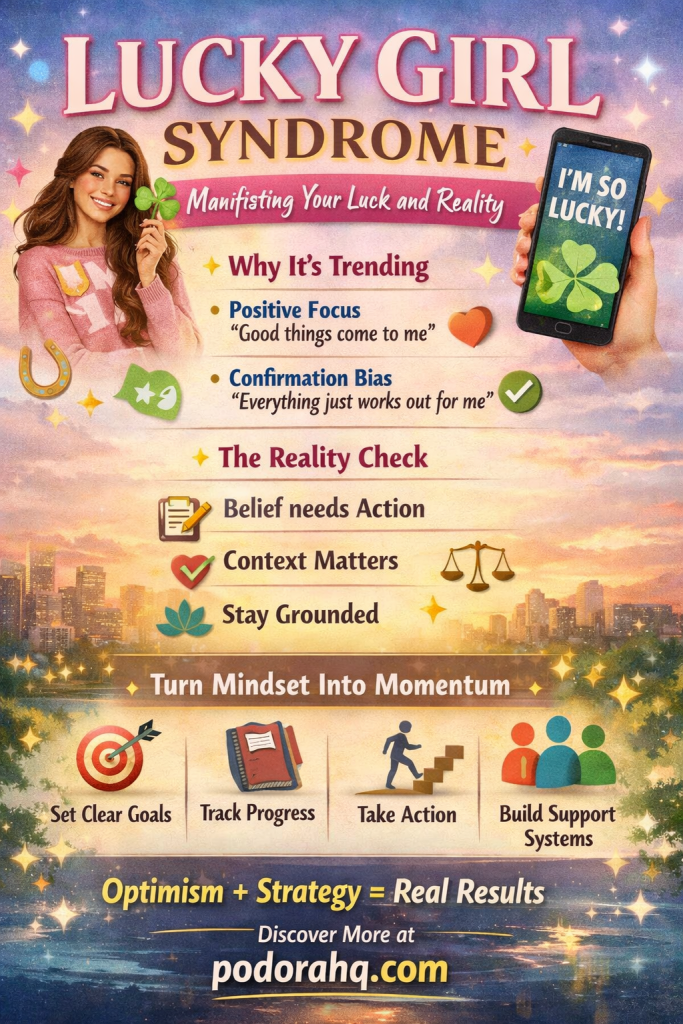
Lucky Girl Syndrome

In the age of TikTok trends and self-improvement mantras, Lucky Girl Syndrome has emerged as one of the most talked-about mindsets online. Millions of users are sharing videos and affirmations under the hashtag #LuckyGirlSyndrome, describing how adopting a “luck-first” mindset has changed their day-to-day experiences. But what is Lucky Girl Syndrome really, and how should you think about it in a practical way? 

The Trend That Took Off on Social Media

Lucky Girl Syndrome isn’t an official psychological diagnosis. It’s a phrase born out of social media culture especially TikTok that describes a form of manifestation and positive affirmation where people tell themselves things like “I am so lucky” or “everything just works out for me” with the belief that this mindset will attract better outcomes. 

Users describe everyday wins green lights, unexpected opportunities, smooth experiences as evidence that adopting these affirmations changed their luck. That perceived uplift in everyday moments is what keeps the phenomenon trending. 

What Makes It So Popular

At its core, Lucky Girl Syndrome taps into two psychological mechanisms:

1. Positive Focus: Repeating optimistic statements trains your brain to notice the good things around you. You start noticing opportunities you might have ignored before. 

2. Confirmation Bias: When you expect good things, you are more likely to remember the times things go well and overlook when they don’t. This strengthens the feeling that you’re “naturally lucky.” 

This combination makes the trend compelling. It feels empowering, it’s easy to practice, and it creates a sense of progress even before goals are achieved.

The Real Psychological Impact

Scientific research on positive thinking supports the idea that a hopeful mindset can influence stress, mood, motivation, and resilience. Optimism doesn’t make goals magically happen, but it can change how you approach challenges and setbacks. 

However, there are important caveats:

It’s not a substitute for action. Simply believing you’re lucky won’t replace planning, effort, and decision-making. Over-reliance on luck can create complacency or make setbacks harder to process. 

Context matters. Social media success stories often gloss over the work, privilege, support systems, or resources behind those outcomes. Not everyone starts from the same position, and that discrepancy matters. 

Positive thinking should be grounded. Mindfulness, realistic goal-setting, and self-compassion are ways to take the emotional benefits of positive thought without slipping into magical thinking or toxic positivity. 

Turning Mindset Into Momentum

Here’s how to make the trend work for you:

  • Start with realistic affirmations that reinforce effort as well as belief.
  • Journal both your progress and your learnings when things don’t go as planned.
  • Use positive thinking to bolster resilience, not to replace action.
  • Surround yourself with structures that support your goals: people, routines, systems.

If Lucky Girl Syndrome has something valuable to offer, it’s this: focusing on outcomes you want can help you frame your objectives and stay motivated. But the real results come when mindset meets strategy — clear goals, measurable progress, and consistent effort.

Lucky Girl Syndrome is more than a catchy hashtag. It reveals how powerful belief and attention are in shaping experience — but it also highlights the need for disciplined follow-through. Optimism can widen your lens. Strategy makes progress tangible.

For deeper insights on how to channel trends like this into meaningful personal growth and performance, explore podorahq.com.
10 Frameworks Used for Time Management

Most conversations about focus start in the wrong place.
They assume distraction is a failure of discipline.
They prescribe motivation, grit, or better habits.

focus, productivity, focus systems, time blocking, deep work, daily planning, execution over motivation, work design, attention management, knowledge work, high performance, founder productivity, executive productivity, burnout prevention, calendar discipline, task management, personal operating system, work smarter, intentional work, distraction control, modern work, systems thinking, planning your day, decision fatigue, cognitive load, async work, creator economy, startup life, leadership, self mastery

That framing is convenient and wrong.

Focus does not disappear because people lack willpower.
Focus disappears because the day is poorly designed.

You do not rise to the level of your goals.
You fall to the level of your systems.

This distinction matters because motivation is intermittent.
Systems operate continuously.

Why motivation keeps failing you

Motivation spikes and fades.
Energy fluctuates.
Attention degrades under noise.

Yet most productivity advice assumes you can repeatedly make high quality decisions in an environment full of interruptions. That assumption is false.

Environment and structure shape behavior whether you are alert or exhausted.
When focus breaks down, the cause is rarely effort.
It is friction, ambiguity, and constant renegotiation.

Focus is not summoned.
It is allowed.


The real problem: the unmanaged day

High performers are not short on ambition.
They are short on a repeatable daily operating system.

The same failure modes appear across roles and industries.

Tasks are scattered across email, chat, notes, and memory.
Calendars reflect meetings but ignore real work.
Days begin reactively, surrendered to the first notification.

The result is familiar.
Busyness without leverage.
Late nights fixing what should have been decided in the morning.

This is not a personal failing.
It is a systems failure.


What a real focus system must do

A functional focus system is not inspirational.
It is mechanical.
It works even on bad days.

At minimum, it must do three things.

Decide once
Define three to five outcomes that matter before the day starts.

Design the day
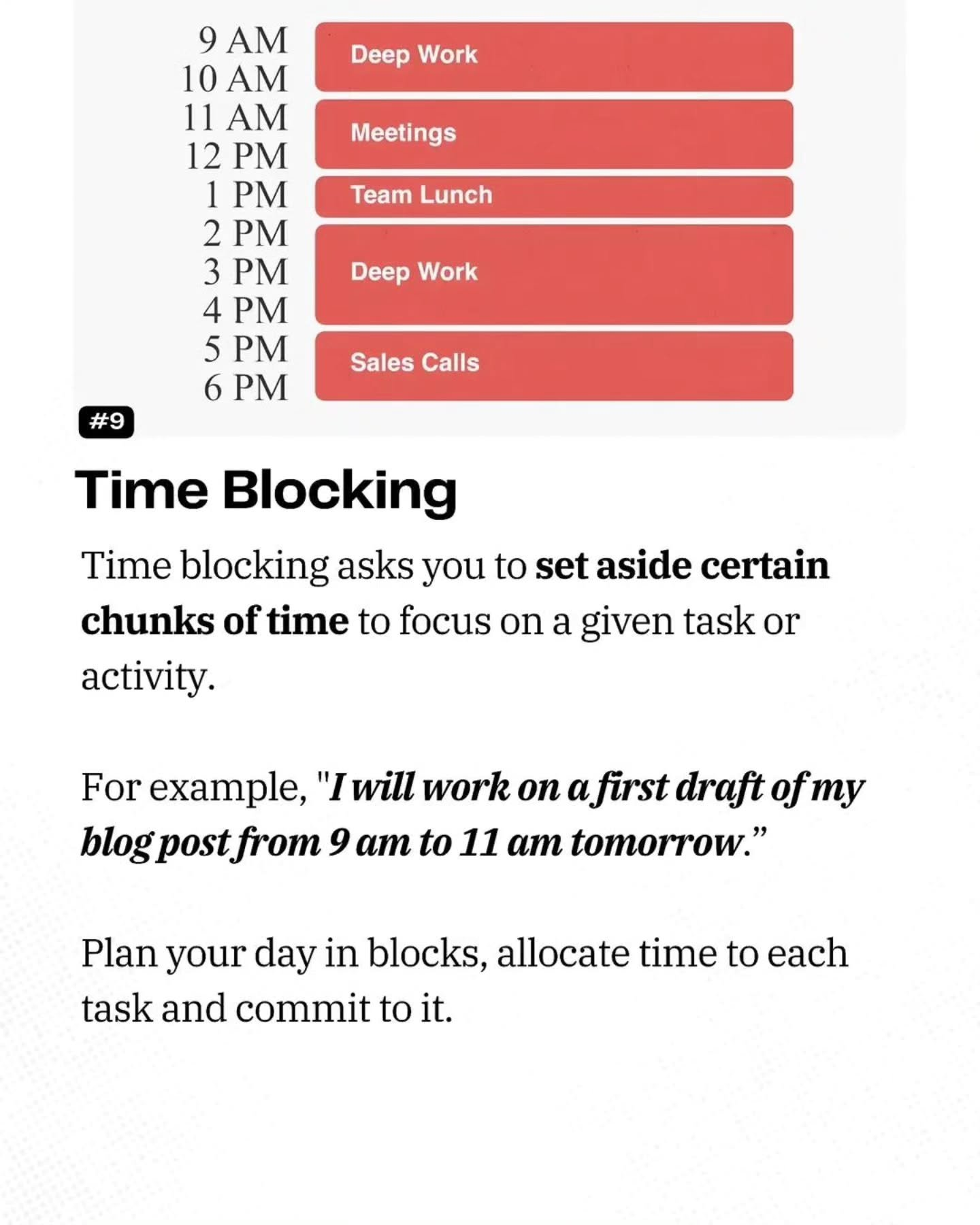
Translate those outcomes into explicit time blocks. Treat the calendar like a project plan.

Defend execution
Make distraction harder than staying on task.

Anything less is hope masquerading as planning.


Why tools matter more than techniques

Most people already know what they should do.
They still fail to do it.

The reason is friction.

If planning requires stitching together multiple tools, motivation is consumed before work begins.
If replanning is painful, people default to reacting.
If there is no feedback loop, the same mistakes repeat.

A system only works if it is easy to repeat.


How FocusDay fits

FocusDay is built around a single idea: remove friction from daily execution.

It does not try to motivate you.
It gives your day structure.

Practically, this means:

One place for the day
Instead of managing tasks across tools, your priorities live in one clean workspace. See how that works at https://usefocusday.com.

Time anchored work
Key tasks become calendar blocks, not vague intentions. Focus is tied to time, not mood. This is the core workflow shown on https://usefocusday.com.

Visible capacity
When everything sits on a timeline, overload is exposed early. Tradeoffs happen before the day collapses.

Execution feedback
Planned versus actual work is visible, allowing the system to improve instead of repeating the same errors.

The goal is simple.
You open FocusDay and the day is already decided.
Your job is execution, not hourly renegotiation.


A practical way to start today

Use FocusDay as the container for execution, not just another task list.

Morning
Open FocusDay before opening email.
Write the three outcomes that would make today successful.
Block time for each one. You can start this flow directly at https://usefocusday.com.

During the day
Work from the plan.
If something urgent appears, replan consciously inside FocusDay instead of letting it hijack the day.

Evening
Mark what was completed.
Adjust estimates.
Notice what consistently slips.

That pattern is not a character flaw.
It is a systems gap asking to be fixed.


The shift

Over time, focus stops being something you chase.
It becomes the default output of a well designed day.

Motivation becomes optional.
Clarity becomes automatic.
Progress becomes repeatable.

That is the difference between hoping to focus
and building a system that produces it.

If the problem is structural, the solution must be too.
That is exactly what FocusDay is built for.
Start by designing tomorrow at https://usefocusday.com.

When Someone Brings You a Problem, Ask this

It sounds easy. It looks gentle. But it changes the entire dynamic of how people approach you, how they think, and how they grow.

So what do you think you should do?

It Builds Confidence

Many people come to you with a problem because they believe your answer is better than theirs. As soon as you ask this question, you hand the thinking back to them. You let them see that their judgment matters. Confidence does not grow from outsourcing decisions. It grows from making them.

It Trains the Mind

Most problems are not solved by knowing every fact. They are solved by understanding the options, the tradeoffs, and the impact. When you ask this question, you force the person to walk through these steps. They learn to think through consequences. They learn to compare paths. They learn to slow down and choose.

It Reduces Dependence

If you answer every question, people stop thinking for themselves. If you ask them what they would do, they begin to trust their own reasoning. Over time, you spend less time firefighting and more time guiding. The person becomes someone who brings you solutions, not crises.

It Reveals Their True Concern

Sometimes the problem they share is not the real issue. When you ask what they think they should do, you uncover what they are afraid of, what they are unsure about, or where they are stuck. You hear their reasoning. You see the gap. You know exactly where to help.

It Creates Ownership

The moment someone says what they think the next step should be, they take responsibility for it. They are no longer waiting for your instruction. They are taking action. Leadership is not given. It is practiced. This question helps people practice.


One sentence that captures the idea:
When someone brings you a problem, the smartest thing you can do is ask the question that sends the thinking back to them.

Not to avoid solving, but to help them grow, to help them reason, and to help them become the kind of person who knows what to do next time.