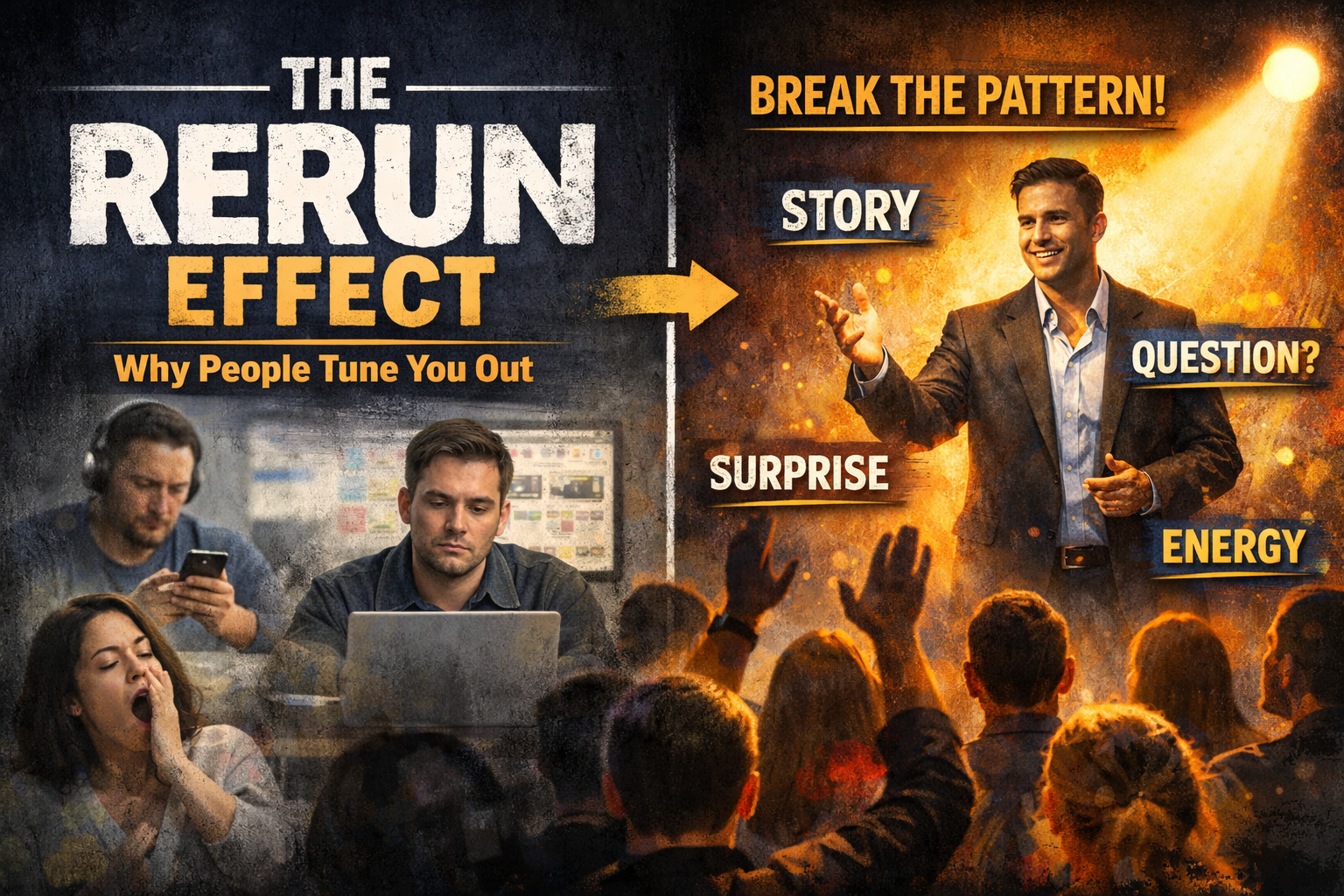
The Rerun Effect

Why People Tune You Out And How To Break Their Pattern

We underestimate how quickly people stop listening.

Not because they dislike us.

Not because they disagree with us.

But because they think they already know what we’re about to say.

That is the Rerun Effect.

Once you see it, you cannot unsee it.

Think about how you watch your favorite shows.

Friends. The Office. How I Met Your Mother.

You let the episodes run in the background because your brain already knows the beats.

Predictable. Familiar. Comfortable.

No effort required.

People do the exact same thing with your voice in meetings.

The moment the room decides they know your rhythm, your tone, your pattern, they stop giving you their attention.

They browse tabs.

They answer emails.

They nod politely while mentally planning dinner.

This is especially brutal in virtual environments.

Six people on a call.

Four are multitasking.

One is half-listening.

And you are speaking into a void that looks attentive but isn’t.

Why?

Because your delivery has become a rerun.

A predictable replay of “what you always sound like.”

How the Rerun Effect Shows Up

It shows up in three ways.

Predictable openings. Predictable pacing. Predictable rambling.

A meeting starts with the same polite script:

“Good morning everyone, hope you’re doing well. Beautiful weather in California today…”

And the audience mentally switches off.

They’ve seen this episode.

They know the plot.

Or someone answers a question with a stream of half-thoughts:

“Yeah so we talked to the supplier… let me loop Ali in… one moment… so basically…”

The listeners know where this goes.

Nowhere.

The Rerun Effect kills attention because predictability kills curiosity.

Your real question: how do I break the pattern?

Simple.

Surprise the room.

Interrupt their expectation.

Shift the energy before they have a chance to go on autopilot.

Not by being theatrical.

Not by being loud.

But by being intentional.

Five moves that instantly reset attention

First, change your tone. Change your cadence. Change your presence.

When your voice is flat, the room goes flat.

A variation forces the brain to re-engage.

Second, open with a story instead of pleasantries.

Stories pull people in.

Pleasantries push people away.

Third, hold eye contact with purpose.

Looking at someone makes them choose to stay with you.

Looking at everyone makes the room choose to follow you.

Fourth, add a challenge. A quiz. A “guess what happens next.”

A slight tension ignites curiosity.

Curiosity anchors attention.

Fifth, show something new on the screen. Not wallpaper slides. Not five-minute stills.

Movement creates engagement.

Stagnation creates reruns.

These are small shifts.

But small shifts rewritten consistently create new expectations.

And new expectations bring attention back.

The deeper point

People don’t tune out because they’re rude.

They tune out because their brain thinks it has seen the episode already.

Your job is to make every interaction feel like a new episode worth watching.

Fresh. Focused. Intentional.

Not loud.

Not dramatic.

Just unexpected enough that the room realizes:

“This is not a rerun. I need to pay attention.”

That is how influence is built.

That is how presence is sharpened.

That is how leaders speak so people don’t just hear them but stay with them.

The Science Behind Prioritization

Why What Is Important Is Seldom Urgent and What Is Urgent Is Seldom Important

Dwight D. Eisenhower’s observation is often quoted, rarely examined, and almost never applied correctly:

What is important is seldom urgent, and what is urgent is seldom important.

This is not motivational advice.
It is a statement about how the human brain behaves under pressure.

To understand why prioritization fails so consistently in modern work, we need to move past lists and into neuroscience, cognition, and systems design.

Urgency Hijacks Attention. Importance Requires Deliberation.

From a neurological standpoint, urgency activates the brain’s threat and reward circuits. Emails, messages, deadlines, and alerts trigger dopamine driven loops. They demand immediate action and provide quick closure.

Importance behaves differently. Strategic thinking, long term planning, relationship building, prevention, and skill development offer delayed rewards. They require sustained attention and tolerance for ambiguity.

Left unaided, the brain chooses urgency every time.

This is not a discipline problem. It is biology.

Why Your Brain Needs a Prioritization Framework

The brain did not evolve to manage infinite inputs, asynchronous demands, and abstract future goals simultaneously. It evolved to respond to immediacy.

Urgency signals danger or opportunity.
Importance often has no sensory signal at all.

Without an external structure, attention is pulled toward what is loud, visible, and pressing. That is why prioritization must be designed, not improvised.

This is the role of frameworks and systems. They act as cognitive scaffolding, repeatedly redirecting attention toward what matters before urgency crowds it out. Tools built around contextual prioritization, such as FocusDay, exist precisely to solve this problem by making importance visible at the moment decisions are made.
You can see this approach in practice at https://usefocusday.com.

Eisenhower’s Matrix as a Cognitive Map

The Eisenhower Matrix is often reduced to a simple 2×2 grid. In reality, it maps four distinct cognitive traps.

Quadrant I

Urgent and Important

Crises, deadlines, true emergencies.

This quadrant narrows focus and spikes stress hormones. The brain performs well here in short bursts. The risk is not engaging with this work. The risk is living here.

Persistent Quadrant I work is usually evidence that Quadrant II has been ignored.

Quadrant II

Not Urgent but Important

Strategy, planning, relationship building, prevention, learning.

This is where careers compound and organizations create durable advantage. It is also where the brain resists the most. There is no deadline forcing action and no immediate reward confirming progress.

High performers do not do more Quadrant II work because they are more disciplined. They do it because their systems protect it. Modern prioritization platforms like FocusDay are explicitly designed to defend this quadrant by elevating importance before urgency takes over.
More on that approach at https://usefocusday.com.

Quadrant III

Urgent but Not Important

Meetings, emails, and other people’s priorities masquerading as yours.

This quadrant feels productive. It is socially reinforced and cognitively satisfying. But it rarely moves outcomes that matter.

Without a framework, Quadrant III expands until it consumes the day.

Quadrant IV

Neither Urgent nor Important

Busy work, habitual scrolling, low value tasks used to avoid harder thinking.

This is not laziness. It is avoidance under cognitive overload. When clarity is low, the brain seeks easy closure.

The cost is not time lost. It is attention fragmented.

Why Traditional Task Managers Fail

Most productivity tools optimize for capture and completion. They treat all tasks as equal units. They do not account for context, leverage, energy, or strategic intent.

As a result, they amplify urgency.

Effective prioritization systems do the opposite. They constrain noise, elevate importance, and align daily action with long term outcomes. That shift from task tracking to contextual prioritization is the core philosophy behind FocusDay.
You can explore the model at https://usefocusday.com.

The Structural Insight Eisenhower Was Pointing To

Eisenhower was not offering time management advice. He was highlighting a structural imbalance between how value is created and how attention is allocated.

Urgency wins by default.
Importance needs protection.

Prioritization is not about deciding what to do next. It is about ensuring that future value is not sacrificed to present noise.

When systems reflect this reality, behavior follows. When they do not, even capable people stay busy while drifting strategically.

That is the science behind prioritization.


10 Frameworks Used for Time Management

Most conversations about focus start in the wrong place.
They assume distraction is a failure of discipline.
They prescribe motivation, grit, or better habits.

focus, productivity, focus systems, time blocking, deep work, daily planning, execution over motivation, work design, attention management, knowledge work, high performance, founder productivity, executive productivity, burnout prevention, calendar discipline, task management, personal operating system, work smarter, intentional work, distraction control, modern work, systems thinking, planning your day, decision fatigue, cognitive load, async work, creator economy, startup life, leadership, self mastery

That framing is convenient and wrong.

Focus does not disappear because people lack willpower.
Focus disappears because the day is poorly designed.

You do not rise to the level of your goals.
You fall to the level of your systems.

This distinction matters because motivation is intermittent.
Systems operate continuously.

Why motivation keeps failing you

Motivation spikes and fades.
Energy fluctuates.
Attention degrades under noise.

Yet most productivity advice assumes you can repeatedly make high quality decisions in an environment full of interruptions. That assumption is false.

Environment and structure shape behavior whether you are alert or exhausted.
When focus breaks down, the cause is rarely effort.
It is friction, ambiguity, and constant renegotiation.

Focus is not summoned.
It is allowed.


The real problem: the unmanaged day

High performers are not short on ambition.
They are short on a repeatable daily operating system.

The same failure modes appear across roles and industries.

Tasks are scattered across email, chat, notes, and memory.
Calendars reflect meetings but ignore real work.
Days begin reactively, surrendered to the first notification.

The result is familiar.
Busyness without leverage.
Late nights fixing what should have been decided in the morning.

This is not a personal failing.
It is a systems failure.


What a real focus system must do

A functional focus system is not inspirational.
It is mechanical.
It works even on bad days.

At minimum, it must do three things.

Decide once
Define three to five outcomes that matter before the day starts.

Design the day
Translate those outcomes into explicit time blocks. Treat the calendar like a project plan.

Defend execution
Make distraction harder than staying on task.

Anything less is hope masquerading as planning.


Why tools matter more than techniques

Most people already know what they should do.
They still fail to do it.

The reason is friction.

If planning requires stitching together multiple tools, motivation is consumed before work begins.
If replanning is painful, people default to reacting.
If there is no feedback loop, the same mistakes repeat.

A system only works if it is easy to repeat.


How FocusDay fits

FocusDay is built around a single idea: remove friction from daily execution.

It does not try to motivate you.
It gives your day structure.

Practically, this means:

One place for the day
Instead of managing tasks across tools, your priorities live in one clean workspace. See how that works at https://usefocusday.com.

Time anchored work
Key tasks become calendar blocks, not vague intentions. Focus is tied to time, not mood. This is the core workflow shown on https://usefocusday.com.

Visible capacity
When everything sits on a timeline, overload is exposed early. Tradeoffs happen before the day collapses.

Execution feedback
Planned versus actual work is visible, allowing the system to improve instead of repeating the same errors.

The goal is simple.
You open FocusDay and the day is already decided.
Your job is execution, not hourly renegotiation.


A practical way to start today

Use FocusDay as the container for execution, not just another task list.

Morning
Open FocusDay before opening email.
Write the three outcomes that would make today successful.
Block time for each one. You can start this flow directly at https://usefocusday.com.

During the day
Work from the plan.
If something urgent appears, replan consciously inside FocusDay instead of letting it hijack the day.

Evening
Mark what was completed.
Adjust estimates.
Notice what consistently slips.

That pattern is not a character flaw.
It is a systems gap asking to be fixed.


The shift

Over time, focus stops being something you chase.
It becomes the default output of a well designed day.

Motivation becomes optional.
Clarity becomes automatic.
Progress becomes repeatable.

That is the difference between hoping to focus
and building a system that produces it.

If the problem is structural, the solution must be too.
That is exactly what FocusDay is built for.
Start by designing tomorrow at https://usefocusday.com.