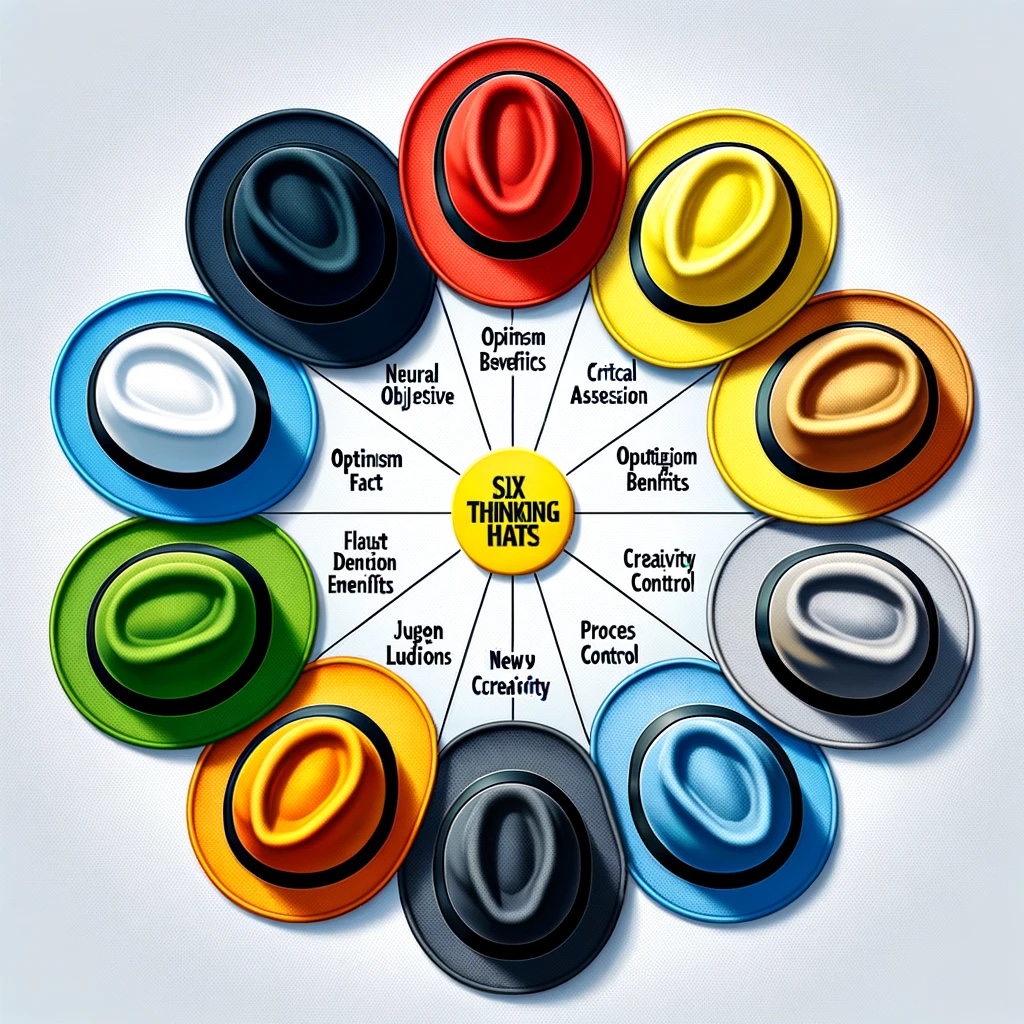
Always approach problem-solving using the Six Thinking Hats framework, which is a valuable tool for examining issues from various perspectives:
White Hat (Facts and Information): Start by gathering all the available data and facts related to the problem. What do we know?
Red Hat (Emotions and Feelings): Consider the emotional aspects of the problem. How do you and your team feel about it? What are your initial gut reactions?
Black Hat (Critical Thinking): Analyze the potential drawbacks, risks, and challenges associated with the problem. What are the potential pitfalls and obstacles?
Yellow Hat (Optimism and Positivity): Focus on the positive aspects and opportunities that may arise from solving the problem. What are the potential benefits and solutions?
Green Hat (Creativity and Innovation): Encourage creative thinking and brainstorming for new ideas and solutions. What innovative approaches can you explore?
Blue Hat (Process Control): Finally, take control of the thinking process. Summarize the insights gained from the other hats, prioritize actions, and outline a plan to address the problem. What’s the next step?
By systematically examining the problem from these different angles, you can arrive at a well-rounded and thoughtful solution.
In the ever-evolving world of business, the ability to think strategically is paramount. One useful tool in this endeavor is the ‘Strategic Thinking MicroSkill Cheat Sheet’. By dividing strategic thinking into three main pillars – Logical, Creative, and Emotional – this cheat sheet provides a roadmap for honing our strategic prowess. Let’s delve deeper.
1. Logical Skills in Strategic Thinking: These skills provide the foundation for critical thinking, problem-solving, and decision-making.
Anticipation: Predicting future changes or challenges allows companies to be proactive rather than reactive.
Meta-cognition: Understanding one’s own cognitive biases can prevent costly mistakes.
High-quality questions: Instead of asking, “Is our strategy working?”, ask, “What conditions make our strategy effective?”
Insight: Logical skills are all about connecting the dots and understanding the bigger picture. It’s not just about having the answers but asking the right questions.
2. Creative Skills in Strategic Thinking: These skills bring innovation and adaptability to the forefront.
Storytelling: A well-crafted narrative can be more persuasive than a data-packed report.
Contrarianism: Sometimes, going against the grain can lead to breakthroughs.
Devalorization: Re-assessing and challenging established norms keeps businesses adaptable.
Insight: Creativity in strategic thinking isn’t just about new ideas; it’s about seeing old challenges in a new light and daring to challenge the status quo.
3. Emotional Skills in Strategic Thinking: These skills anchor decisions in empathy and self-awareness.
Empathy: Truly understanding your customer’s or team’s perspective can lead to more nuanced strategies.
Courage: The business landscape is filled with uncertainty. Having the courage to take calculated risks can set companies apart.
Self-awareness: Recognizing one’s own strengths and weaknesses can guide better decision-making.
Insight: Emotions drive decisions. By understanding and harnessing emotions, businesses can craft more effective and resonant strategies.
The ‘Strategic Thinking MicroSkill Cheat Sheet’ isn’t just a list of skills; it’s a blueprint for success. By understanding and cultivating these skills, we can navigate the complex waters of business with confidence and foresight.
In the complex world of executive leadership, the “4 Stages of Competence” framework serves as a compass, guiding us through the intricate landscape of professional development. This framework is not merely a theoretical construct; it’s a strategic tool that resonates with the journey of a CEO. Allow me to elucidate this concept through an analogy that parallels the stages of competence with the navigation of a corporate leader.
1. Unconscious Incompetence: The Unexplored Territory
Imagine embarking on a journey into an uncharted market. The landscape is unfamiliar, and the rules of engagement are unknown. This stage, known as “Unconscious Incompetence,” is characterized by a lack of awareness of the skills and knowledge required to succeed.
Analogy: It’s akin to entering a new market without recognizing the unique dynamics, regulations, and customer behaviors that govern it.
2. Conscious Incompetence: The Awakening of Insight
As the exploration advances, the complexities and challenges become apparent. This stage, termed “Conscious Incompetence,” is marked by the realization of one’s limitations and the understanding of the skills that must be acquired.
Analogy: It’s the moment a CEO recognizes the need for specific market intelligence, cultural understanding, and strategic alliances but has yet to develop these competencies.
3. Conscious Competence: The Strategic Alignment
With determination and strategic investment in learning and development, the necessary skills are cultivated. This stage, known as “Conscious Competence,” requires deliberate focus and effort to apply the newly acquired competencies effectively.
Analogy: It’s the phase where a CEO can navigate the new market landscape, leveraging insights and alliances, but it requires conscious strategic planning and execution.
4. Unconscious Competence: The Mastery of Leadership
Over time, the once novel skills become ingrained and are executed with natural ease. This stage, “Unconscious Competence,” signifies a level of mastery where complex decisions and strategies are executed effortlessly.
Analogy: It’s the point where a CEO intuitively understands the market dynamics, cultural nuances, and strategic levers, leading with an innate wisdom that transcends conscious thought.
The Executive’s Navigation
The 4 Stages of Competence is more than a developmental framework; it’s a navigation system for the executive leader. It provides a roadmap for personal growth, team development, and organizational excellence.
For CEOs and top-level executives, this framework offers a sophisticated lens through which to view leadership development. It’s a compass that guides not only the individual leader but the entire organization towards a state of mastery.
In the ever-evolving landscape of global business, the ability to navigate through these stages is not merely a skill; it’s a strategic imperative. It’s the compass that steers the corporate ship through uncharted waters towards success, innovation, and excellence.
Embrace this journey, for the compass of competence is in your hands, and the horizon of mastery awaits your exploration.

 Maverick