How to Be a Better Leader by Communicating More Assertively

Lead with Clarity. Lead with Conviction. Lead with Intent.

Leadership often fails not because of strategy or talent, but because the message never lands with the force it needs. People follow direction only when they understand it, trust it, and feel the confidence behind it. That is the real work of assertive communication. It sits between silence and force. It allows you to say what needs to be said with clarity, with steadiness, and with respect.

Assertiveness is not volume. It is not dominance. It is the ability to speak with a clear mind, a steady tone, and a firm sense of what matters. When you communicate this way, people understand your expectations, your standards, and your priorities. They know you are present. They know you are intentional. They know you are accountable.
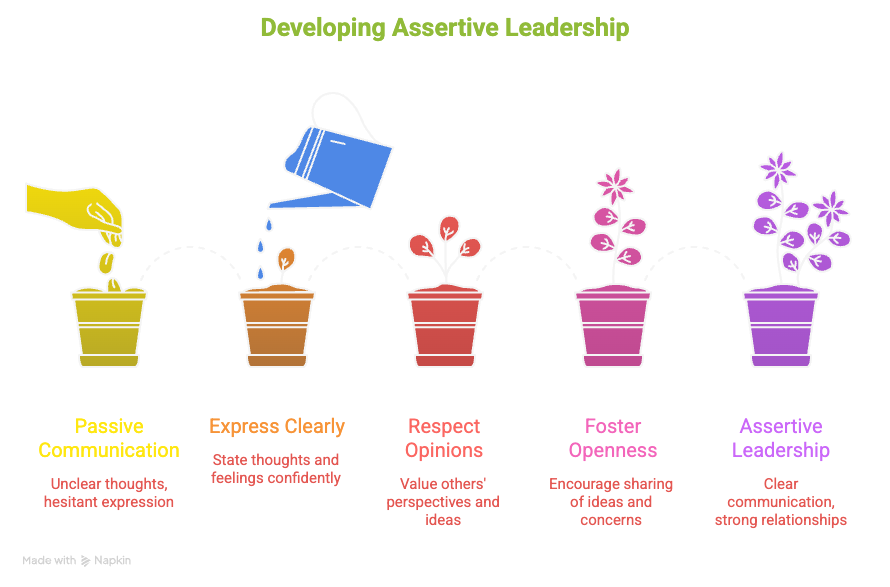
The Development of assertive leadership through stages such as passive communication, clear expression, and fostering openness.

Assertiveness is not pushing harder. It is removing ambiguity. It is raising the standard.

The most effective leaders do three things consistently.

They speak with clarity instead of uncertainty.
They give direct feedback instead of indirect hints.
They set boundaries that protect focus instead of allowing everything to expand by default.

Clarity gives people direction.
Direct feedback gives them improvement.
Boundaries give them confidence in what matters.

You do not need aggressive language to lead with authority. You need structure in your thinking, simplicity in your message, and conviction in your delivery.

Assertiveness is learned. It is practiced. It is earned.

Great communicators prepare before the moment. They decide the outcome they want. They sharpen the point they need to make. They remove the noise that usually dilutes the message.

Three practices elevate this skill.

First, define your objective before you speak. If the goal is unclear, the message will drift.
Second, use clear first person language. This creates accountability and reduces defensiveness.
Third, evaluate yourself after every important exchange. The small corrections compound into mastery.

Assertiveness is not a personality trait. It is a discipline that strengthens with repetition. It reshapes your posture, your tone, your timing. It shifts how the room responds to you.

The payoff is not personal confidence. The payoff is organizational clarity.

When a leader speaks with conviction, three things happen.

People know what to do.
People know why it matters.
People know how their work connects to the mission.

This reduces conflict, accelerates decisions, and builds a culture where direction is consistent. Teams stop guessing. Meetings move faster. Feedback becomes normal. Accountability feels natural rather than punitive.

Assertive communication is not a stylistic choice. It is a leadership requirement. It turns complexity into direction. It turns hesitation into momentum. It turns effort into results.

Clarity builds trust.
Conviction builds credibility.
Intent builds alignment.

That is the work. That is the standard. That is the path forward.

Executive Communication: Five Immutable Rules

Photo by Matheus Natan on Pexels.com

Effective communication is not a one-size-fits-all endeavor; it’s a nuanced skill requiring adaptability and precision, especially when interacting with executive leadership. In corporate hierarchies, effective communication with executives sets the tone for a relationship marked by trust, value, and long-term engagement. This blog post elucidates five rules that are critical for mastering the art of executive communication.

Rule #1: Elevate Your Perspective – Escape the Minutiae

Executives often operate at an altitude where minutiae blur into the backdrop, overshadowed by overarching goals and strategic imperatives. The daily grind might be crucial to operational effectiveness, but when communicating with executives, it’s pivotal to rise above the operational details.

In one of my early career interactions with a C-suite executive, I started explaining the nuances of a project. Within minutes, the executive interrupted, saying, “Give me the 30,000-foot view.” That incident was a paradigm shift in how I approached executive communication thereafter.

Photo by Bess Hamiti on Pexels.com

Rule #2: Exude Confidence

Nothing builds credibility faster than a demeanor marked by unshakable confidence. Executives are more likely to invest their trust and resources in individuals who radiate assurance and poise.

I remember walking into a high-stakes meeting where multimillion-dollar decisions were on the table. When I presented our department’s strategy, I conveyed absolute confidence. The result? Our budget got approved without a single alteration.

Photo by Christina Morillo on Pexels.com

Rule #3: Align with Financial and Strategic Objectives

To resonate with executives, frame discussions in terms of ROI, profitability, and market relevance. Articulate your plans by highlighting their contributions to the organizational bottom line.

When I had to pitch a new initiative to our CEO, I chose to focus on its impact on market penetration and shareholder value. This alignment instantly grabbed the CEO’s attention, cutting through the noise of other competing initiatives.

Photo by Tima Miroshnichenko on Pexels.com

Rule #4: Adapt to Their Time Frames

Executives think in terms of quarterly results, yearly achievements, and multi-year strategies. Understand this elongated time frame and frame your contributions accordingly. Alignment in time frames builds rapport and facilitates trust.

During a strategy meeting, our COO was looking 5 years ahead. When I presented my department’s 3-year plan in that context, the entire room felt a palpable alignment.

Photo by cottonbro studio on Pexels.com

Rule #5: Exercise Business Acumen

Being tactically skilled is a given; what sets you apart is strategic foresight. Exhibit your grasp on market trends, profitability drivers, and value addition to align with executives’ overarching business goals.

When our company was at a strategic crossroads, I was asked for an opinion. Instead of picking sides, I presented a SWOT analysis showing how each option would affect the company’s market position. My business acumen was appreciated and became a crucial part of the decision-making process.

Photo by Anna Nekrashevich on Pexels.com

Final Thoughts

In the world of executive communication, there is no room for mediocrity. It demands a specialized set of skills—conciseness, confidence, and alignment with both financial goals and time frames, bolstered by a deep-seated understanding of business imperatives.

If you find yourself making common mistakes in executive interactions, such as being overly verbose or failing to align with financial objectives, consider executive coaching. It’s an investment that pays dividends in enhancing your career trajectory.

To discuss personalized coaching opportunities, please book a call with the speaker.

Your mastery in communicating with executives could be the defining factor in propelling you into their inner circle, thereby unlocking avenues for influence, impact, and career progression.

What rule resonated the most with you? Share your thoughts in the comments below.

Subscribe for weekly insights on achieving executive-level positions and career advancement.

Video: Tips for Effective Executive Communication


Disclaimer: All experiences shared are based on personal observations and are intended to aid readers in improving their communication skills. Names and specific situations have been altered to protect confidentiality.