How to Be a Better Leader by Communicating More Assertively

Lead with Clarity. Lead with Conviction. Lead with Intent.

Leadership often fails not because of strategy or talent, but because the message never lands with the force it needs. People follow direction only when they understand it, trust it, and feel the confidence behind it. That is the real work of assertive communication. It sits between silence and force. It allows you to say what needs to be said with clarity, with steadiness, and with respect.

Assertiveness is not volume. It is not dominance. It is the ability to speak with a clear mind, a steady tone, and a firm sense of what matters. When you communicate this way, people understand your expectations, your standards, and your priorities. They know you are present. They know you are intentional. They know you are accountable.
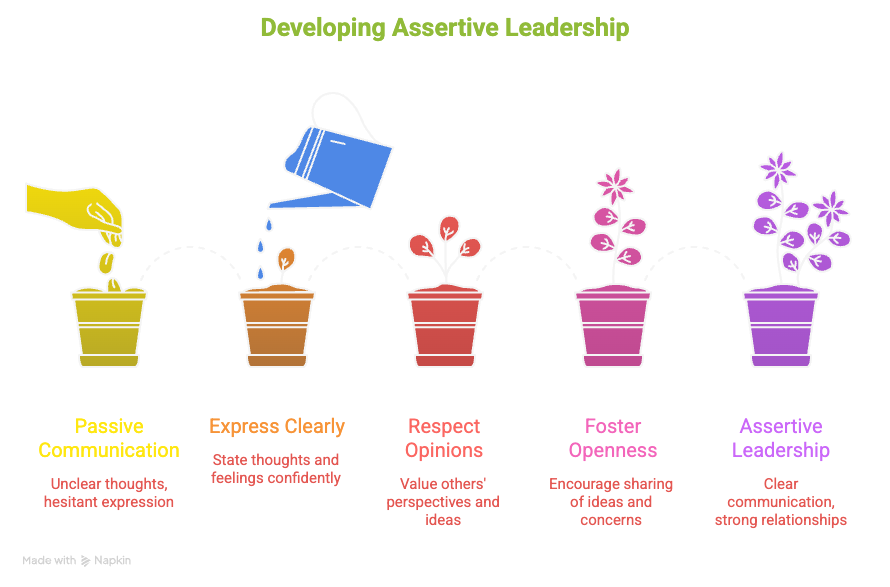
The Development of assertive leadership through stages such as passive communication, clear expression, and fostering openness.

Assertiveness is not pushing harder. It is removing ambiguity. It is raising the standard.

The most effective leaders do three things consistently.

They speak with clarity instead of uncertainty.
They give direct feedback instead of indirect hints.
They set boundaries that protect focus instead of allowing everything to expand by default.

Clarity gives people direction.
Direct feedback gives them improvement.
Boundaries give them confidence in what matters.

You do not need aggressive language to lead with authority. You need structure in your thinking, simplicity in your message, and conviction in your delivery.

Assertiveness is learned. It is practiced. It is earned.

Great communicators prepare before the moment. They decide the outcome they want. They sharpen the point they need to make. They remove the noise that usually dilutes the message.

Three practices elevate this skill.

First, define your objective before you speak. If the goal is unclear, the message will drift.
Second, use clear first person language. This creates accountability and reduces defensiveness.
Third, evaluate yourself after every important exchange. The small corrections compound into mastery.

Assertiveness is not a personality trait. It is a discipline that strengthens with repetition. It reshapes your posture, your tone, your timing. It shifts how the room responds to you.

The payoff is not personal confidence. The payoff is organizational clarity.

When a leader speaks with conviction, three things happen.

People know what to do.
People know why it matters.
People know how their work connects to the mission.

This reduces conflict, accelerates decisions, and builds a culture where direction is consistent. Teams stop guessing. Meetings move faster. Feedback becomes normal. Accountability feels natural rather than punitive.

Assertive communication is not a stylistic choice. It is a leadership requirement. It turns complexity into direction. It turns hesitation into momentum. It turns effort into results.

Clarity builds trust.
Conviction builds credibility.
Intent builds alignment.

That is the work. That is the standard. That is the path forward.

The Rerun Effect

Why People Tune You Out And How To Break Their Pattern

We underestimate how quickly people stop listening.

Not because they dislike us.

Not because they disagree with us.

But because they think they already know what we’re about to say.

That is the Rerun Effect.

Once you see it, you cannot unsee it.

Think about how you watch your favorite shows.

Friends. The Office. How I Met Your Mother.

You let the episodes run in the background because your brain already knows the beats.

Predictable. Familiar. Comfortable.

No effort required.

People do the exact same thing with your voice in meetings.

The moment the room decides they know your rhythm, your tone, your pattern, they stop giving you their attention.

They browse tabs.

They answer emails.

They nod politely while mentally planning dinner.

This is especially brutal in virtual environments.

Six people on a call.

Four are multitasking.

One is half-listening.

And you are speaking into a void that looks attentive but isn’t.

Why?

Because your delivery has become a rerun.

A predictable replay of “what you always sound like.”

How the Rerun Effect Shows Up

It shows up in three ways.

Predictable openings. Predictable pacing. Predictable rambling.

A meeting starts with the same polite script:

“Good morning everyone, hope you’re doing well. Beautiful weather in California today…”

And the audience mentally switches off.

They’ve seen this episode.

They know the plot.

Or someone answers a question with a stream of half-thoughts:

“Yeah so we talked to the supplier… let me loop Ali in… one moment… so basically…”

The listeners know where this goes.

Nowhere.

The Rerun Effect kills attention because predictability kills curiosity.

Your real question: how do I break the pattern?

Simple.

Surprise the room.

Interrupt their expectation.

Shift the energy before they have a chance to go on autopilot.

Not by being theatrical.

Not by being loud.

But by being intentional.

Five moves that instantly reset attention

First, change your tone. Change your cadence. Change your presence.

When your voice is flat, the room goes flat.

A variation forces the brain to re-engage.

Second, open with a story instead of pleasantries.

Stories pull people in.

Pleasantries push people away.

Third, hold eye contact with purpose.

Looking at someone makes them choose to stay with you.

Looking at everyone makes the room choose to follow you.

Fourth, add a challenge. A quiz. A “guess what happens next.”

A slight tension ignites curiosity.

Curiosity anchors attention.

Fifth, show something new on the screen. Not wallpaper slides. Not five-minute stills.

Movement creates engagement.

Stagnation creates reruns.

These are small shifts.

But small shifts rewritten consistently create new expectations.

And new expectations bring attention back.

The deeper point

People don’t tune out because they’re rude.

They tune out because their brain thinks it has seen the episode already.

Your job is to make every interaction feel like a new episode worth watching.

Fresh. Focused. Intentional.

Not loud.

Not dramatic.

Just unexpected enough that the room realizes:

“This is not a rerun. I need to pay attention.”

That is how influence is built.

That is how presence is sharpened.

That is how leaders speak so people don’t just hear them but stay with them.

When Someone Brings You a Problem, Ask this

It sounds easy. It looks gentle. But it changes the entire dynamic of how people approach you, how they think, and how they grow.

So what do you think you should do?

It Builds Confidence

Many people come to you with a problem because they believe your answer is better than theirs. As soon as you ask this question, you hand the thinking back to them. You let them see that their judgment matters. Confidence does not grow from outsourcing decisions. It grows from making them.

It Trains the Mind

Most problems are not solved by knowing every fact. They are solved by understanding the options, the tradeoffs, and the impact. When you ask this question, you force the person to walk through these steps. They learn to think through consequences. They learn to compare paths. They learn to slow down and choose.

It Reduces Dependence

If you answer every question, people stop thinking for themselves. If you ask them what they would do, they begin to trust their own reasoning. Over time, you spend less time firefighting and more time guiding. The person becomes someone who brings you solutions, not crises.

It Reveals Their True Concern

Sometimes the problem they share is not the real issue. When you ask what they think they should do, you uncover what they are afraid of, what they are unsure about, or where they are stuck. You hear their reasoning. You see the gap. You know exactly where to help.

It Creates Ownership

The moment someone says what they think the next step should be, they take responsibility for it. They are no longer waiting for your instruction. They are taking action. Leadership is not given. It is practiced. This question helps people practice.


One sentence that captures the idea:
When someone brings you a problem, the smartest thing you can do is ask the question that sends the thinking back to them.

Not to avoid solving, but to help them grow, to help them reason, and to help them become the kind of person who knows what to do next time.