The notion that the world’s wealth is a fixed pie, to be divvied up among us, is an enduring myth that persists from the playgrounds of our youth to the boardrooms of our adult lives. This childhood misconception leads many to view the economy as a zero-sum game, where one person’s gain is another’s loss. However, this is the Pie Fallacy—a misleading belief that fails to recognize the dynamic nature of wealth creation.
“Wealth is not about having a lot of money; it’s about having a lot of options.” – Chris Rock
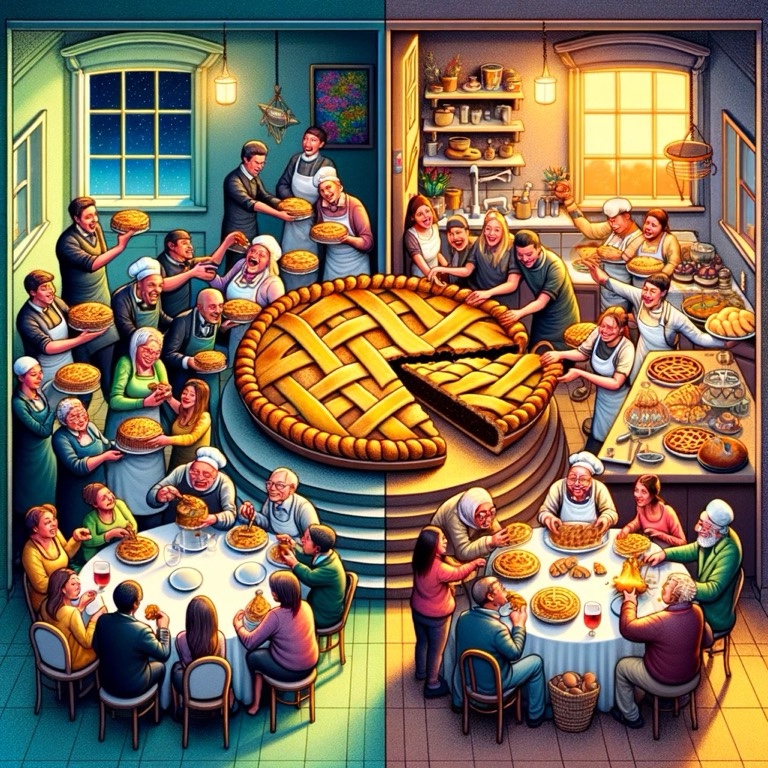
Wealth is not a stagnant pond but a spring, continuously fed by the streams of innovation, labor, and entrepreneurship. The concept of money, often mistaken for wealth itself, is merely a facilitator, a means of exchanging the value that we create. The static view of wealth overlooks the fact that every day, individuals and businesses are engaged in activities that expand the pie for everyone.
Consider the example of technology startups that have revolutionized industries and created services that were previously unimaginable. These companies didn’t take a larger slice of the pie from others; they baked a whole new one. When you download a new app that simplifies your life or use a service that saves you time, you’re witnessing the expansion of wealth.
The same principle applies on a more personal scale. When someone restores an old car, they aren’t merely transferring wealth from one place to another; they are adding value through their skills and effort. The car, once a rusting hulk, is transformed into a valuable classic. Its increased value is a direct result of human ingenuity and hard work, not the deprivation of another.
This truth has profound implications for how we approach wealth as a society. Policies aimed at merely redistributing wealth, while sometimes necessary, don’t address the core engine of economic growth: wealth creation. Encouraging innovation, protecting intellectual property rights, and fostering a business environment where new ideas can flourish—these are the keys to expanding the pie for everyone.
In dispelling the Pie Fallacy, we must embrace the idea that wealth is not finite. Our economic system thrives on the creation of value, not the mere circulation of currency. As we innovate and build, as we refine and improve, the pie grows, and with it, the potential for prosperity for all. Understanding this is crucial for developing economic policies that foster growth and opportunity, rather than just redistributing a falsely perceived limited resource.
The Pie Fallacy should be left in the past, along with other childhood myths. It’s time to recognize the boundless nature of human potential to generate wealth, ensuring that the pie doesn’t just get sliced more thinly, but that it gets bigger and better for everyone partaking in it.
 Maverick