Right or Wrong Is the Wrong Question. The Real Question Is How You Got There
Most debates collapse into a tired binary. Right versus wrong. Agree versus disagree. Win versus lose.
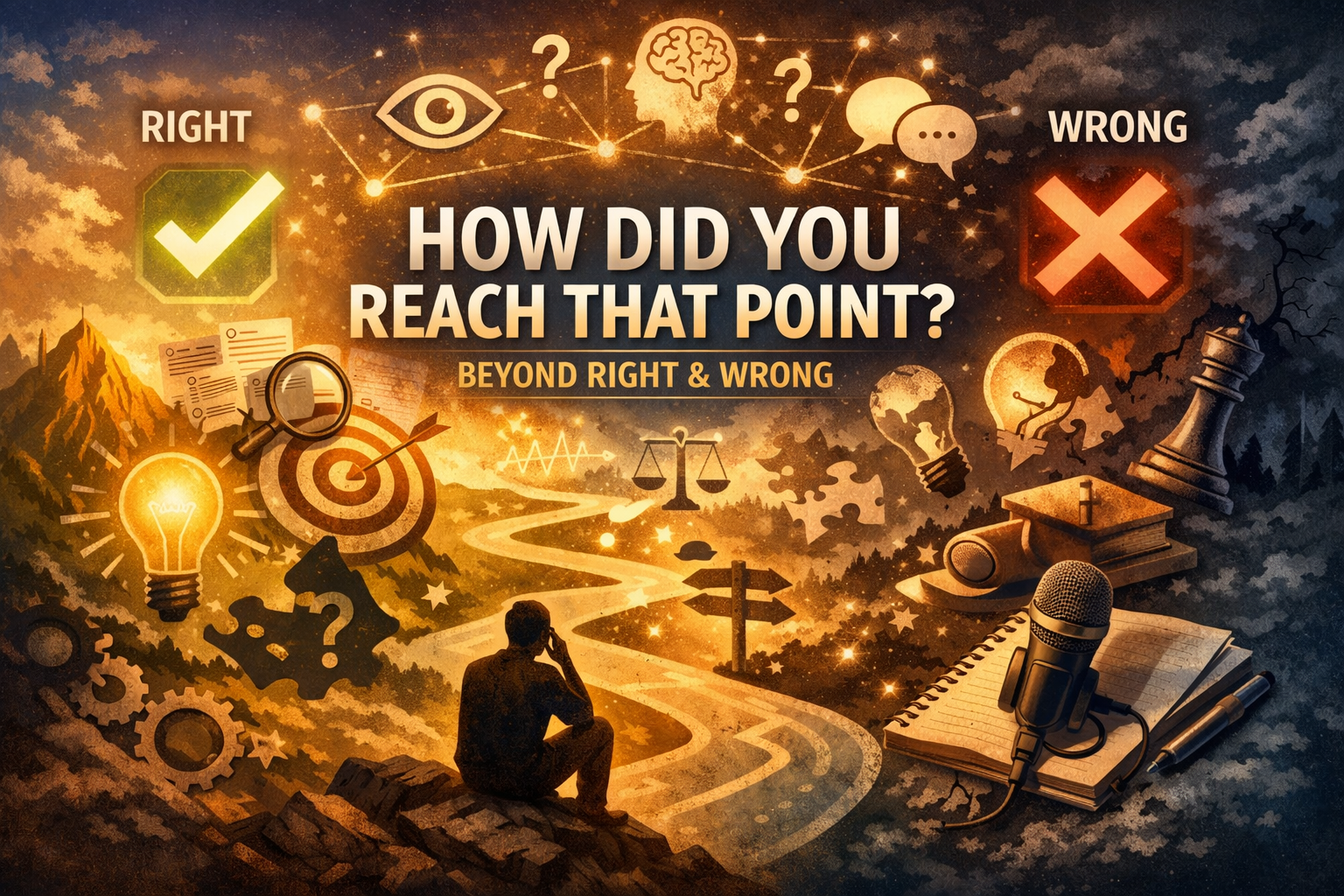
That framing is lazy.
In real decision making, in leadership, in strategy, in personal growth, outcomes matter less than the thinking that produced them. Two people can land on the same answer for entirely different reasons. One path is sound. The other is fragile. The result may look identical today, but only one of those paths scales tomorrow.
The uncomfortable truth is this.
Most people cannot explain how they reached their conclusion. They only know what they believe.
That gap matters.
Outcomes Are Noisy. Thinking Is Not.
Outcomes are polluted by timing, luck, incomplete information, and external forces you do not control. A bad decision can look brilliant in the short term. A sound decision can fail due to factors no one could reasonably anticipate.
If you judge thinking by outcome alone, you train yourself to chase validation instead of clarity.
Serious thinkers reverse the order.
They ask three questions.
What information did I privilege
What assumptions did I accept
What reasoning steps did I follow
Only after that do they evaluate whether the conclusion holds.
This is how experienced operators separate signal from noise.
Most Opinions Are Post-Rationalized Instincts
Here is the uncomfortable part most people avoid.
The majority of opinions are not reasoned. They are felt first, then justified later.
The brain is remarkably good at constructing explanations that feel logical while quietly protecting identity, ego, or tribe. This is not a character flaw. It is a human default.
The danger appears when people confuse justification with reasoning.
Reasoning is directional. It moves from premises to conclusion.
Justification is defensive. It moves from conclusion backward.
Once you see the difference, you cannot unsee it.
The Hidden Skill: Making Your Thinking Inspectable
High leverage thinkers do one thing differently.
They make their thinking visible.
They externalize their reasoning. They capture how ideas formed, what evidence influenced them, what doubts existed along the way, what changed their mind, and what still feels unresolved.
This is not journaling for therapy.
This is building an audit trail for your mind.
When thinking stays internal, it feels coherent even when it is not. When thinking is externalized, weak links surface quickly.
This is why writing, speaking, and structured reflection sharpen judgment faster than passive consumption ever will.
It is also why platforms that capture thinking, not just outcomes, quietly compound intellectual advantage over time.
Why Smart People Disagree More Than You Think
When two capable people disagree, the difference is rarely intelligence. It is usually one of three things.
They started with different assumptions
They weighted evidence differently
They optimized for different constraints
Arguing about the conclusion skips the real work.
The real work is mapping the path.
Once you understand the path, disagreement becomes productive. You can examine premises. You can challenge weights. You can adjust constraints.
Without that, debate devolves into posture.
Thinking in Public Forces Better Thinking in Private
There is a reason founders, researchers, and serious builders talk through ideas out loud.
When thinking is shared, even imperfectly, it becomes accountable.
You notice gaps you ignored.
You hear contradictions you rationalized.
You detect overconfidence you did not feel internally.
This is not about performance. It is about pressure testing.
This is also why audio has become a powerful medium for thinking. Speaking forces sequence. You cannot hide behind reordering paragraphs after the fact. You move forward in time, thought by thought.
Platforms like https://podorahq.com exist precisely for this reason. They are not about polished conclusions. They are about preserving the intellectual journey. The false starts. The pivots. The moments where certainty softened into nuance.
That record becomes a personal knowledge asset over time.
The Long-Term Advantage of Process-Oriented Thinking
People who focus only on being right plateau.
People who focus on how they think keep improving.
Process oriented thinkers do three things consistently.
They revisit old beliefs without defensiveness
They track how their thinking evolves over time
They separate identity from opinion
This compounds.
Five years later, they are not just more informed. They are structurally better thinkers.
They make fewer unforced errors. They adapt faster. They hold complexity without collapsing into certainty too early.
If You Care About Truth, Start With Your Method
Truth is not a destination. It is an asymptote.
You do not arrive. You approach.
The only way to move closer is to improve the method, not obsess over the last answer you happened to land on.
Ask yourself this instead of asking if you are right.
What did I assume
What did I ignore
What would change my mind
If you cannot answer those, the conclusion does not matter yet.
And if you want a durable place to capture, revisit, and refine that thinking over time, https://podorahq.com is built for exactly that purpose.
Not to declare certainty.
But to document the path that led you there.


 Maverick