How to Be a Better Leader by Communicating More Assertively

Lead with Clarity. Lead with Conviction. Lead with Intent.

Leadership often fails not because of strategy or talent, but because the message never lands with the force it needs. People follow direction only when they understand it, trust it, and feel the confidence behind it. That is the real work of assertive communication. It sits between silence and force. It allows you to say what needs to be said with clarity, with steadiness, and with respect.

Assertiveness is not volume. It is not dominance. It is the ability to speak with a clear mind, a steady tone, and a firm sense of what matters. When you communicate this way, people understand your expectations, your standards, and your priorities. They know you are present. They know you are intentional. They know you are accountable.
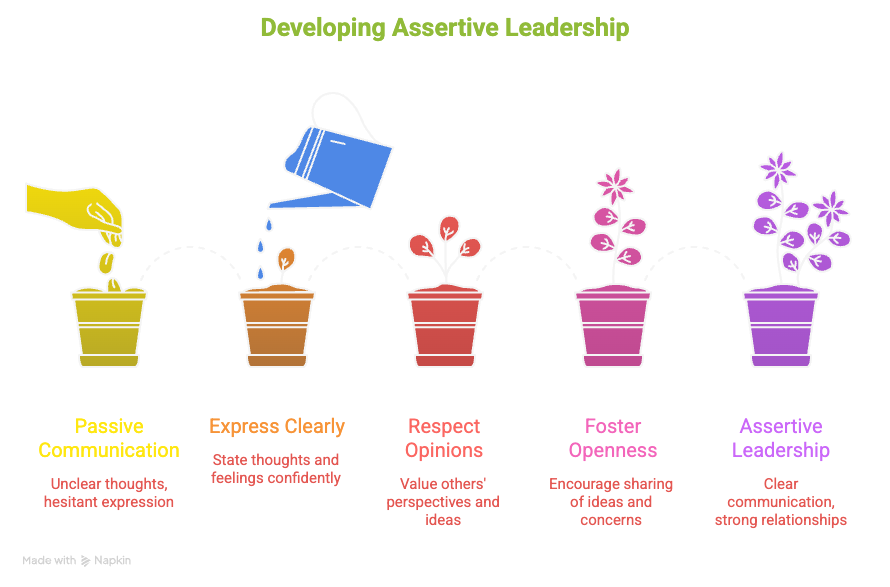
The Development of assertive leadership through stages such as passive communication, clear expression, and fostering openness.

Assertiveness is not pushing harder. It is removing ambiguity. It is raising the standard.

The most effective leaders do three things consistently.

They speak with clarity instead of uncertainty.
They give direct feedback instead of indirect hints.
They set boundaries that protect focus instead of allowing everything to expand by default.

Clarity gives people direction.
Direct feedback gives them improvement.
Boundaries give them confidence in what matters.

You do not need aggressive language to lead with authority. You need structure in your thinking, simplicity in your message, and conviction in your delivery.

Assertiveness is learned. It is practiced. It is earned.

Great communicators prepare before the moment. They decide the outcome they want. They sharpen the point they need to make. They remove the noise that usually dilutes the message.

Three practices elevate this skill.

First, define your objective before you speak. If the goal is unclear, the message will drift.
Second, use clear first person language. This creates accountability and reduces defensiveness.
Third, evaluate yourself after every important exchange. The small corrections compound into mastery.

Assertiveness is not a personality trait. It is a discipline that strengthens with repetition. It reshapes your posture, your tone, your timing. It shifts how the room responds to you.

The payoff is not personal confidence. The payoff is organizational clarity.

When a leader speaks with conviction, three things happen.

People know what to do.
People know why it matters.
People know how their work connects to the mission.

This reduces conflict, accelerates decisions, and builds a culture where direction is consistent. Teams stop guessing. Meetings move faster. Feedback becomes normal. Accountability feels natural rather than punitive.

Assertive communication is not a stylistic choice. It is a leadership requirement. It turns complexity into direction. It turns hesitation into momentum. It turns effort into results.

Clarity builds trust.
Conviction builds credibility.
Intent builds alignment.

That is the work. That is the standard. That is the path forward.

Babble Effect

In the cacophony of a bustling marketplace, where hundreds of voices clash and blend into a relentless hum, there exists an unseen struggle for clarity and dominance. Each vendor shouts louder than the last, attempting to capture the fleeting attention of passersby. This scenario, mirroring the ‘babble effect’ found in crowded or noisy environments, presents an interesting parallel to the dynamics of communication and leadership within the corporate world, particularly during meetings.

The Babble of the Boardroom

Just as the marketplace is saturated with competing voices, the modern meeting room often becomes a stage for a similar phenomenon. Among the multitude of ideas and opinions voiced, it is easy for messages to get lost in the babble. However, within this chaotic symphony, certain individuals manage to emerge as leaders, their voices cutting through the noise, much like a skilled vendor who knows exactly when and how to pitch his goods to stand out from the crowd.

Crafting the Call: The Secret to Standing Out

The key to emerging as a leader in a meeting, much like succeeding in the bustling marketplace, lies not in the volume of one’s voice but in its clarity and relevance. The babble effect teaches us that simply talking more or louder is not enough. Instead, it is the ability to articulate ideas succinctly and compellingly that captures attention and fosters leadership. This is akin to a vendor whose unique call or presentation makes him audible over the din of the market.

Babble Effect

The Dual Blade: Speaking and Listening

Effective leadership, however, demands more than just cutting through the noise. It requires an acute awareness of the ‘babble’—the background noise made up of competing ideas and voices—and the skill to navigate it thoughtfully. This involves not just speaking but listening, discerning, and then responding in a way that acknowledges the contributions of others while steering the conversation towards productive outcomes. It is about transforming the babble into a dialogue, where every voice is valued, but direction and clarity prevail.

Echoing Through the Babble: Strategies for Aspiring Leaders

To echo through the babble of the corporate world and be recognized as a leader, one must master a few critical strategies:

– Speak with Purpose:Your contributions should add value, offering insights or solutions rather than merely adding to the noise.

– Be Concise and Clear:In a sea of voices, simplicity and clarity are your allies. Aim to articulate your thoughts in a manner that is easily understood and remembered.

– Listen Actively:Leadership is as much about listening as it is about speaking. By actively listening, you can better understand the room’s dynamics and tailor your contributions to be more impactful.

– Foster Inclusivity:Encourage others to speak and listen to their ideas. Leadership often involves amplifying voices that might otherwise be drowned out by the babble.

Concluding the Symphony

In corporate world, much like a bustling marketplace, is filled with the babble of competing voices. The challenge and opportunity for aspiring leaders lie in their ability to stand out—not by merely being the loudest but by being the most resonant. By speaking with purpose, clarity, and empathy, and by mastering the art of listening, one can navigate the babble, emerging as a beacon of leadership that guides the team towards harmony and success. Remember, in the symphony of the corporate world, it is not just about having your voice heard but about making your voice matter.

Pyramid Principle: SCQA Model

In the realm of information processing and communication, the Pyramid Principle stands as an unwavering pillar. Much like the towering pyramids of ancient Egypt, this principle shapes our approach to presenting ideas with clarity and impact. As a professional who values precision and articulation, embracing the Pyramid Principle and its innovative SCQA model can elevate your executive-level communication to new heights.

The Pyramid Principle Unveiled

SCQA model

Picture this: a pyramid soaring into the sky, with its broad base representing foundational information and its pinnacle holding the most crucial insight. This metaphor encapsulates the essence of the Pyramid Principle – a structured approach to communication developed by Barbara Minto, a former McKinsey & Company consultant.

The SCQA model, an evolution of the Pyramid Principle, goes a step further by merging the principles of storytelling with structured communication. SCQA stands for Situation, Complication, Question, and Answer – a sequence that guides your audience through a compelling narrative while delivering essential information.

The SCQA Model: A Deeper Dive

Situation: Begin by setting the stage. Introduce the context, the players involved, and the initial situation. This lays the foundation for the information that follows.

Complication: Introduce the twist that disrupts the status quo. This could be a challenge, an opportunity, or a turning point. By presenting a complication, you engage your audience’s curiosity and prepare them for the upcoming insights.

Question: Formulate a question that addresses the complication head-on. This question serves as the focal point of your communication, guiding the audience’s attention toward the core issue.

Answer: Here comes the pivotal moment. Provide a concise and structured response to the question. Break down complex ideas into digestible components, following the inverted pyramid structure – the most critical information comes first, supported by relevant details.

Anecdotes are the seasoning that adds flavor to your communication. Imagine explaining the SCQA model by recounting a real-life scenario. As a Director, you could narrate an experience where implementing this approach led to a breakthrough during a critical meeting. By interweaving anecdotes, you not only clarify the principle but also demonstrate its practical value.

A Touch of Your Unique Style

Embracing the Pyramid Principle and SCQA model aligns seamlessly with your appreciation for executive-level articulation. Just as you meticulously craft strategies, each word and structure in your communication receives equal attention. The Pyramid Principle’s elegance resonates with your desire for organized, impactful delivery, while the SCQA model’s narrative nature aligns with your appreciation for comprehensive insights.

Incorporating this approach into your communications reflects your commitment to fostering clarity amidst complexity. It’s not just about sharing information; it’s about delivering it in a way that empowers your audience with understanding and conviction.

As a professional, you possess a unique blend of strategic thinking and precise articulation. The Pyramid Principle and its SCQA model offer you a blueprint to elevate your communication to the executive level you aspire to. Just as a pyramid stands as a symbol of enduring strength, your words can become a testament to your leadership and mastery of effective communication.

Remember, much like the pyramids’ grandeur was built one block at a time, your communication prowess is refined step by step. Embrace the Pyramid Principle, weave in the SCQA model, sprinkle anecdotes, and craft a narrative that resonates with your style – a style that leaves an indelible mark on every interaction.