How AI-Powered Insights are Revolutionizing Learning

We are living through a “synthesis revolution.”

For the last decade, the internet has focused on access. We have more podcasts, more YouTube videos, and more newsletters than any human could consume in ten lifetimes. But we’ve hit a wall. We don’t need more information; we need better implementation.
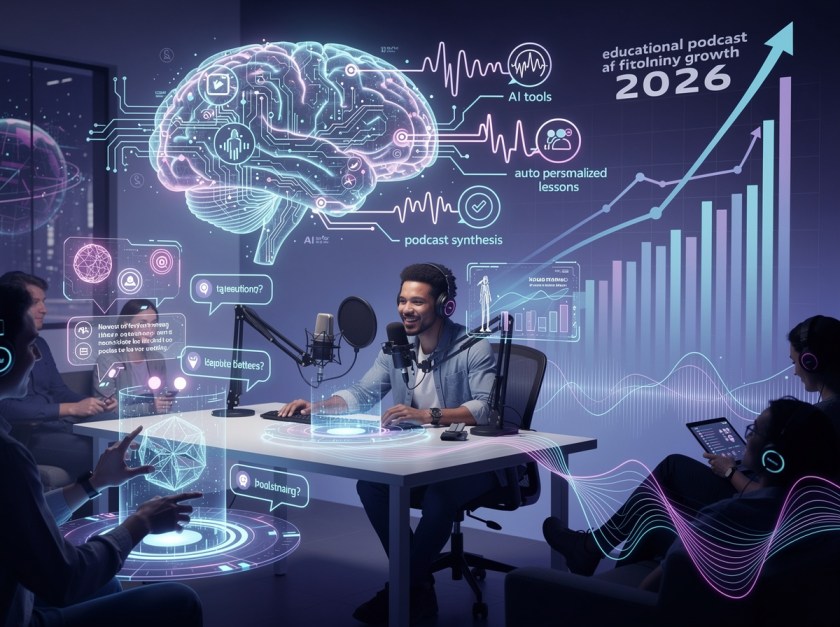
podorahq.com

The problem with the modern podcasting landscape isn’t a lack of quality—it’s the “forgetting curve.” Science shows that we forget nearly 80% of what we learn within 24 hours if we don’t actively engage with it.

In 2026, the most successful podcasts aren’t just “shows”—they are learning engines. And the fuel for those engines? AI-Powered Insights.

The Shift: From Passive Listening to Active Implementation

Most podcast listeners are “passive.” They listen while commuting, cleaning, or exercising. While this is great for general awareness, it’s terrible for deep learning. Important frameworks, life-changing habits, and business strategies are heard, nodded at, and then lost to the wind.

This is the gap Podora was built to bridge.

By moving beyond simple transcripts and into the realm of AI-Powered Synthesis, we are changing the relationship between the creator and the listener.

1. The Death of “Keyword” Search

In the past, podcast SEO was about keywords. If you talked about “Growth Hacking,” you wanted that word in your transcript so Google could find it. But search engines have evolved. They now prioritize semantic meaning and utility.

AI-powered insights don’t just find the word “Growth Hacking”; they extract the methodology of the growth hack. This provides a “Search Intent” match that is far more valuable to a high-intent audience.

2. Building Brand Loyalty through “The Result”

Why do people follow creators like Andrew Huberman or Tim Ferriss? Because they provide protocols that work.

When you provide a Podora-distilled takeaway, you are giving your listener a “Success Shortcut.” If they apply a tip from your show and see a result in their life, they don’t just like your podcast—they trust your brand. You move from being an “entertainer” to a “mentor.”

3. Fighting Information Fatigue

“Information Fatigue” is real. Listeners are becoming pickier about which episodes they commit 60 minutes to. By offering an “Actionable Insights” dashboard upfront, you give your audience the confidence to dive in. You show them that you value their time and have done the work to ensure every minute is spent wisely.

Implementation is the New Currency

As we move deeper into the AI era, the “commodity” is the content itself. The “luxury” is the distillation.

At Podora, we believe that the best podcasts in the world deserve to be more than just background noise. They deserve to be blueprints for action. Our AI doesn’t just “listen”—it analyzes, categorizes, and distills, turning your audio into a toolkit for your audience.

The Future of Your Show

The question for podcasters in 2026 is simple: Are you adding to the noise, or are you providing the signal?

By integrating AI-powered insights into your workflow, you aren’t just making your show easier to find—you’re making it impossible to ignore.


Stop being “just a podcast.” Become an implementation engine. Discover the power of AI-Powered Insights at PodoraHQ.com

The Artificial Super Intelligence (ASI) Revolution

The march from ANI to AGI is now significantly pronounced in this world of AI. ASI, standing for Artificial Super Intelligence, is far beyond AGI. Such a system can, craftily and at lightning speed, learn recursively from itself and then outstrip human capabilities in all domains of intelligence.

Artificial Super Intelligence (ASI) generated by Soras.com

Artificial Narrow Intelligence (ANI)

  • Excels in highly specialized tasks—e.g., image recognition, language translation, or personalized recommendations—based on curated datasets.
  • Examples include digital assistants like Siri and Alexa, or recommendation algorithms such as those used by Netflix and Amazon.

Artificial General Intelligence (AGI)

  • Mirrors human-level problem-solving and adaptability across diverse domains.
    • An AGI would interpret unfamiliar tasks with human-like flexibility, an area of active research pursued by companies like OpenAI (website) and DeepMind (website).

Artificial Super Intelligence (ASI)

  • Surpasses human intellectual capacity and speed.
  • Achieves self-improvement by scrutinizing and refining its own underlying algorithms—a phenomenon sometimes referred to as recursive self-improvement.

The Mechanics of Rapid Recursive Learning

At the heart of ASI lies a core iterative process whereby the AI system perpetually learns how to learn more effectively:

Meta-Learning

  • The system analyzes not just outputs, but also the learning methodologies themselves.
  • By refining its approach to data ingestion and interpretation, each cycle yields more sophisticated capabilities.

Automated Model Building

  • New architectures can be generated based on real-time performance metrics without extensive human intervention.
  • Neural architecture search (NAS) is already used by leading research labs to automate the design of high-performing neural networks.

Self-Optimizing Knowledge Graphs

  • ASI dynamically assembles and reshapes intricate knowledge graphs, updating them with newly acquired information.
  • This continuous mapping of concepts ensures broad contextual awareness and deeper connections between topics.

Exponential Scaling

  • As each round of self-improvement compounds on the previous one, the system’s competence can expand exponentially.
  • Demonstrations of this phenomenon can be seen in projects like AlphaGo Zero, which trained itself to superhuman levels in Go within a matter of weeks (DeepMind case study).

    Real Use Cases

    Healthcare & Drug Discovery

    • Case in Point: AI-driven solutions are already reducing drug discovery timelines by using reinforcement learning to screen millions of compounds quickly. An ASI system could accelerate these breakthroughs even further, potentially formulating hypotheses and testing them in simulated environments before lab experiments are conducted.
    • Anecdote: During the COVID-19 pandemic, AI systems like BenevolentAI and Google’s DeepMind were used to study potential drug targets within days, an effort that might take traditional labs months.
    1. Financial Markets & Risk Management
      • Case in Point: Algorithmic trading has employed self-learning techniques to interpret real-time market data and conduct high-frequency trades. An ASI-level system would refine its models in near-instantaneous cycles, potentially restructuring entire trading strategies on the fly.
      • Hedge funds like Citadel and Two Sigma rely on machine learning for predictive analysis. Imagine those algorithms magnified exponentially by a system that can devise entirely new quantitative methods overnight.
        Engineering & Product Design
      • Case in Point: AI-driven “generative design” in industries like automotive and aerospace uses algorithms to iterate thousands of potential structural designs quickly. An ASI could optimize form and function at a rate unimaginable to human engineers, considering countless permutations in minutes.
      • General Motors, in partnership with Autodesk, used a generative design system to create a seat bracket that was 40% lighter and 20% stronger than existing parts—an early glimpse of what recursive AI systems can accomplish.
        Large-Scale Climate Modeling
      • Case in Point: Climate modeling involves processing vast variables—ocean temperatures, wind patterns, and atmospheric conditions. An ASI with robust self-improvement capabilities could forge highly accurate models, potentially predicting and mitigating climate disasters well in advance.
      • The European Centre for Medium-Range Weather Forecasts (ECMWF) employs AI for short- and medium-range weather forecasting. An ASI might refine these models in real time, incorporating emergent data at a global scale.

    Quotes on the Future of AI

    Elon Musk

    Stephen Hawking

    • “Success in creating effective AI could be the biggest event in the history of our civilization. Or the worst. We just don’t know…”
      BBC Interview, 2014

    Andrew Ng

    Bill Gates

    • “The development of AI could spell the end of the human race… but we need to harness the benefits it can bring.”
      – Paraphrased from interviews and keynote addresses at Microsoft events, reflecting both optimism and caution.

      The Road Ahead: Charting a Path to ASI

      Refinement of AGI

      • Achieving robust human-level intelligence is the stepping-stone to exponential super-intelligence.
      • Ongoing projects at organizations like OpenAI (blog) or Anthropic (website) are pivotal in paving this path.

      Global Collaboration

      • Balancing competition with collective progress is essential to ensure responsible use of AI.
      • Initiatives like the Partnership on AI (website) promote transparency and inclusivity in AI development.

      Continuous Risk Assessment

      • An ever-improving system could develop capabilities faster than anticipated. Multi-stakeholder engagement—encompassing academia, industry, and governance—should remain vigilant.

      Societal Integration

      • Public education and policy formulation must go hand in hand with technological advances to maximize benefits while minimizing risks.

      Artificial Super Intelligence (ASI) envisions a future where machines recursively refine their own learning processes to outperform human intelligence in virtually every domain. From drug discovery and climate modeling to financial markets and generative product design, the potential for breakthrough innovations is unparalleled. Yet, with such transformative power come pressing questions around governance, ethics, and human accountability.

      As we stand on the threshold of this new era, voices from industry and academia implore us to exercise both ambition and caution. The lessons gleaned from Elon Musk’s existential warnings, Stephen Hawking’s cautious optimism, and Andrew Ng’s vision of AI’s ubiquity underscore the importance of thoughtful, collaborative action. Whether ASI becomes humanity’s most extraordinary asset or its most complex challenge will depend on the foresight, regulatory wisdom, and shared responsibility we invest in its development.

      Ambient Clinical Documentation

      The recent HIMSS conference in Orlando, Florida, showcased a revolutionary technology poised to transform doctor-patient interactions: ambient clinical documentation. This technology, championed by industry leaders like Microsoft’s Nuance Communications, Abridge, and Suki, promises significant benefits for both healthcare providers and patients.

      Key Features of Ambient Clinical Documentation:

      • Automatic Notes: Eliminate time-consuming transcription! Conversations are automatically converted into clear and concise clinical notes and summaries using artificial intelligence. This not only saves valuable time but also ensures accurate and complete medical records.
      • Personalized Documentation: Tailored documentation is key. Ambient clinical documentation allows doctors to customize reports to suit their individual preferences and the specific needs of different medical specialties. Imagine a customizable toolkit that empowers doctors to deliver top-notch care in any situation.
      • Seamless Integration: No more juggling multiple applications! This technology integrates seamlessly with existing Electronic Health Records (EHR) systems like Epic Systems. This streamlines workflows for busy healthcare professionals, allowing them to access and utilize vital patient information effortlessly.

      The Impact of Ambient Clinical Documentation:

      • Reduced Physician Burnout: Doctors are often overwhelmed by paperwork, leading to burnout and frustration. Ambient clinical documentation acts as a hero, automating administrative tasks and freeing up valuable time for doctors to focus on what matters most – their patients.
      • Improved Patient Care: With less time spent on administrative tasks, doctors can dedicate more energy to meaningful patient interactions. This translates to improved patient satisfaction and ultimately, better health outcomes.
      • A Shift in Healthcare Delivery: The rapid adoption of ambient clinical documentation signals a major change in healthcare. As technology evolves, so too does the way we deliver care. By embracing innovation, we pave the way for a future where healthcare is not only more efficient but also more personalized and patient-centered.

      Beyond the Hype: A Game-Changer for Healthcare

      Ambient clinical documentation is more than just a passing trend – it’s a game-changer. As it gains momentum, it has the potential to transform healthcare entirely. We can expect a future of seamless, patient-focused care. Stay tuned for exciting developments on the horizon!