Here’s the deal: success only comes before work in the dictionary. If you want to achieve something extraordinary, resilience must be your foundation, and hustle your greatest asset. Ignore the noise, focus on the grind, and aim higher—don’t just go to the club, own the club.
But here’s a deeper truth: most of the things we stress about don’t even matter. The real key to unlocking success? Learning to love yourself and becoming comfortable in your own skin.
When you reach that level of self-assurance, life slows down. You become more relaxed, more authentic—and authenticity is magnetic. It draws people, opportunities, and even capital toward you.
When you’re truly at peace with yourself, you’ll walk into a room and own it without saying a word. Everyone will want to talk to you, and success will naturally follow.
So, if I could give advice to my 18-year-old self, here’s what I’d say:
• It’s not just about being smart—be strategic.
• Don’t waste time, and don’t let anyone else waste it for you.
• Be true to yourself, and let the power of authenticity do the rest.
Success isn’t about luck—it’s about clarity, focus, and showing up for yourself every single day.
In today’s fast-paced, success-driven world, the notion that relentless effort guarantees rewards is deeply ingrained in our collective psyche. We are conditioned to believe that the harder we work, the greater the reward. However, an intriguing and paradoxical principle known as the Law of Reversed Effort challenges this belief, suggesting that, in many instances, less effort can actually yield more significant rewards.
Understanding the Law of Reversed Effort
The Law of Reversed Effort posits that excessive effort can be counterproductive, leading to diminished returns. This concept, often associated with Eastern philosophies and psychological theories, argues that relaxation and a state of ease can enhance performance and outcomes. The essence of this law is simple yet profound: striving too hard can create tension, anxiety, and resistance, whereas a relaxed approach can lead to greater success and satisfaction.
The Power of Relaxation
A vivid illustration of the Law of Reversed Effort can be found in the realm of elite sports. Observing top athletes, one might notice a common characteristic—they appear relaxed, smooth, and fluid in their movements. This relaxed demeanor is not a sign of lack of effort or commitment but rather a strategic approach to performance.
Usain Bolt: The Epitome of Relaxed Excellence
Usain Bolt, the legendary Jamaican sprinter, is a perfect embodiment of the Law of Reversed Effort. Known for his record-breaking performances and charismatic personality, Bolt’s approach to sprinting highlights the power of relaxation in achieving peak performance.
Pre-Race Calmness: Before his races, Bolt is often seen joking, dancing, and interacting with the crowd. This pre-race routine is not mere showmanship; it helps him stay relaxed and keeps anxiety at bay. Bolt’s lighthearted demeanor allows him to approach the race with a calm mind, ready to perform at his best.
Effortless Running Style: During his races, Bolt’s running style is characterized by smooth, fluid movements. Unlike many sprinters who appear tense and strained, Bolt’s relaxed stride and loose upper body contribute to his remarkable speed. This effortless style not only conserves energy but also minimizes the risk of injury.
Mental Clarity and Focus: Bolt’s ability to stay relaxed under immense pressure enables him to maintain mental clarity and focus. This mental state is crucial for making split-second decisions during the race and responding to the competition.
Training Philosophy: Bolt’s training regimen, under the guidance of coach Glen Mills, emphasizes the importance of relaxation and recovery. While intense training is a part of his routine, equal importance is given to rest and recovery, allowing his body to perform optimally when it matters most.
Applying the Law of Reversed Effort in Career and Profession
The principles demonstrated by elite athletes like Usain Bolt can be applied to various aspects of our lives, including our careers and professional endeavors. Here are a few ways to embrace the Law of Reversed Effort in a professional context:
Mindfulness and Meditation: Incorporating mindfulness and meditation into your daily routine can help cultivate a relaxed and focused mind. This mental clarity can enhance productivity, creativity, and decision-making in the workplace.
Balanced Work Approach: Striving for a balance between effort and relaxation can lead to more sustainable and rewarding professional outcomes. This might mean setting clear boundaries between work and personal time, ensuring you get adequate rest, and taking regular breaks to recharge.
Trusting the Process: In the professional realm, trusting the process rather than forcing results can lead to more authentic and meaningful achievements. This approach reduces stress and fosters a healthier work environment.
Quality Over Quantity: Prioritizing the quality of your work over the sheer quantity can lead to greater professional success. Focused, high-quality effort often yields better results than prolonged, strenuous exertion.
Networking and Collaboration: Engaging in relaxed, genuine networking and collaborative efforts can open doors to new opportunities and foster stronger professional relationships. Approach interactions with a mindset of ease and authenticity rather than aggressive self-promotion.
The Law of Reversed Effort teaches us that sometimes, the key to achieving our highest potential lies in doing less, not more. By adopting a relaxed and fluid approach, much like elite athletes such as Usain Bolt, we can unlock greater rewards and enjoy a more balanced, fulfilling life and career. Embrace the paradox—less effort can indeed mean more reward. By integrating these principles into our professional lives, we can enhance our performance, reduce stress, and achieve more meaningful success.
We’ve all been there—staring at a to-do list that seems endless, avoiding the nagging feeling of unproductive days, or wondering where to start. If you’ve been spinning in loops of indecision, this guide will break you free.
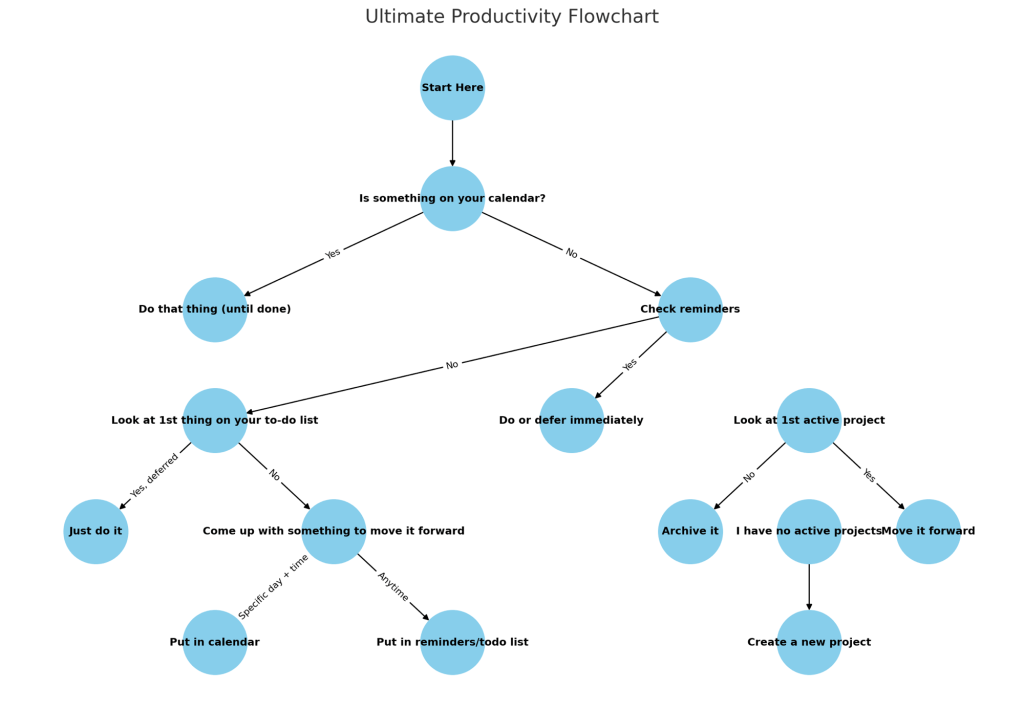
The flowchart below is a deceptively simple yet powerful tool to eliminate procrastination, clarify priorities, and get things done, one decision at a time.
Get things done
Trust me. You’ll want to print this out. Let’s walk through it step by step.
Step 1: Start Here
The flowchart starts with a single question:
“Is something on your calendar right now?”
• If yes → Do that thing until it’s done.
• If no → Keep moving through the system.
The brilliance here is that if you’ve already scheduled it, the choice is removed. No overthinking. Just execute.
Step 2: Check Your Reminders
If you’re calendar-free, it’s time to check your reminders.
• Something there? Do or defer it immediately.
• Nothing there? Let’s go to your to-do list.
Step 3: Look at Your To-Do List
This is where most people get stuck. You stare at the list, panic a little, and close the app. The chart cuts through this paralysis with precision:
1. Find the first item on your list.
2. Ask: “Have you deferred it already?”
• If yes, stop the loop—just do it (for crying out loud).
• If no, it’s time to come up with an action to move the task forward.
The key here is forward motion. No task is too small to take some action.
Step 4: Move Tasks Forward
Now you’ve identified a next step. The question becomes:
“When should I do it?”
You have two choices:
1. Specific Day + Time → Put it on your calendar.
2. Anytime → Put it in your reminders or back in your to-do list.
This removes ambiguity and ensures the task doesn’t float endlessly in “someday” limbo.
Step 5: Look at Active Projects
If your to-do list is empty, take a look at your 1st active project:
• Is it still relevant?
• If yes, great—move the project forward.
• If no, archive it and move on.
Projects that no longer serve you are clutter. Let them go.
If you have no active projects, congratulations! You’re starting fresh. It’s time to create a new project and get excited about what’s next.
Key Takeaways from This System
1. Decisions are Binary: This chart removes ambiguity. It breaks every moment of indecision into clear “yes” or “no” questions.
2. Action Over Perfection: The system focuses on moving tasks forward, not getting stuck on perfect timing or ideal conditions.
3. Eliminate Clutter: If tasks or projects aren’t relevant anymore, you archive them—freeing up mental and emotional space.
4. Build Systems, Not Just Lists: By integrating calendars, reminders, and to-do lists, this method turns your workflow into a seamless system.
How to Use It
1. Print out the flowchart and keep it visible—on your desk, fridge, or workspace.
2. When you feel stuck, overwhelmed, or uncertain about what to do next, start at the top.
3. Let the system guide you to clarity and action
Productivity doesn’t need to be complicated. This flowchart combines simplicity with laser focus, allowing you to cut through procrastination and overwhelm.
Trust the system. Trust yourself. Start anywhere—and take the next step.

 Maverick