Theory of mind is the ability to understand and predict the mental states of others. It is a crucial cognitive ability that allows us to understand the intentions, beliefs, and desires of those around us, and to adjust our own behavior accordingly. In recent years, the concept of theory of mind has become increasingly important in the field of artificial intelligence (AI), as researchers work to develop machines that can understand and interact with humans in more natural and intuitive ways. In this blog, we will explore the concept of theory of mind in both humans and AI, and discuss some of the challenges and opportunities that arise when these two worlds intersect.
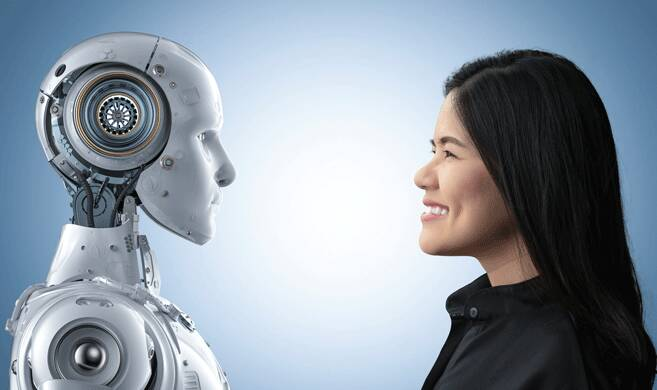
©phonlamaiphoto on Adobe Stock
Human Theory of Mind
Humans have an innate ability to understand the mental states of others from a very early age. This ability is thought to be a product of our evolutionary history, as it has been critical to our survival as a social species. The development of theory of mind begins in infancy, as babies learn to distinguish between different facial expressions and respond to the emotional cues of those around them. As children grow older, they become increasingly adept at understanding and predicting the mental states of others, and this ability becomes an important part of their social and emotional development.
There are several key components to theory of mind in humans. These include the ability to recognize and interpret facial expressions, gestures, and other nonverbal cues; the ability to infer the beliefs, desires, and intentions of others based on their behavior; and the ability to adjust one’s own behavior in response to these mental states. Humans also have a strong sense of empathy, which allows us to understand and share the emotions of others, and to respond appropriately to their needs.
AI and Theory of Mind
In recent years, researchers in the field of artificial intelligence have begun to explore the concept of theory of mind in machines. The goal is to develop machines that can understand and interact with humans in more natural and intuitive ways, by recognizing and responding to our mental states in much the same way that other humans do.
One approach to developing theory of mind in AI involves the use of machine learning algorithms. These algorithms are trained on large datasets of human behavior, such as facial expressions, gestures, and speech patterns, in order to learn to recognize and interpret these cues in much the same way that humans do. By analyzing patterns in this data, machine learning algorithms can make predictions about the mental states of others, and adjust their own behavior accordingly.
Another approach to developing theory of mind in AI involves the use of natural language processing (NLP) techniques. These techniques are used to analyze human speech patterns, and to identify the underlying beliefs, desires, and intentions that are being communicated. By understanding the meaning behind human language, machines can respond in more natural and intuitive ways, and can better predict the needs and desires of those around them.
Challenges and Opportunities
While the development of theory of mind in AI holds great promise, there are also significant challenges that must be overcome. One of the biggest challenges is the need for large datasets of human behavior, which can be difficult and expensive to collect. There is also the risk of bias in these datasets, which can lead to errors and inaccuracies in the predictions made by machine learning algorithms.
Another challenge is the need for machines to develop a sense of empathy and emotional intelligence, which is crucial to understanding and responding to the needs and desires of humans. This is a difficult task, as emotions are complex and multifaceted, and can be difficult to understand even for other humans.
Despite these challenges, the development of theory of mind in AI holds great promise for the future of human-machine interaction. Machines that can understand and respond to our mental states in more natural and intuitive ways will be better able to assist us in our daily lives, and will be more effective at working alongside us to solve complex problems.


 Maverick