Why People Tune You Out And How To Break Their Pattern
We underestimate how quickly people stop listening.
Not because they dislike us.
Not because they disagree with us.
But because they think they already know what we’re about to say.
That is the Rerun Effect.
Once you see it, you cannot unsee it.
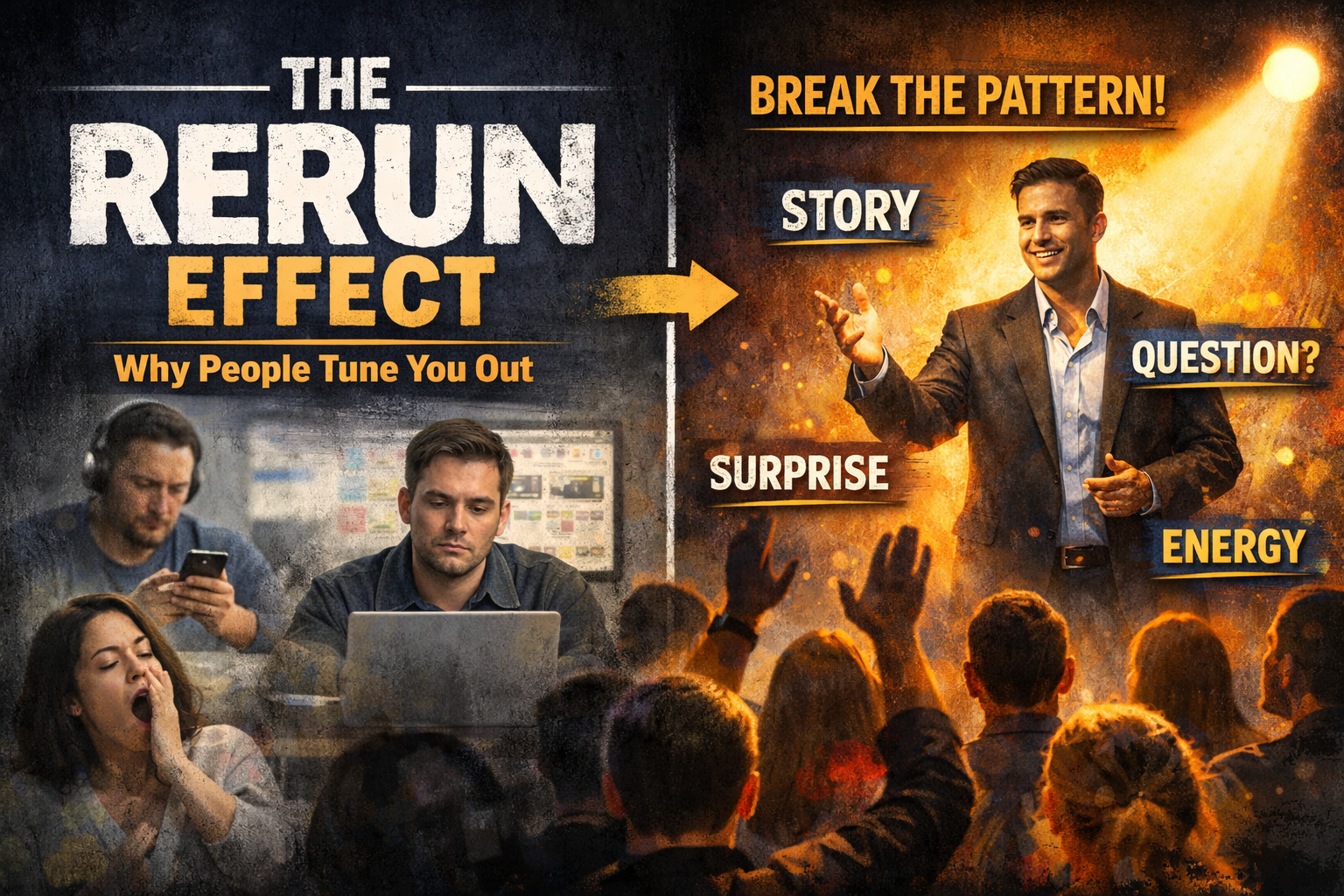
Think about how you watch your favorite shows.
Friends. The Office. How I Met Your Mother.
You let the episodes run in the background because your brain already knows the beats.
Predictable. Familiar. Comfortable.
No effort required.
People do the exact same thing with your voice in meetings.
The moment the room decides they know your rhythm, your tone, your pattern, they stop giving you their attention.
They browse tabs.
They answer emails.
They nod politely while mentally planning dinner.
This is especially brutal in virtual environments.
Six people on a call.
Four are multitasking.
One is half-listening.
And you are speaking into a void that looks attentive but isn’t.
Why?
Because your delivery has become a rerun.
A predictable replay of “what you always sound like.”
How the Rerun Effect Shows Up
It shows up in three ways.
Predictable openings. Predictable pacing. Predictable rambling.
A meeting starts with the same polite script:
“Good morning everyone, hope you’re doing well. Beautiful weather in California today…”
And the audience mentally switches off.
They’ve seen this episode.
They know the plot.
Or someone answers a question with a stream of half-thoughts:
“Yeah so we talked to the supplier… let me loop Ali in… one moment… so basically…”
The listeners know where this goes.
Nowhere.
The Rerun Effect kills attention because predictability kills curiosity.
Your real question: how do I break the pattern?
Simple.
Surprise the room.
Interrupt their expectation.
Shift the energy before they have a chance to go on autopilot.
Not by being theatrical.
Not by being loud.
But by being intentional.
Five moves that instantly reset attention
First, change your tone. Change your cadence. Change your presence.
When your voice is flat, the room goes flat.
A variation forces the brain to re-engage.
Second, open with a story instead of pleasantries.
Stories pull people in.
Pleasantries push people away.
Third, hold eye contact with purpose.
Looking at someone makes them choose to stay with you.
Looking at everyone makes the room choose to follow you.
Fourth, add a challenge. A quiz. A “guess what happens next.”
A slight tension ignites curiosity.
Curiosity anchors attention.
Fifth, show something new on the screen. Not wallpaper slides. Not five-minute stills.
Movement creates engagement.
Stagnation creates reruns.
These are small shifts.
But small shifts rewritten consistently create new expectations.
And new expectations bring attention back.
The deeper point
People don’t tune out because they’re rude.
They tune out because their brain thinks it has seen the episode already.
Your job is to make every interaction feel like a new episode worth watching.
Fresh. Focused. Intentional.
Not loud.
Not dramatic.
Just unexpected enough that the room realizes:
“This is not a rerun. I need to pay attention.”
That is how influence is built.
That is how presence is sharpened.
That is how leaders speak so people don’t just hear them but stay with them.

 Maverick