
Why not me?

Why not me? Resilient

Life tosses us into the tumultuous seas of uncertainty and hardship without warning. Matthew McConaughey, during an uplifting speech at the University of Houston, imparted a powerful lesson that resonates with the tenacity of the human spirit: the refusal to be a victim to circumstance.

In his book, “Burn the Boats,” McConaughey recounts his own confrontation with fear upon a testicular cancer diagnosis. The natural inclination to question, “Why me?” stems from a place of perceived immunity—a notion that life’s harsh storms should batter some distant other, not oneself. Yet, it is in the crucible of such trials that McConaughey proposes a radical shift in perspective—transforming the victim’s lament of “Why me?” to a warrior’s cry of “Why not me?”

The real question isn’t who deserves to face the challenge, but who has the fortitude to weather it. “Why not me?” becomes a mantra of empowerment, a declaration that we are not only equipped to handle life’s adversities but perhaps even destined to meet them head-on. McConaughey’s realization that he had better resources to tackle his diagnosis highlights a broader truth: the challenges we face may indeed be the universe’s way of entrusting us with a unique purpose, a test designed for our individual strengths.

“Life is not about finding shelter in a storm but about dancing in the rain,” as the saying goes, encapsulating the essence of McConaughey’s message. And in another viral slice of wisdom, we’re reminded that “Ships don’t sink because of the water around them; ships sink because of the water that gets in them.” The same is true for us; it’s not the external battles that define our fate, but the internal resolve to face them.

So, let us embrace each tribulation with the question, “Why not me?” and find within ourselves the capacity to navigate through the tempest. In doing so, we may just discover that the fiercest storms often lead to the brightest rainbows, and in the heart of adversity lies the seed of growth.
Pie Fallacy

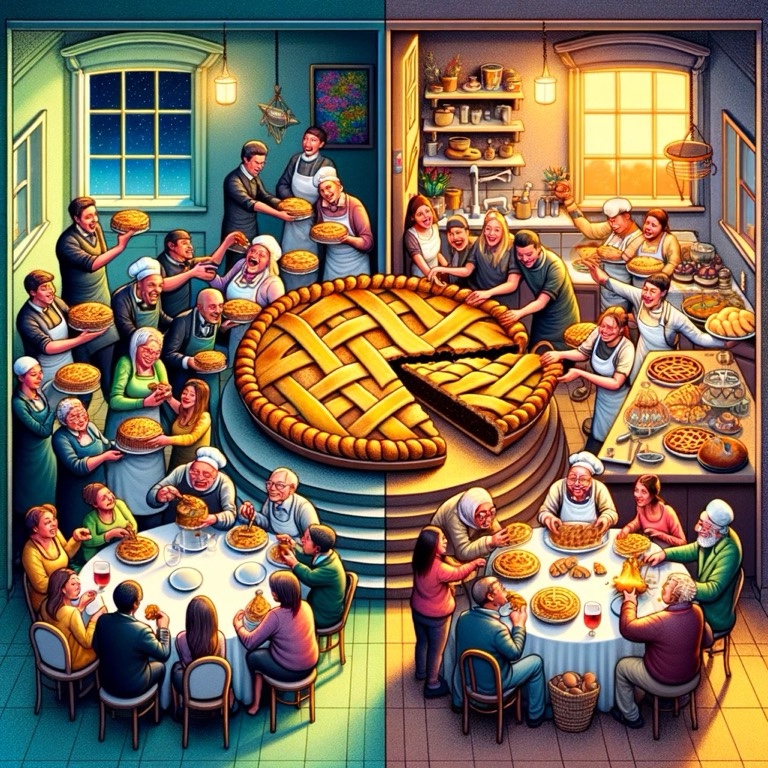
The notion that the world’s wealth is a fixed pie, to be divvied up among us, is an enduring myth that persists from the playgrounds of our youth to the boardrooms of our adult lives. This childhood misconception leads many to view the economy as a zero-sum game, where one person’s gain is another’s loss. However, this is the Pie Fallacy—a misleading belief that fails to recognize the dynamic nature of wealth creation.

“Wealth is not about having a lot of money; it’s about having a lot of options.” – Chris Rock

Pie Fallacy

Wealth is not a stagnant pond but a spring, continuously fed by the streams of innovation, labor, and entrepreneurship. The concept of money, often mistaken for wealth itself, is merely a facilitator, a means of exchanging the value that we create. The static view of wealth overlooks the fact that every day, individuals and businesses are engaged in activities that expand the pie for everyone.

Consider the example of technology startups that have revolutionized industries and created services that were previously unimaginable. These companies didn’t take a larger slice of the pie from others; they baked a whole new one. When you download a new app that simplifies your life or use a service that saves you time, you’re witnessing the expansion of wealth.

The same principle applies on a more personal scale. When someone restores an old car, they aren’t merely transferring wealth from one place to another; they are adding value through their skills and effort. The car, once a rusting hulk, is transformed into a valuable classic. Its increased value is a direct result of human ingenuity and hard work, not the deprivation of another.

This truth has profound implications for how we approach wealth as a society. Policies aimed at merely redistributing wealth, while sometimes necessary, don’t address the core engine of economic growth: wealth creation. Encouraging innovation, protecting intellectual property rights, and fostering a business environment where new ideas can flourish—these are the keys to expanding the pie for everyone.

In dispelling the Pie Fallacy, we must embrace the idea that wealth is not finite. Our economic system thrives on the creation of value, not the mere circulation of currency. As we innovate and build, as we refine and improve, the pie grows, and with it, the potential for prosperity for all. Understanding this is crucial for developing economic policies that foster growth and opportunity, rather than just redistributing a falsely perceived limited resource.

The Pie Fallacy should be left in the past, along with other childhood myths. It’s time to recognize the boundless nature of human potential to generate wealth, ensuring that the pie doesn’t just get sliced more thinly, but that it gets bigger and better for everyone partaking in it.

The Progress Principle


In the tapestry of our professional lives, it’s often the smallest threads that weave the most significant patterns. This concept, known as the ‘Progress Principle,’ posits that the most profound source of motivation in the workplace stems from making meaningful progress in our tasks, however small. Like a gardener nurturing a seedling into a blooming plant, recognizing and celebrating small wins can lead to significant growth and fulfillment.

The Progress Principle
  1. Understanding the Progress Principle:
    Imagine you’re building a mosaic, where each tiny piece of tile is a small accomplishment. Individually, these pieces might seem insignificant, but when assembled, they create a masterpiece of progress. This principle isn’t about grand achievements; it’s about valuing the minor, yet crucial steps that lead to major milestones.
  2. Analogies to Illuminate the Concept:
  • Cooking a Gourmet Meal: Just as a chef relishes the perfect chop of an onion or the simmer of a sauce, celebrate the small tasks in your project. Each task completed is like an ingredient added, bringing you closer to the delightful final dish.
  • Running a Marathon: Every step taken is a victory in itself, a testament to endurance and will. Similarly, in your work, cherish each stride, no matter how small, as it brings you closer to the finish line.
  1. Practical Ways to Make it a Habit:
  • Daily Reflections: At the end of each day, jot down at least one small win. This could be as simple as a positive interaction with a colleague or as complex as solving a persistent problem.
  • Setting Micro-Goals: Break down large projects into bite-sized tasks. Each completed task is a small win, propelling you forward.
  • Visual Progress Trackers: Use a visual aid, like a progress bar or a checklist, to make your advancements tangible and gratifying.
  • Team Celebrations: In a team setting, acknowledge individual and collective small wins. This can be through shout-outs in meetings or a dedicated space on a communal board.


The journey towards our goals is often dotted with many small steps. By embracing the Progress Principle, we turn our focus to these steps, finding joy and motivation in each one. Like a series of brushstrokes completing a beautiful painting, it’s these small, consistent actions that lead to a masterpiece of achievements.

Call to Action
Start today by acknowledging your first small win – even reading this blog and contemplating the Progress Principle is a step forward. Remember, every great journey begins with a single, albeit small, step.