Cynics vs. Optimists

In the realm of business, leadership, and personal growth, there exists a perpetual tug-of-war between two contrasting perspectives: cynicism and optimism. The dichotomy is elegantly captured in the statement: “Cynics get to be right, and optimists get to be rich.” This sentence encapsulates not just a difference in outlook but also suggests a consequential impact on success. Let’s delve into the nuanced implications of being a cynic or an optimist, drawing on real-life anecdotes and thought-provoking quotes from renowned individuals.
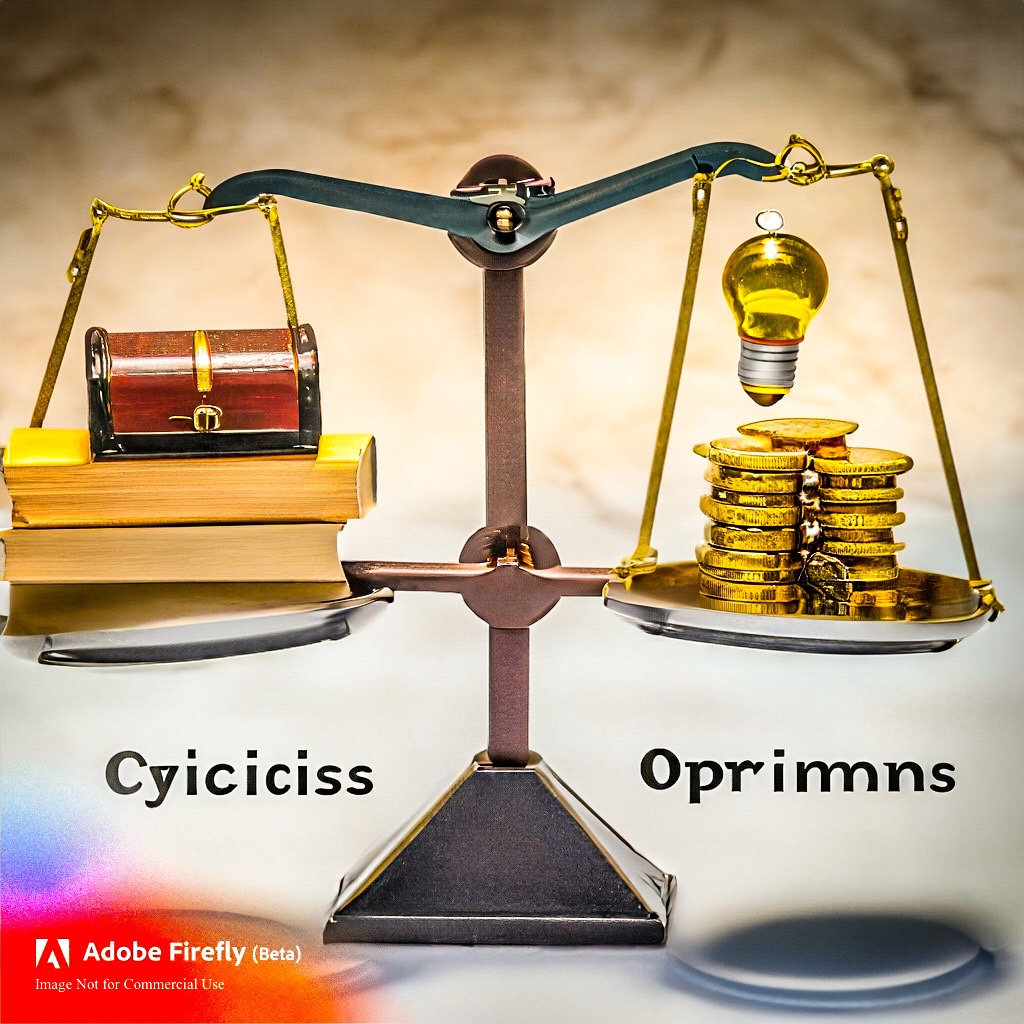
Cynics VS Optimists

The Righteous Cynic

Cynicism often presents itself as a form of intellectual sophistication. Cynics pride themselves on their ability to see through facades and question the status quo. Warren Buffet once said, “Risk comes from not knowing what you’re doing.” Cynics argue that their critical mindset minimizes risk as they understand the world more clearly than their optimistic counterparts.

During the Dot-Com bubble of the late ’90s, a significant number of investors were swept up by unwarranted optimism. Cynics, on the other hand, warned about the unsustainability of businesses with no concrete revenue model. When the bubble burst, the cynics found themselves vindicated. They were “right,” but their caution had also held them back from other lucrative opportunities.

The Affluent Optimist

In stark contrast to cynics, optimists thrive on possibility and potential. They often see setbacks as temporary and treat failures as stepping stones to success. Henry Ford remarked, “Whether you think you can or you think you can’t, you’re right.” For optimists, the belief in oneself and in favorable outcomes fuels success, and more often than not, leads to financial gain.

Elon Musk’s venture into private space exploration through SpaceX is a prime example of optimism at work. Many considered the privatization of space travel a quixotic endeavor. Despite early failures and widespread skepticism, Musk’s unwavering optimism led to revolutionary advancements, including the reusable Falcon 9 rocket. Today, SpaceX stands as a testament to the affluence that optimism can yield.

The Balanced Perspective: Realist Optimism

While cynicism and optimism represent opposite ends of a spectrum, many successful leaders suggest a balanced approach—realist optimism. Bill Gates once shared, “Most people overestimate what they can do in one year and underestimate what they can do in ten years.” This perspective embodies a mixture of critical evaluation and long-term optimism.

In the world of investment, many hedge funds adopt a strategy of ‘hedging’ that combines both optimistic and cynical approaches. By diversifying assets and leveraging data analytics, they maximize gains while minimizing losses, demonstrating the efficacy of a balanced mindset.

The debate between cynicism and optimism is more than a philosophical divergence; it has real-world implications for success and wealth accumulation. While cynics often find their perspectives validated, they may miss out on expansive opportunities. Optimists, buoyed by a belief in positive outcomes, frequently achieve financial affluence even if they stumble along the way. The most effective leaders understand that a balance between the two—realist optimism—offers the most sustainable path to success. As you navigate your professional journey, consider which mindset serves you best in your quest for either righteousness or affluence—or perhaps, a harmonious blend of both.


The Two-Arrows Concept

“Between stimulus and response, there is a space. In that space is our power to choose our response. In our response lies our growth and our freedom.” – Viktor E. Frankl

Life often presents us with scenarios that feel like a double-edged sword. This brings us to the ‘Two-Arrow Concept,’ a philosophy that suggests we have two types of challenges to face: the initial problem itself (the first arrow) and our emotional reaction to it (the second arrow). In this blog, we’ll explore how understanding and applying this concept can offer profound insights into navigating life’s challenges.

Two-arrows Concept

Imagine you’ve been working diligently on a project at work, only to have it criticized publicly by your boss. The first arrow is the criticism. It’s external and beyond your control. The second arrow is your emotional reaction, which could range from humiliation to anger. This arrow is something you can control.

The Tale of Two Friends:

Two friends, Sarah and Emily, faced the same scenario. Sarah’s second arrow was aimed inward, resulting in feelings of inadequacy and self-doubt. Emily, on the other hand, chose to see the criticism as an opportunity for improvement. The difference in their outcomes was staggering. Sarah’s productivity dipped, while Emily went on to receive commendations for her work.

“Don’t Shoot the Second Arrow”

Buddhist philosophy advises us not to shoot the second arrow, meaning, don’t add suffering to an already challenging situation. As Henry David Thoreau said, “It’s not what you look at that matters; it’s what you see.” When we stop fueling the emotional fire, we empower ourselves to find rational, constructive responses to the first arrow.

The CEO’s Choice:

Consider a CEO faced with plummeting sales figures. The first arrow is the decline itself—hard, factual, and external. The second arrow could be panic or despair, but the seasoned CEO knows better. Instead, they initiate a detailed analysis, identify gaps, and reformulate strategies.

Mastering the Second Arrow

“Maturity is achieved when a person accepts life as full of tension,” said Joshua L. Liebman. Accepting that the first arrow will hit is half the battle. The mastery lies in how you deal with the second one.

Understanding the Two-Arrow Concept is akin to acquiring a life skill. It teaches us to separate the controllable from the uncontrollable, to act rather than react, and to turn challenges into stepping stones for growth. It’s not the absence of problems but your ability to deal with them that defines your journey.

“In the middle of difficulty lies opportunity,” Albert Einstein once said. So the next time life shoots an arrow at you, remember, you have the power to decide whether or not to shoot the second one.

The Two-Arrow Concept is not just a philosophy; it’s a framework for emotional intelligence and rational decision-making. By mastering this concept, you open doors to resilience, wisdom, and an enriched life experience.

The Framing Effect

In the sophisticated corridors of leadership, decision-making is an omnipresent responsibility. Executives often find themselves evaluating multiple variables while making crucial choices that have far-reaching consequences. Among the cognitive biases that can subtly influence these decisions is the Framing Effect. This phenomenon postulates that the manner in which information is presented can significantly sway an individual’s choice, irrespective of the information’s inherent value.

Conceptual Examples

To elucidate, consider two ostensibly different yet inherently identical medical findings:

  • Example 1: Clinical research indicates a novel pharmaceutical is 90% effective in averting cardiac events.
  • Example 2: The same research reveals that the medication has a 10% failure rate in preventing cardiac events.

Despite the mathematical equivalence, the former scenario is more compelling due to the positive framing. This exemplifies the Framing Effect: people are inclined to gravitate toward positively framed information.

Sectoral Implications

  • Healthcare: Physicians may employ framing to guide patient choices on treatments. A surgical procedure with inherent risks may be presented as a “life-saving intervention” as opposed to a “life-risking procedure,” thereby influencing consent.
  • Corporate Landscape: Consumer behavior is markedly influenced by how offers are framed. Labeling a 20% price reduction as a “limited-time discount” is more enticing than presenting the item at its “usual price.”
  • Political Arena: Policymakers frequently utilize framing to mold public opinion. A proposed tax hike may be characterized as “future investment” rather than an “economic burden.”

Strategic Countermeasures

In navigating this cognitive bias, the following executive-level strategies are advised:

  1. Critical Awareness: Recognize the framing mechanisms at play in the presentation of information.
  2. Content Over Context: Prioritize the intrinsic value of the information over its presentation.
  3. Diverse Perspectives: Obtain multiple viewpoints on a subject to neutralize framing influences.
  4. Questioning for Clarity: Actively engage in clarifying queries to fully comprehend the implications of the framed information.

The Framing Effect is an intricate cognitive bias that can surreptitiously affect even the most judicious of decisions. Gaining a nuanced understanding of this bias equips executives with the acumen to mitigate its influence, thereby enabling more informed and objective decision-making.